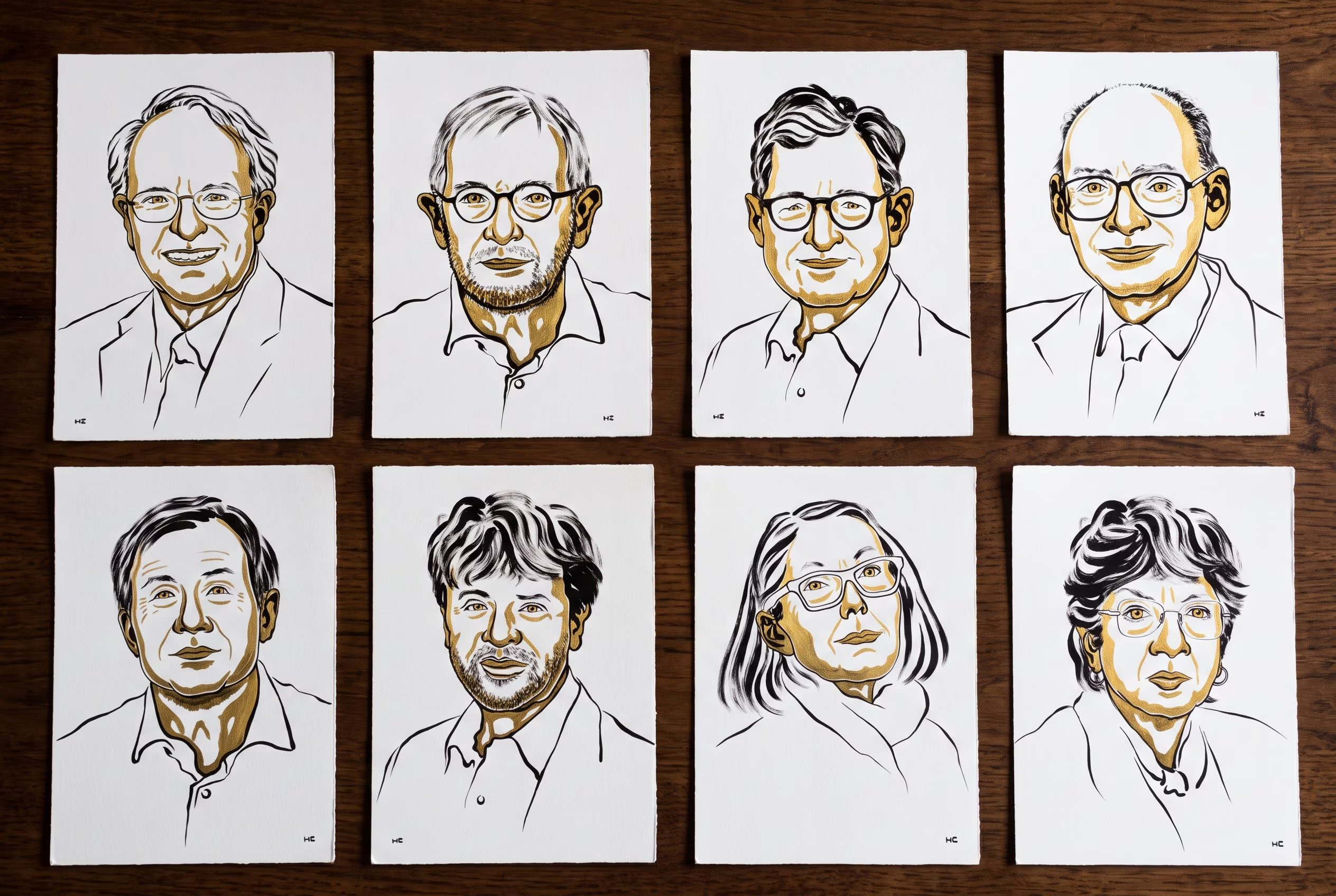
This year too, the Nobel season, among the highest global awards, has come to an end: it is closed by the prize for Economics, just awarded to Robert E. Hall and Michael Woodford«for the microeconomic foundations of macroeconomic stabilization». The Nobel is a prestigious honor that is awarded every year to those who have distinguished themselves in a particular way in various fields, from economics to literature, to medicine, chemistry, physics and peace.
An award that was created by the scientist Alfred Nobel in 1895 for which several institutions are responsible today, such as the Royal Swedish Academy of Sciences, which awards prizes for economics, physics and chemistry, the Karolinska Institute which awards prizes for the field of medicine, the Norwegian Nobel Committee which selects the winner of the peace prize and the Swedish academy which chooses the winner for literature.
After the announcement, the official presentation of the Prize will take place on December 10th, the anniversary of Alfred Nobel’s death, in Stockholm (with the exception of the Nobel Peace Prize, which is awarded in Oslo). So let’s see all the winners for 2026.
Nobel Prize in Economics 2026 to Robert E. Hall and Michael Woodford
The last award of the 2026 edition, the Nobel Prize in Economic Sciences, was awarded to Robert E. Hall, Stanford University, and Michael Woodford, Columbia University, “for the microeconomic foundations of macroeconomic stabilization”. As the official press release explains, the winners «have developed new macroeconomic models that have significantly improved our ability to implement an effective stabilization policy. Based on these models, well-timed fiscal and monetary policy measures can reduce the peaks and troughs of the economy.”
«Robert E. Hall and Michael Woodford receive this year’s prize in economic science for demonstrating how economic models could be reconstructed to revitalize stabilization policy. Rather than basing the models on statistical links between macroeconomic variables, such as inflation, production and consumption, they chose to build them on a microeconomic foundation. This includes understanding how the aggregate of individual households and businesses influence the economy through their actions.”
John Hassler, chairman of the Economic Sciences Prize Committee, explained that thanks to the work of Robert E. Hall and Michael Woodford “we are better equipped to deal with shocks to the economy, such as energy crises or sudden changes in the level of household consumption.”
Nobel Peace Prize goes to Navanethem Pillay
The 2026 Nobel Peace Prize was awarded to the 85-year-old South African jurist Navanethem Pillay “for her commitment to the promotion of peace and international law”. In the statement, the Committee broadened its focus by explaining that in an era in which the number of wars and conflicts is increasing and in which judges and institutions of international law are under political attack, the ability to resolve conflicts without resorting to force or violence depends on respect for the rule of international law.
Born in Durban, South Africa, in 1941 into an Indian family of Tamil origin and raised under apartheid, Pillay was a judge of the International Criminal Tribunal for Rwanda, which she then presided over from 1999 to 2003. There she played a key role in the development of an innovative jurisprudence that recognized rape as an act of genocide. She then served as a judge of the International Criminal Court from 2003 to 2008 and as the United Nations High Commissioner for Human Rights from 2008 to 2014. Ad hoc judge of the International Court of Justice since 2019, in the genocide case against Myanmar, she then led the UN Commission of Inquiry into the Occupied Palestinian Territory from 2021 to 2025, defining Israel’s activities as genocide.
Nobel Prize for Literature to Anne Carson
The Swedish Academy awarded the 2026 Nobel Prize for Literature to Canadian writer Anne Carson, poet, essayist, translator and scholar of the classical world, “for her bold and inventive work which, in a playful dialogue with the classical tradition, created new forms for contemporary literature”.
Born in Toronto in 1950, she studied classics at the University of Toronto and taught at universities such as Princeton and McGill. In fact, poetry, essay, narrative, literary criticism, theatrical dialogue and translation coexist in his books. The best known example is Autobiography of the red (1998), which transforms the mythological monster Geryon into the protagonist of a bildungsroman in verse, while in another text, It was a cloudCarson superimposes the figure of Helen of Troy with that of Marilyn Monroe.
Nobel Prize for Chemistry to Henri Kagan and Kenso Soai
For the 2026 Nobel Prize in Chemistry, the Royal Swedish Academy of Sciences awarded Henri B. Kagan and Kenso Soai «for the discovery of nonlinear effects and autocatalysis in asymmetric organic synthesis». The official press release explains, in fact, that the 2026 Nobel Prize for Chemistry recognizes discoveries that have allowed chemists to drive chemical reactions that lead to homochirality: «Henri Kagan and Kenso Soai have provided a solution to a chemical mystery more than a century old: how homochirality can emerge spontaneously. The chemical reactions they developed are spectacular,” said Heiner Linke, president of the Nobel Committee for Chemistry.
Thanks to these two scholars, respectively from the Université Paris-Sud in France and the Tokyo University of Science in Japan, today we know how homochirality can arise, that characteristic of the chemistry of life whereby molecules such as amino acids, which can exist in two mirror-image forms, in living organisms are present almost exclusively in only one.
Nobel Prize for Physics to Francis Halzen
The 2026 Nobel Prize in Physics went to Francis Halzen, 82, born in Tienen, Belgium, and professor at the University of Wisconsin-Madison, “for decisive contributions to the IceCube Neutrino Observatory and the discovery of high-energy neutrinos of astrophysical origin.” An award that he did not share with anyone and that had not happened for Physics since 1992 when Georges Charpak won.
He was responsible for the intuition that the clear ice of the South Pole could be transformed into a gigantic neutrino detector, as well as leading, for decades, the IceCube Neutrino Observatory, the experiment built in Antarctica to capture them. In 2013 it provided the first evidence of very high energy neutrinos coming from outside the solar system and in 2017 it made it possible to trace it to a precise source, a blazar. For Mark Pearce, president of the Nobel Committee for Physics, “Francis Halzen led an international team of researchers and engineers who provided us with a fantastic instrument. His tenacity and scientific vision paved the way for a new type of astronomy.”
Nobel Prize for Medicine to Deisseroth, Hegemann and Nagel
The week opened on Monday 5 October with the Nobel Prize in Physiology or Medicine, awarded to Karl Deisseroth, Peter Hegemann and Georg Nagel «for their discoveries on light-activated ion channels and optogenetics».
As explained in the official press release, «the prize is awarded for optogenetics, a method that allows us to show how nerve cells shape memories, emotions and behaviors in the living brain. Peter Hegemann and Georg Nagel discovered an extraordinary protein, channelrhodopsin, in a unicellular alga. Karl Deisseroth transformed the protein into a light-controlled switch for nerve cells.”
“Optogenetics offers opportunities to map the brain in a way we could once only dream of,” said Per Svenningsson, chairman of the Nobel Committee for Physiology or Medicine, a science that has fundamentally changed our understanding of the brain.