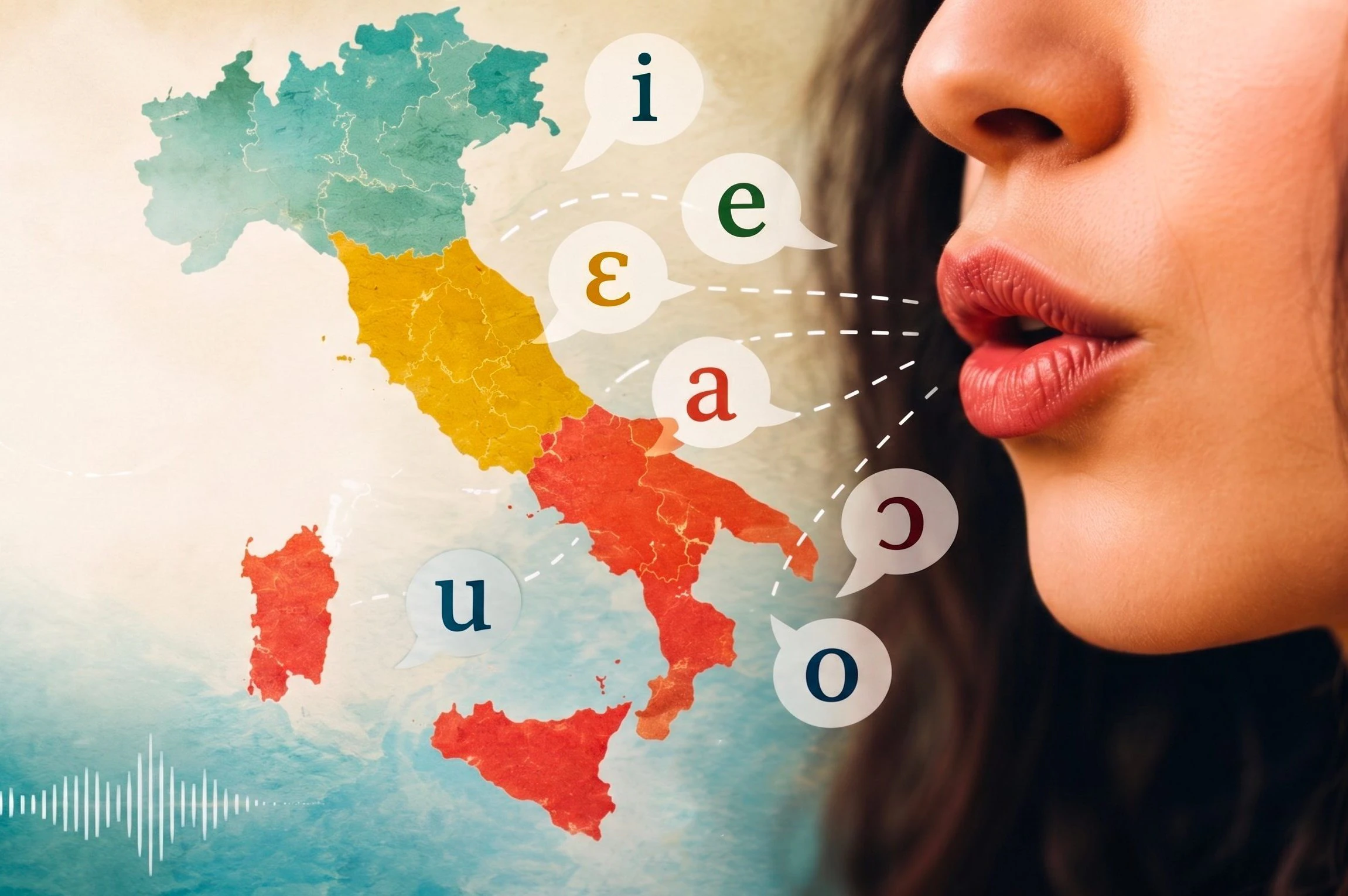
There are those who claim to be able to guess the geographical origin of a person after hearing them say a few words. It’s not always that simple, of course, but often the way we pronounce vowels offers interesting clues about the area we grew up in. When we speak Italian, in fact, we bring with us a series of phonetic characteristics that derive from the regional varieties of the language. More than dialects in the strict sense, in these cases the academic Nicola De Blasi speaks of regional Italians: varieties of Italian influenced by local dialects and the linguistic history of the different territories.
The Treccani Encyclopedia specifies that standard Italian distinguishes, at a phonological level, seven stressed vowels: /i, e, ɛ, a, ɔ, o, u/. Writing continues to use five letters to indicate vowels, but in pronunciation the signs “e” and “o” are used for two different timbres, open and closed, which in standard Italian are two different phonemes. A phoneme is the smallest unit of sound that takes on a distinctive value (i.e. it allows a word to be identified): to recognize the phonemes of a given language it is therefore sufficient to identify minimal pairs, i.e. two words that are distinguished by a single sound, that sound is a phoneme. A classic example is the couple fishing and fishing: the spelling is identical, but the meaning changes based on the pronunciation of the vowel, so “è” and “é” in Italian are two different phonemes.
What are the different Italian regional accents: North, Center and South
Although there is a reference model, spoken Italian has numerous regional nuances. The pronunciation of vowels, the rhythm of the sentence and the intonation can vary significantly from one area of the country to another. In the regional varieties of northern Italy, for example, the realization of the medium-open and medium-closed vowels may differ from that foreseen by the standard. These are variations documented by linguistic literature and linked to the history of the different linguistic areas of the North.
In Central Italy, and in particular in Tuscany, we find the variety that has had the greatest influence on the formation of standard Italian. For this reason many normative descriptions of pronunciation take the Tuscan model as reference. However, as the Accademia della Crusca reminds us, there is no single legitimate way of speaking Italian: regional varieties are part of the normal life of the language. Specific phonetic characteristics are also observed in the South.
Treccani points out that, in the regional Italian of Sicily, the opposition between open and closed middle vowels tends not to be distinctive, unlike what happens in the standard. This helps create a sound that is immediately recognizable to many listeners.
Vowels are linguistic imprints
Vowels represent one of the most sensitive aspects of pronunciation. Speakers often do not notice their phonetic habits, while listeners can perceive them easily. A And slightly more closed, one or more open or a particular intonation can suggest, at least in part, the geographical area of origin of a speaker. For this reason, scholars consider pronunciation one of the most interesting traces of the relationship between language and territory. The accent is not just a way of speaking: it is the result of a cultural and linguistic history that accompanies every community.
Observing these differences helps to understand that Italian is not a uniform and immobile reality. On the contrary, it is a language that lives through the people who speak it and which takes on different nuances depending on the geographical and social contexts. As both Treccani and the Accademia della Crusca underline, the regional pronunciation should not be considered an error, but a manifestation of the internal variety of the Italian language. In this sense, the accent does not only “betray” where we come from: it also tells the historical and cultural path that contributed to forming our voice.