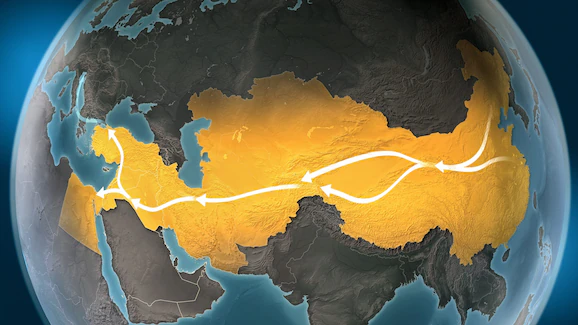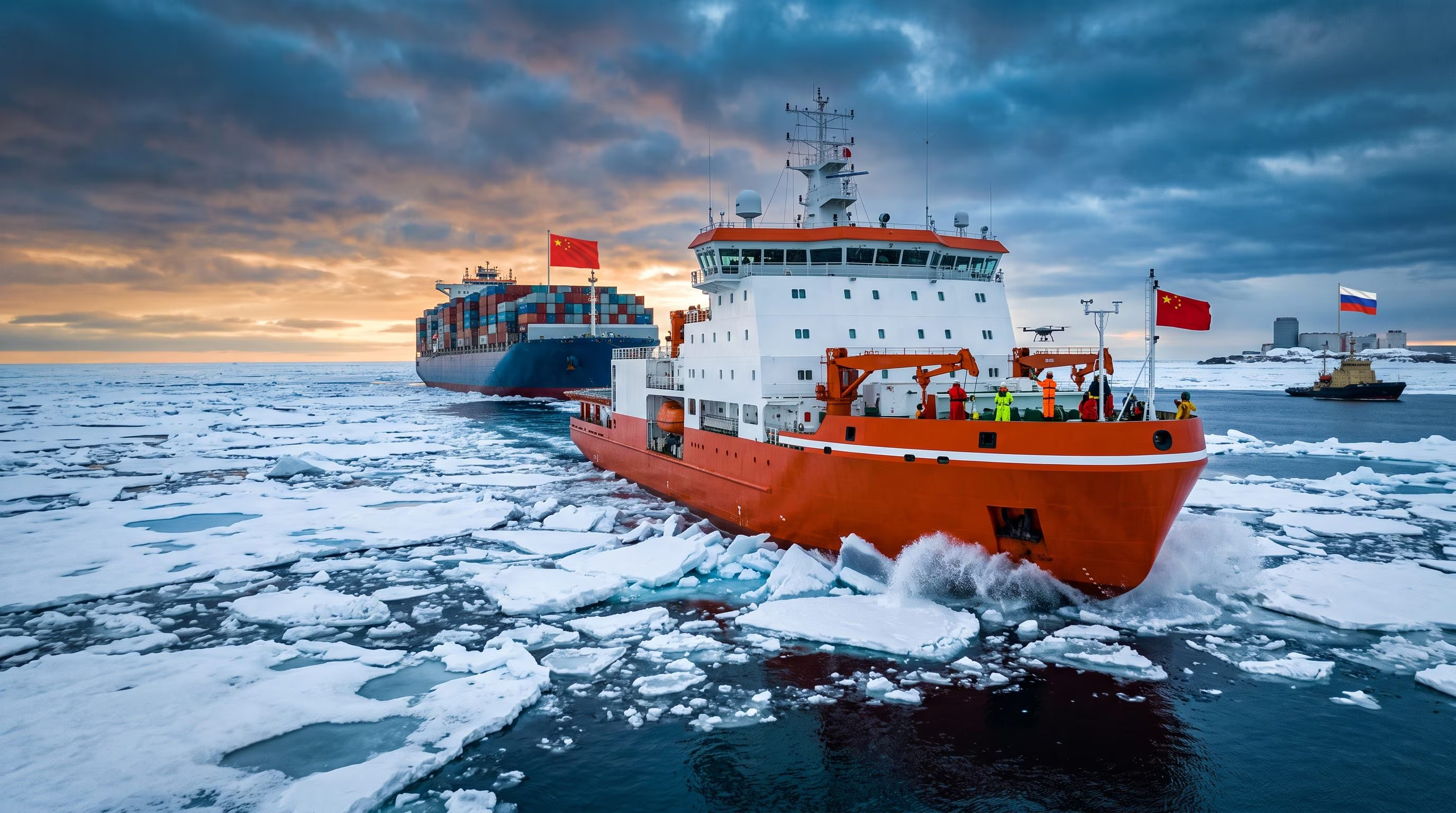
Thanks to the melting of the ice, China has inaugurated a new trade route with Europe, the “Ice Silk Road”, the Ice Silk Road through the Arctic. The objective is to halve travel times compared to the traditional route, reducing them from 40 to 20 days, with the Asia-Europe journey reduced to around 7,500 nautical miles, compared to the over 11,000 miles needed to pass through the Suez Canal, also bypassing the closure of the Strait of Hormuz. After a first experimental commercial voyage in 2025, crowned with success, in 2026 China pressed its foot on the accelerator of the Arctic Route, on the one hand launching a large scientific expedition in July, and on the other hand inaugurating the first regular commercial service line with Northern Europe in mid-August. The Beijing-Moscow axis, however, has alarmed the NATO powers and at the same time threatens to damage the Arctic ecosystem.
What is the Ice Silk Road, the Arctic trade route
With the opening of the last era of great geographical explorations, during the nineteenth century, polar routes such as the Northwest Passage and the Northern Sea Route (NSR) became the forbidden dream of navigators and explorers. Sir John Franklin’s tragic British expedition of 1845 – when the ships HMS Erebus and HMS Terror vanished in the ice of the Canadian Arctic with all 129 men on their crew – has chronicled for generations the merciless hostility of an inaccessible environment.
Today the climate crisis and the progressive retreat of the sea ice are reshaping the balance of the planet. China has forcefully inserted itself into this new geographical and economic context, intending to open up an alternative trade route for its trade with Europe and to ensure privileged access to the energy resources of the North. An initiative that takes shape in the construction of the Ice Silk Road (or Polar Silk Road) and which is triggering strong alarms in Washington and among the NATO powers, worried about the consolidation of the strategic axis between Beijing and Moscow in the Arctic. It is no coincidence, for example, that the United States has turned the spotlight back on Greenland, an island rich in rare earths and considered by Washington an indispensable shield to block the way to Chinese aims in the North Atlantic.
The Polar Silk Road is the strategic framework officially launched by Beijing in 2018 with the publication of its Arctic White Paper – a document in which China defined itself for the first time “Near-Arctic State” (quasi-Arctic state) – and subsequently integrated among the priorities of the 14th Five-Year Plan (2021-2025). Crossing the Northern Sea Route (NSR) along the coast of Siberia, the route reduces the Asia-Europe journey to approximately 7,500 nautical milescompared to the over 11,000 nautical miles needed to pass through the Suez Canal.
For years considered a distant hypothesis, the initiative is taking shape through a series of key operational steps:
- the 2025 test: in September 2025, the cargo ship Istanbul Bridge of the Sea Legend Line company made a historic test voyage from the port of Ningbo-Zhoushan to Felixstowe (UK) in just 20 days, carrying around 4,000 containers and setting a speed record between Asia and Europe;
- the 2026 scheduled service: in the summer of 2026, the Sea Legend company made the leap in quality by starting the “China-Europe Arctic Express”the first regularly scheduled naval service across the Arctic. Taking advantage of a pool of 7 ships authorized by the Russian state agency Rosatom, the route includes seasonal departures scheduled from August to October to connect the ports of China with Northern Europe;
- the joint naval expedition: parallel to the merchant arm, in July 2026 Beijing launched its 16th Arctic expedition, deploying a massive fleet of four research vessels: the three icebreakers Xuelong (Snow Dragon), Xuelong 2 and Jidi (Polar), joined by the ocean-going vessel Tansuo-3 (“Exploration-3”).
The numbers compared: travel times, distances and costs
Comparing the three main maritime routes to connect the ports of eastern China (such as Ningbo or Shanghai) with Northern Europe (Felixstowe, Rotterdam) one immediately understands the savings in terms of time, and therefore money:
- Traditional route via Suez: approximately 11,100 nautical miles (i.e. 21 thousand km) in 35-40 days;
- Circumnavigation of Africa (Cape of Good Hope): approximately 14 thousand nautical miles (i.e. 25 thousand km) in 45-50 days
- Arctic Route (Northern Sea Route): 7.500-7,800 nautical miles (i.e. about 13 thousand km) in About 20 days
Today, between 80% and 90% of world trade in goods by volume passes through maritime transport. The reduction of journey times to just 20 days allows shipowners to save millions of dollars in fuel per single route and to drastically increase the turnover rate of their fleet.
However, the usefulness of the Arctic is not a hypothesis for the future: it is already an operational reality of primary importance. As highlighted by industry surveys and recent analyzes published by Reuters, Russia is already fully exploiting the summer window of the Northern Sea Route to send massive volumes of crude oil to Asian markets, primarily China.
Already in the first days of August, more than a dozen oil tankers loaded with approx 8 million barrels of Russian crude headed east via the Arctic route – a volume that alone exceeds half of all crude oil transported along the NSR during the entire 2025 shipping season. For Moscow it is a vital corridor to circumvent geopolitical bottlenecks and Western sanctions, while for Beijing it represents tangible proof that the polar route is now an active and strategic trade artery.
Why China is aiming for the Ice Silk Road: Beijing’s 4 strategic pillars
China’s interest in the North Pole is not simply a commercial opportunity, but a national and economic security priority based on four key reasons.
First of all, overcoming the “Malacca Dilemma”. Over 80% of China’s energy imports currently pass through the Strait of Malacca and the South China Sea. In the event of a geopolitical crisis or conflict with the United States, this route could easily be blocked by the US Navy. The Arctic Route, together with the new Silk Road, offers Beijing an alternative access route to Europe and the Atlantic entirely protected by Russian territorial waters.
Then, the aDirect access to energy and mineral resources: the Arctic seabed holds approximately 30% of the world’s undiscovered natural gas reserves and 13% of its oil, as well as rich deposits of rare earths, nickel, copper and platinum. Integration with Russia allows China to finance and secure supplies of polar energy mega-projects such as Yamal LNG and Arctic LNG 2.
The Suez Canal crisis in 2021 (Ever Given incident) and the recent instability in the Red Sea and the Strait of Hormuz are demonstrating the vulnerability of traditional maritime arteries. The Arctic could represent a logistics insurance policy for the supply chain of Chinese factories, allowing resilience against global bottlenecks.
Finally, pprojection of scientific and military power: establishing itself as a primary player in the Arctic guarantees Beijing a de facto seat in future polar governance tables, while allowing it to refine navigation technologies in extreme conditions and underwater acoustic detection capabilities that can be used for defense purposes.
The shadows of the Polar Silk Road
The expansion of the Polar Silk Road is not without strong ecological, bureaucratic and competitive tensions. Despite the retreat of the ice, the Arctic remains unpredictable and lacks supporting infrastructure. In case of damage to the propellers, failures or stranded among the ice floesrescue operations are complex and exorbitant. An accident would not only cause an incalculable ecological disaster, but would block the logistics chain for weeks.
Replacing traditional routes with the Arctic means moving from dependence on the Middle East to total subordination to Moscow’s rules: Russia imposes high duties and a monopoly on the expensive escort services of the state agency Rosatom. From here, the aNATO alarm: the joint presence of Russian nuclear icebreakers, cargo ships and a massive Chinese scientific fleet transforms the Arctic into a theater where commercial logistics overlaps with hydrographic research for military and underwater navigation purposes. The response of the West and its allies was along three well-defined lines. On a geostrategic level, the United States has turned the spotlight back on Greenland: the island is not only a treasure chest of mineral resources disputed by Beijing, but constitutes the natural shield essential for controlling access to the North Atlantic.
At the same time, on the military front, NATO views with strong concern the dual-use nature (civil and military) of Chinese scientific expeditions. The bathymetric surveys conducted by the Tansuo-3 ship and the Shenhai Yongshi submarine under the pack ice are not only used to trace merchant routes, but provide the Beijing Navy with acoustic and topographic maps to allow its nuclear attack submarines to navigate undisturbed. The West is leveraging International Maritime Organization (IMO) regulations and NGO complaints against the use of Heavy Fuel Oil by Chinese ships, imposing increasingly stringent ecological constraints to raise the operating costs of the Ice Silk Road.
The move also triggered the South Korea’s response: to counter Beijing’s hegemony, Seoul and the shipowner PanStar have scheduled a demonstration voyage along the NSR for the end of August 2026, with the aim of positioning themselves as a sustainable commercial alternative compliant with international standards.
Finally, a large environmental impact is expected: NGOs such as the Norwegian Bellona denounce the use of heavy fuel oil (HFO) by Chinese freighters. The related emissions of black carbon (black particulate matter) darken the snow, reducing the albedo effect and accelerating the melting of ice. According to Nature Communications, the increase in Arctic shipping traffic risks increasing global emissions from shipping8.2% by 2100.