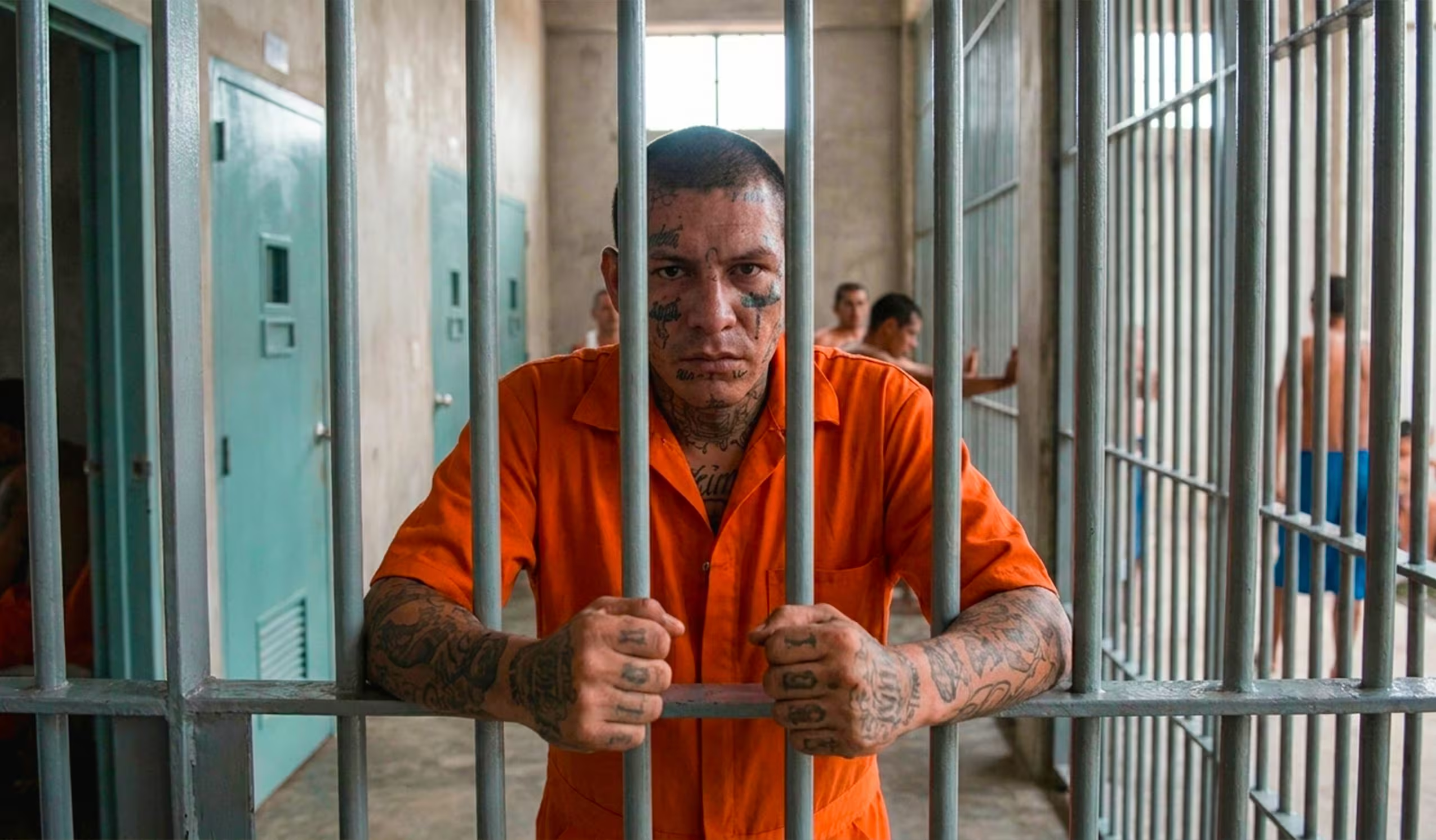
Panama’s prison system has been near breaking point for years, with approx 24,000 prisoners crammed into structures designed to barely accommodate them 14,700, known for overcrowding and harsh conditions for prisoners. But the real straw that broke the camel’s back was the sensational mass escape on June 1, 2026, when 195 inmates escaped at the same time from La Joyita prison. To respond to this crisis and the increase in crimes coordinated directly from the cells, President José Raúl Mulino announced an impressive plan to 392 million dollars for the construction of three new prisons. These will be partly inspired by the CECOT maxi-project, carried out in El Salvador and at the center of numerous controversies – especially of an ethical nature.
How the new prisons in Panama will be made
The government’s plan does not envisage just one type of prison, but three distinct projects designed for different purposes and profiles of prisoners, for total investments of over 392 million dollars.
The first is the Maximum Security Prison in Las Garzas. This is the project that most closely follows El Salvador’s hard line and will have an estimated cost of approximately 130 million dollars. Approximately, they will be accommodated inside 2,000 prisoners and will be implemented through the Public-Private Partnership model, which delegates long-term management and maintenance to private consortia. The main objective is thetotal isolation of criminal gang leaders to prevent them from continuing to manage extortion and murder from inside the prison.
The Complejo Penitenciario de Provincias Centrales, in the Divisa area, is the second facility. With an investment estimated between 172 and 177.2 million dollarsthis prison will be built on 45 hectares of land and will be able to accommodate between 2,500 and 3,000 prisoners. It will be divided into minimum, medium and high security modules: while the most dangerous inmates will be in individual cells, the low-risk ones will be housed in six-person dormitories. The complex will also include schools, professional training laboratories (plumbing, construction) and agricultural spaces. From what we know so far, it appears that the facility will be equipped with advanced video surveillance systems, biometric controls and electronic access mechanisms.
Finally, the third building of the project is the Centro de Resarcimiento y Rehabilitación, also in Las Garzas. This project is worth approx 85 million dollars and will be located opposite the current La Joya complex, with a capacity of 2,500 people. This prison will be intended exclusively for “pre-released” prisoners (in the final stage of their sentence). The structure does not aim for maximum isolation, but for rehabilitation and social reintegrationoffering bedrooms (not traditional cells), study areas, sports facilities and therapeutic support to reduce the risk of relapse.
The timing and critical issues of the project which is inspired by the CECOT of El Salvador
The bureaucratic machine moved quickly, especially after the prison break in June. For the maximum security prisonalready at the end of May 2026, the Minister of the Presidency Juan Carlos Orillac approved the transition to the feasibility phase of the project. It is estimated that the international tender can be launched within approximately nine months (so at the beginning of 2027). For the Divisa complexthe tender was officially launched onJune 8, 2026while for the Las Garzas rehabilitation centerthe race started on May 29, 2026with the deadline for submitting offers set for 14 July 2026.
However, a work of this magnitude is generating strong discussions in the country, highlighting various obstacles, primarily the opposition of local communities. They strongly oppose the construction of the maximum security prison, especially due to its proximity to important schools, such as the Instituto Nacional de Agricultura, and the potential environmental impact on the Cañazas and Santa María rivers. Then there is a problem linked to the entry of weapons, since the Panamanian prison system suffers from a serious corruption problem. Over the years, inmates and witnesses have reported that the guards are easily bribed, allowing the entry of smartphones, drugs and even heavy weapons (such as pistols and Kalashnikovs). Finally, there is a last aspect linked to an ethical question. Just like the CECOT in El Salvador, these structures are already raising strong doubts not only regarding the possible treatment of prisoners, but also the criteria for incarceration – not always transparent and potentially usable to get rid of political opponents.