Establishing with certainty which countries have the most powerful navies in the world at their disposal is not easy for a series of reasons: first of all, it is necessary to carefully evaluate the numerical consistency of the assets in service with a certain navy as well as the overall tonnage that characterizes both surface ships and submarines. At a subsequent level, attention must be paid to the armament carried on board the vessels and to its technical characteristics (in particular whether there are fixed or rotary wing aircraft which can also act as power multipliers for the aircraft carriers carrying them). Finally, we must not forget either the training or the operational experience accumulated by the crews, especially in war situations or in complex multi-weapon operations. Once these premises have been made, here is the classification, with reservations, of the main navies of the globe.
1. The US Navy of the United States: the most powerful navy in the world
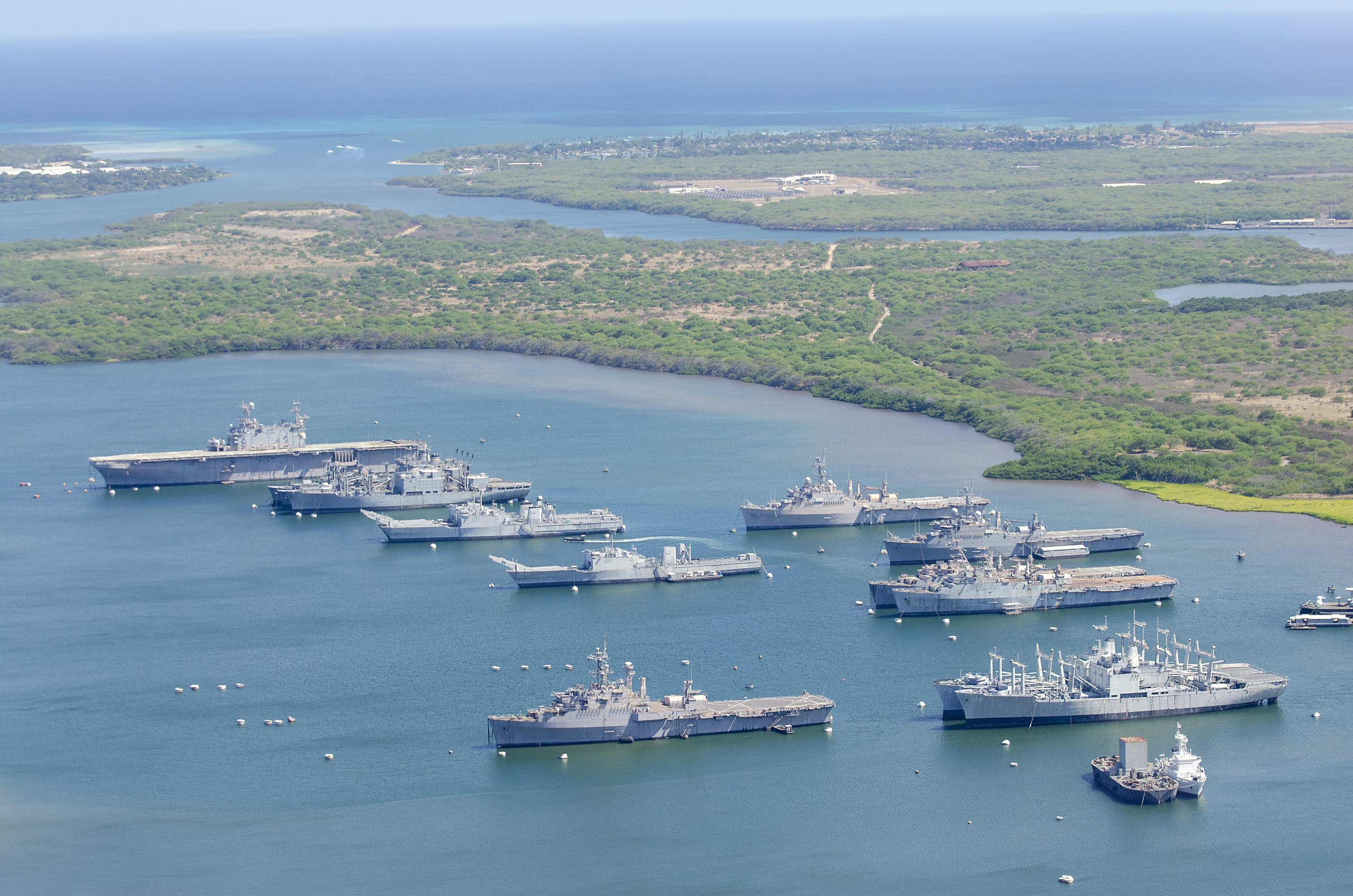
The first place in our ranking sees the presence of the US Navy, the Navy of the United States of America. Although in recent decades it has significantly reduced both its personnel and the number of vessels, so much so that it is considered a shadow of what it was at the end of the Cold War (at the end of the 1980s the US Navy had as many ships in service as the sum of the other 13 most powerful navies in the world), Washington’s war fleet still remains the most powerful naval weapon in the world.
The US Navy presents a balanced deployment which sees the presence in large numbers of all the main types of warships, in particular aircraft carriers (authentic floating citadels) which, from the Second World War onwards, represent the main instrument for projecting the Stars and Stripes hegemony in the main crisis areas. The elite position that both sailors and airmen occupy within the American military system, as well as the first-rate training, have further strengthened the esprit de corps to the full advantage of the endurance and resilience of the weapon.
Lastly, both US Navy vessels and aircraft are equipped with weapon systems capable of hitting any adversary thousands of kilometers away and with relative impunity without giving them the chance to react (as was seen during the first days of the War with Iran, when American attacks completely decimated the Iranian conventional navy without it having the chance to respond in a symmetrical manner). And this technological superiority is a further element that allows the US Navy to deservedly claim first place in the ranking.
2. China and its naval fleet
For a long time, from the end of the Chinese Civil War until the 1980s, the People’s Republic of China had a navy at its disposal which, although gradually growing in numbers, was essentially limited to the task of defending Chinese territorial waters with minimal projection capabilities away from the homeland. All this ended in 1982, when under the leadership of the then Chief of Staff, Admiral Liu Huaqing, the People’s Liberation Army Navy (PLAN) began a mammoth plan to modernize and increase operational capabilities which continues today, moving on to the doctrine of “high seas defense”.
Over forty years later, the PLAN is today a fearsome naval force on paper and very numerous (nowadays the Chinese can boast a navy that has surpassed, numerically speaking, the US Navy). Beijing’s objective is no longer linked to the mere defense of territorial waters, but rather envisages the ability of ships with the red flag to be able to carry out missions far away from national borders, also not forgetting the territorial disputes regarding the possession of the Paracel and Spratly islands and the status of Taiwan.
Although China’s naval growth has been rapid from all points of view, to date it is still not possible to adequately evaluate the level of training of personnel as well as the performance of the weapons systems and electronics of both ships and aircraft given that China has not fought a large-scale war since 1979, and even then naval actions were greatly reduced. Lastly, China still does not possess a sufficient number of aircraft carriers to guarantee it can challenge the US Navy on a fully equal footing. For these reasons the PLAN is placed in second place.
3. Russia, Japan, South Korea and India: third place is played on excellence
In third place we find a quartet of countries (Russia, Japan, South Korea and India) that closely follow the two seeded players described above but which, unable to openly challenge them, have so far opted to develop sectoral excellence that guarantees them to put the superiority of the USA and China to the test.
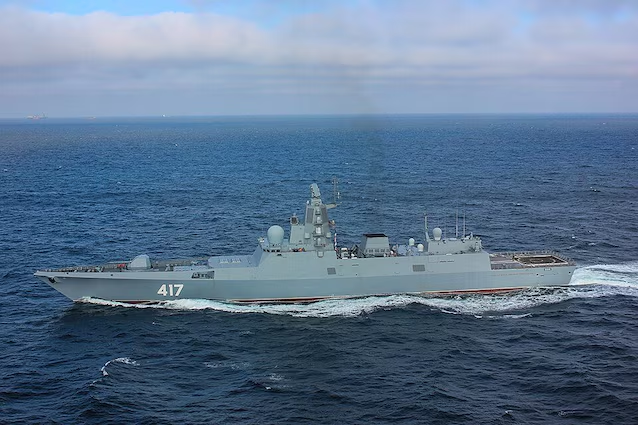
The Russian Navy today has a curious mix of vessels in service partly inherited from the Soviet period and partly newly built. While the Soviet Navy of the last period of the Cold War was projected towards the oceanic dimension and even toyed with the idea of competing on equal terms against the US Navy and the NATO navies, its direct heir abandoned this ambition (at least for the moment) and fell back on a distinctly defensive strategy. However, the Russians continue to invest heavily in their submarine component which is both numerous and technologically advanced. Furthermore, in recent years they were the first to begin integrating hypersonic weapons (in this case, the 3M22 Zircon missiles) on some classes of their vessels, thus beating both the Americans and the Chinese to the punch in this critically important field.
The characteristics of the navies of Japan and South Korea, two countries allied with the USA and which continue to look to them as a source of inspiration, are distinctly Western. Both Far Eastern countries are increasing their naval capabilities while keeping within the strategic framework of containing China. To this end, both the Japanese and the South Koreans are investing in strengthening their submarine fleets, in the construction of destroyers with strong anti-ballistic missile defense capabilities and in the construction of new “pocket aircraft carriers” to improve amphibious and overseas projection capabilities.
Finally, the trajectory of the modern Indian Navy is peculiar. Strongly influenced from the beginning by its cumbersome parent (the British Royal Navy), the Indian Navy was born immediately with the very long-term strategic objective of dominating the ocean that bears the name of its country (Indian Ocean). Although it will still take at least another 3 decades before India can think of competing on an equal footing with the USA at a naval level, the Indians are continuing to pursue this objective and, thanks both to the development of the national shipbuilding industry and to the technological partnerships forged over the years with Russia and European countries, they are strengthening their fleet by imitating at the same time all the modernization paths of the countries that have been described so far with particular attention paid to the entry into service of new large design aircraft carriers indigenous.
The race to dominate the seas in a world at war
Beyond what is happening at the “tops of the food chain”, it is necessary to highlight the fact that the naval arms race is a trend that is affecting numerous countries around the world, and not just among the large and medium powers. The reason for this worrying trend is easy to say: both at the political level and at the high military levels there is a clear awareness that the balance at a planetary level is dramatically changing and that the near future will be characterized by the outbreak of new major conventional wars.