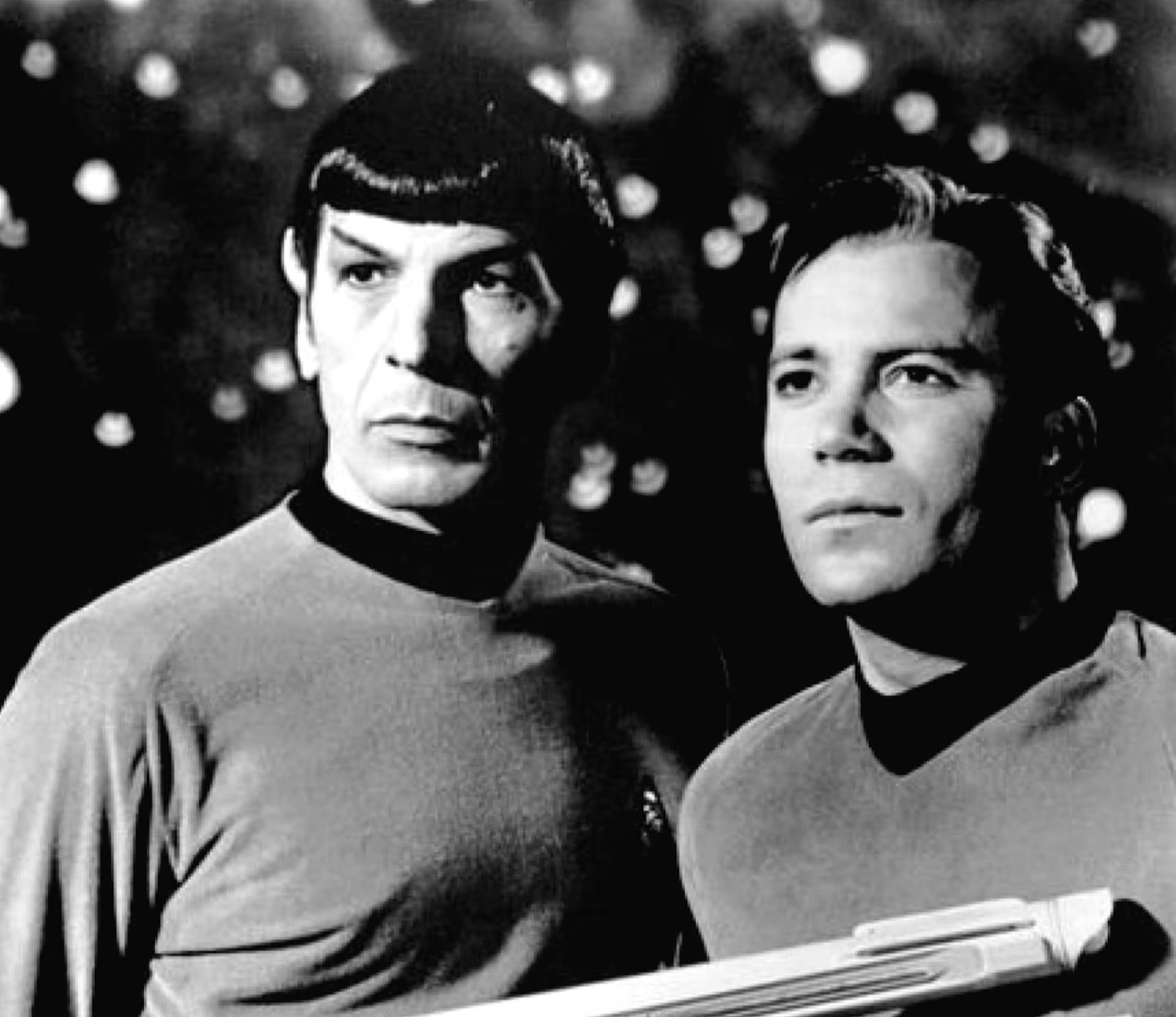
Born on 8 September 1966 from the imagination of Gene Roddenberry, the Star Trek TV series turns sixty years old today, 8 September 2026. Since the first seasons, thanks to the memorable science fiction setting, the saga has enjoyed extraordinary success, becoming an ever-expanding franchise. Today it has 14 films, 11 main television series, some of which are animated, and an endless number of derivative works, including video games, role-playing games and board games. A new film is in the works, written and directed by John Francis Daley and Jonathan Goldstein, with new characters and a plot centered on the birth of Starfleet, which according to its authors will look to the tone of Training Day. For those who want to recover the saga, there are two ways: follow the release order, recommended for newbies, or the chronological order of the story.
The technologies of the science fiction series Star Trek
On the evening of September 8, 1966, NBC aired The Man Trap, the first episode of the series, which its creator had sold to the network as A wagon train to the stars. Many years have passed since that date but the space adventures of Kirk, Spock, McCoy, Sulu, Uhura, Scotty and Chekov remain in the collective imagination even today. Above all, the most famous and historic captain of the classic Star Trek series stands out, James T. Kirk, played by actor William Shatner. Some of the incredible and iconic technologies used by the characters seem pure fantasy, others have become reality: let’s see some.
The communicator
Anyone who has the series in mind Star Trek cannot help but think of an object, an iconic gadget: the communicator, a space communication device supplied to the Enterprise crew. In the saga of Star Trek we can consider this object as a precursor, with many more functions, of mobile phones.
In July 2010, CBS launched the app for iPhone Star Trek Communicatordeveloped by Talkndog Mobile, which reproduced its appearance and unmistakable chirp. In June 2016 The Wand Company put on the market a working replica of the classic series model which, when connected via Bluetooth to a smartphone, actually allowed you to make and receive calls.
The medical tricorder
The tricorder seen in the series is basically a portable device that can analyze a person’s health condition. Since 2008, several projects have sought to create a real medical tricorder: QuantuMDx has developed a pocket-sized DNA laboratory capable of diagnosing a disease in less than 15 minutes; in the same year a portable device for analyzing subcutaneous lesions was created by Georgia Tech. In 2011 the X Prize Foundation and Qualcomm launched the Tricordera $10 million prize for a mobile device capable of recognizing pathologies and measuring vital signs without the intervention of a doctor.
Warp drive
Star Treklike much science fiction, is based on the idea that it is possible to travel at the speed of light. According to the theory of relativity, nothing can exceed the speed of light (300,000 km per second), which makes this invention impossible to implement in reality. In the series, the invention of the engine by the fictional Zefram Cochrane marks the moment in which humanity becomes an interstellar civilization, ready to meet the other species of the universe and from that meeting the Federation of United Planets will be born. In Star Trektherefore, becomes the pillar that supports the whole of history; without this innovation there would be no way to go “in search of new worlds and new civilisations”.
Universal translator
In the series the universal translator allowed the crew to communicate with any alien species. Today there are numerous universal translators on the market, perhaps a little less elegant than those imagined by science fiction, designed to perform exactly the same function. The closest result, and in some ways also the best known, is Google Translate, which in addition to supporting hundreds of languages and having real-time voice translation, is now an ordinary function of all smartphones.
Teleportation
Teleportation is one of the most iconic elements of Star Trek. Current physical knowledge does not offer us, unlike in the series, any tool capable of teleportation. But something similar is being experimented with, there are studies that concern the transfer of information, in which it is the data that moves, not the matter.
The most spectacular result in this field dates back to 2017, when a group of Chinese researchers managed for the first time to teleport the state of a photon from Earth to Space, using the Micius satellite. The operation was made possible by entanglement, the phenomenon by which two particles remain linked to each other to the point of behaving like a single object, their properties are described by a single wave function, that of the entire system and this bond does not loosen even when the particles are at enormous distances.