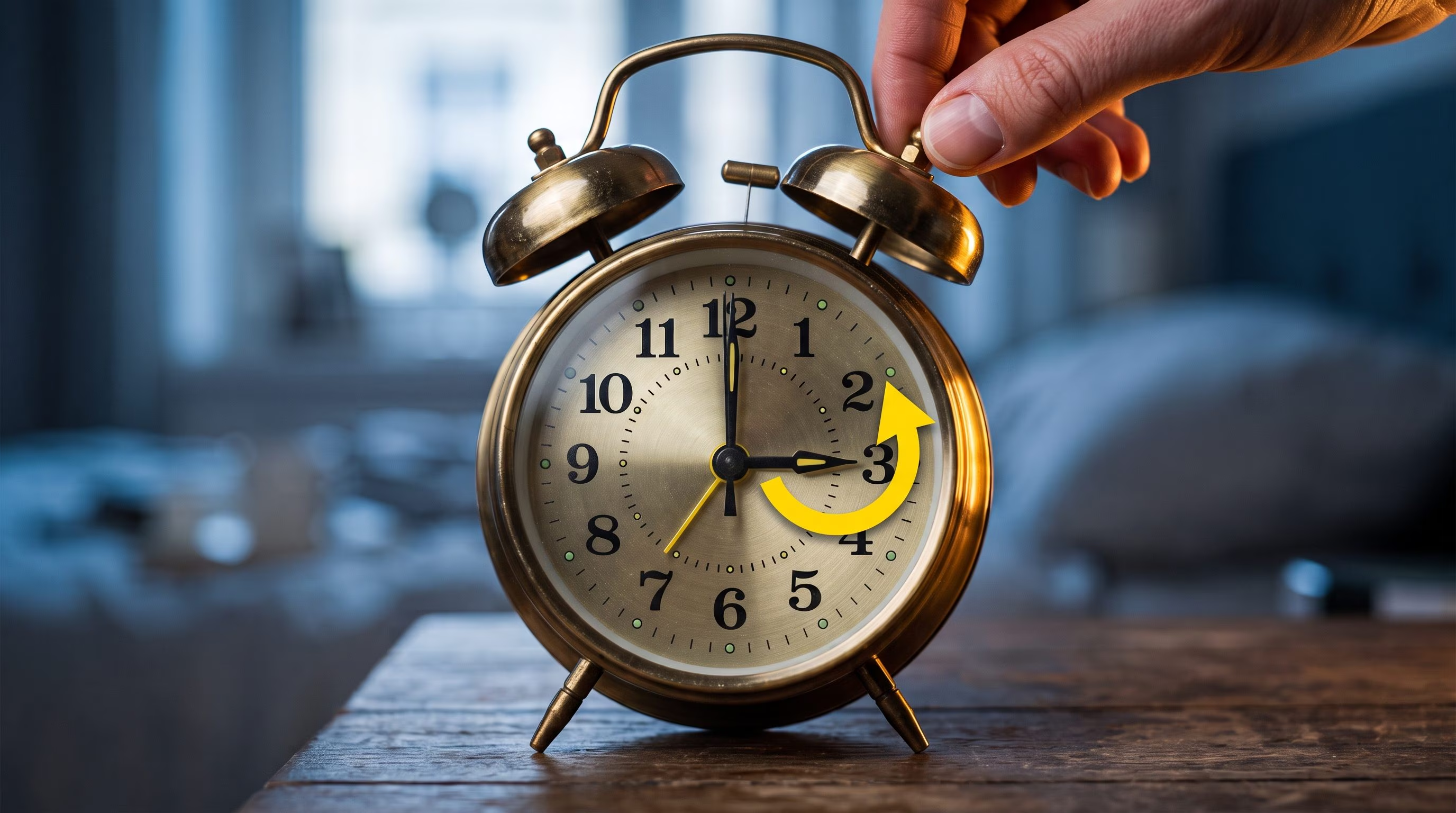
With the end of summer now near, the moment is coming when we will move the hands of the clock, with the return to solar time, expected on the night between Saturday 24 October and Sunday 25 October. The hands will be set back one hour, with 03:00 becoming 02:00. On the first evening we will gain an extra hour of sleep, as well as an additional hour of light in the early morning, at the expense of one lost in the late afternoon.
Solar time is so defined because it follows the apparent motion of the Sun, placing noon (i.e. 12) around the moment the Sun reaches its highest point in the sky. This is in fact the “natural” time, allowing you to take advantage of natural lighting in the early hours of the morning. In Italy, alternation with summer time (the “summer” time, in which we find ourselves at the moment) was experimented for the first time in 1916, but has been officially in force since 1966.
In the coming years, however, the twice-yearly time change could be abolished: discussions had actually already started within the European Union in 2018, with the EU Parliament having expressed its opinion in favor of abolishing the seasonal change in 2019. The process, however, ran aground due to delays due to the COVID-19 pandemic and the difficulties in finding a common timetable at European level.
In March 2026, the Italian Parliament launched a fact-finding investigation (which is still ongoing) dedicated to the impact of permanent summer time on the national territory, with a focus on the possible effects and repercussions on the production sectors. At the moment, therefore, the issue of abolition is still being evaluated, at least as far as Italy is concerned.
When standard time returns and daylight saving time changes: hands go back 60 minutes
Like every year, the transition from summer time to standard time is set for the last Sunday in October. On the night between 24 and 25 October 2026, the hands will therefore be moved back by one hour, with 03:00 becoming 02:00. The changeover occurs simultaneously throughout the European Union, at 1:00 UTC (coordinated universal time, i.e. the Greenwich Mean Time zone), which in Italy corresponds to 3:00 in the morning. During that night, therefore, we will be able to enjoy an extra hour of sleep.
Solar time is considered the most “natural” time, because it follows the apparent motion of the Sun, placing midday (12 o’clock) around the moment in which the Sun reaches its highest point in the sky. Moving the hands back 60 minutes, therefore, brings forward the times of sunrise and sunset by one hour: consequently, we will find ourselves with an extra hour of light in the morning, losing an hour of light in the evening.
Unless changed, daylight saving time will return to effect on March 28, 2027.
The fact-finding investigation for the abolition of the exchange rate now: why do we still do it?
As mentioned, the time change twice a year (the last weekend of March for summer time and the last weekend of October for solar time) has been in force in Italy since 1966: according to Terna data, the introduction of summer time in 2026 should allow savings of around 80 million euros, thanks to a lower electricity consumption of around 302 million kWh, which is equivalent to the average annual requirement of 115 thousand families.
In recent years, however, debates have increased for a possible elimination of the alternation between summer time and standard time: in 2019 the European Parliament had already expressed its desire to abolish the seasonal change, but the procedure has stalled over the years.
In October 2025, Spanish Prime Minister Pedro Sánchez announced his intention to propose to the European Union the definitive abolition of the time change: on 11 March 2026, the
The process should have ended on 30 June 2026, but at the moment it is still ongoing on the website of the Chamber of Deputies: at least for 2026 the alternation between solar time and summer time therefore seems confirmed.