2026 is gaining particular attention because it is a year with very frequent and large-scale artistic thefts: in fact, for several months, paintings, jewels and other treasures have been illicitly stolen from some of the most important European museum institutions and then disappeared (almost always) into thin air.
The most recent concerns some works by the impressionist painter Renoir: four of his paintings were stolen on 8 September from the museum dedicated to the painter in Cagnes-sur-Mer, near Nice. The thieves left two works behind, but stole two worth 9 million.
Let’s look at all these thefts, from the most valuable to the minor ones.
- 1The theft of the Polyptych by Antonello da Messina
- 2The masterpieces of the Magnani Rocca Foundation
- 3The Renoirs stolen from the museum in Cagnes-sur-Mer, southern France
- 4The treasure of Bronze Age artefacts
- 5Two coin thefts in Spain
The theft of the Polyptych by Antonello da Messina
This is certainly the most discussed theft of the summer. On the night of August 15th, four important works by the Renaissance artist Antonello da Messina (Messina, 1430 – 1479) were stolen from the Accascina Regional Museum of Messina (MuMe).
These are the panels of the famous Polyptych of San Gregorio, a work from 1473 commissioned by the abbess Fabria Cirino and originally composed of six panels (one of which was lost some time ago), and a double-faced panel with the Madonna and Christ in mercy.
The thieves apparently tried to steal all five tables kept in the museum, but two of these were abandoned during the escape and later found on a low external wall by some passers-by. The overall value of the lost works is between 70 and 80 million euros.
The masterpieces of the Magnani Rocca Foundation
Also in Italy, during the night between 22 and 23 March, some precious works were stolen from the Magnani Rocca Foundation in Mamiano di Traversetolo, in the province of Parma.
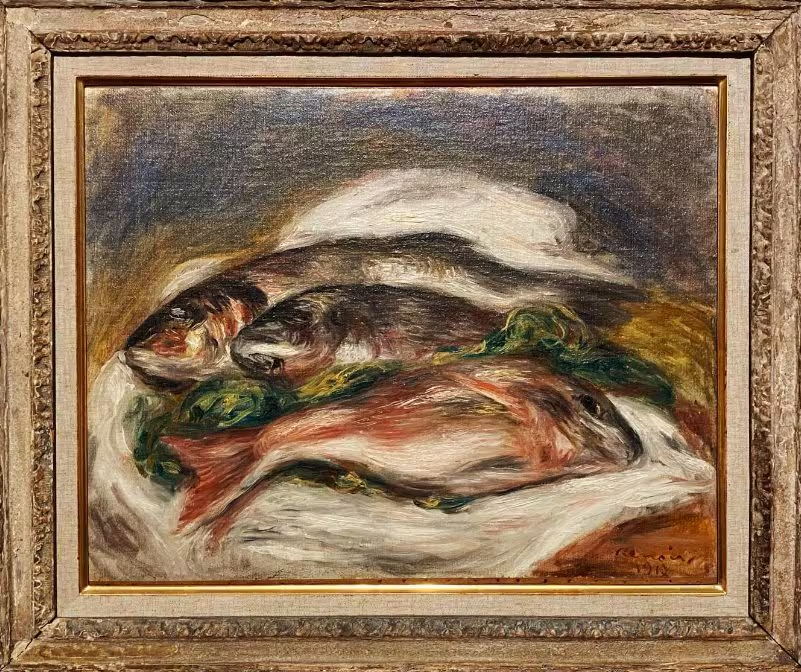
It’s about the paintings Pisces by Pierre-Auguste Renoir (Limoges, 1841- Cagnes-sur-Mer, 1919) on the cover of the article and Still life with cherries by Paul Cézanne (Aix-en-Provence, 1839 – Aix-en-Provence, 1906) and the aquatint on paper Odalisque on the terrace by Henri Matisse (Le Cateau-Cambrésis, 1869 – Nice, 1954): all together they are worth around 9 million euros. Fortunately, the works were recovered unharmed last August.
The theft of the Renoirs from the museum in Cagnes-sur-Mer, southern France
There was also another theft with the impressionist painter Renoir at its center. Four of his paintings were stolen on September 8 from the museum dedicated to the painter in Cagnes-sur-Mer, not far from Nice. Although the alarms were triggered immediately – which forced the fleeing thieves to leave behind two works, which were soon recovered – two paintings worth 9 million were stolen: the Portrait of Mrs. Colonna Romano (around 1910) and The Young Woman at the Well (around 1886).
The museum, opened in 1960 in the villa where the painter lived his last years, has a collection of around ten paintings (portraits, nudes, landscapes) and sculptures, but also original objects and furnishings.
The treasure trove of Bronze Age artefacts
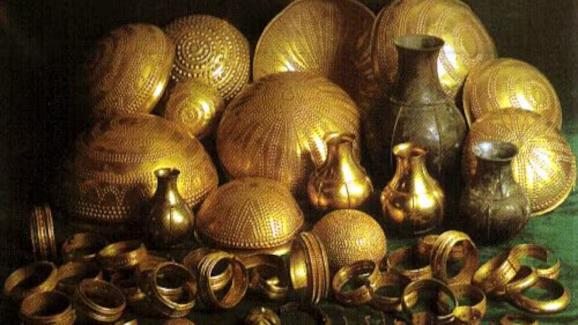
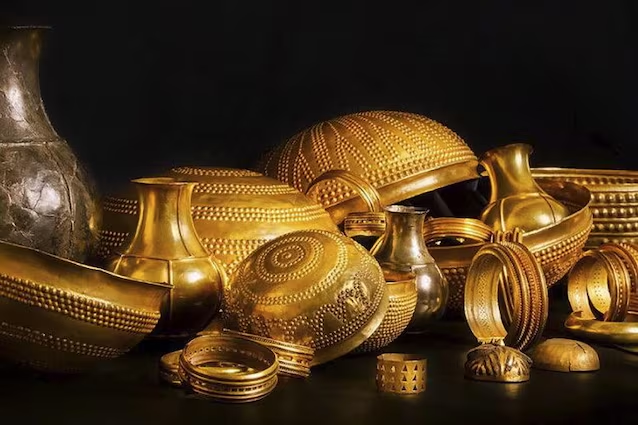
One of the most important European collections of Bronze Age artefacts was stolen on the night between 26 and 27 August from the Museum of Villena (a town in the province of Alicante) where it was kept: the treasure, which dates back to 1,000 BC, includes 11 bowls, 28 bracelets and three gold containers, three silver bottles, two amber and gold artefacts, an iron and gold object and a bracelet of iron.
Discovered in 1963 by the archaeologist José Maria Soler and his collaborators in the bed of a river, the Villena Treasure has a value of approximately 1.7 million and is considered the pinnacle of prehistoric goldsmithing.
Two coin thefts in Spain
During 2026, Spain also saw two important collections of historical coins stolen. On April 25, 149 coins that made up the so-called Villanueva Treasure, a collection of coins discovered in the city of Villanueva de la Serena in 1987, were stolen from the Provincial Archaeological Museum of Badajoz, Spain. Minted between the end of the eighteenth century and the beginning of the nineteenth century, these monetae had a value of around half a million euros.
On July 27, the Provincial Museum of Albacete was also burgled: thieves stole 220 19th century gold coins, part of the collection of 42 pieces dating back to the reigns of Charles III, Charles IV and Isabella II (the value of which was not estimated, except as “much higher” than the weight of the gold).