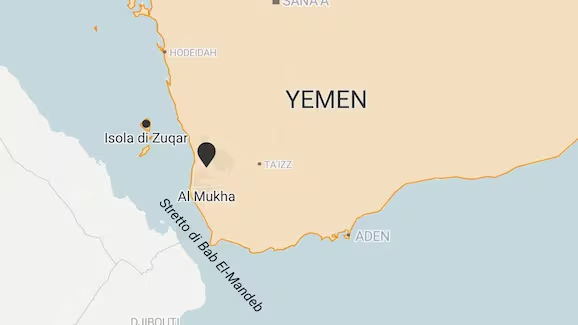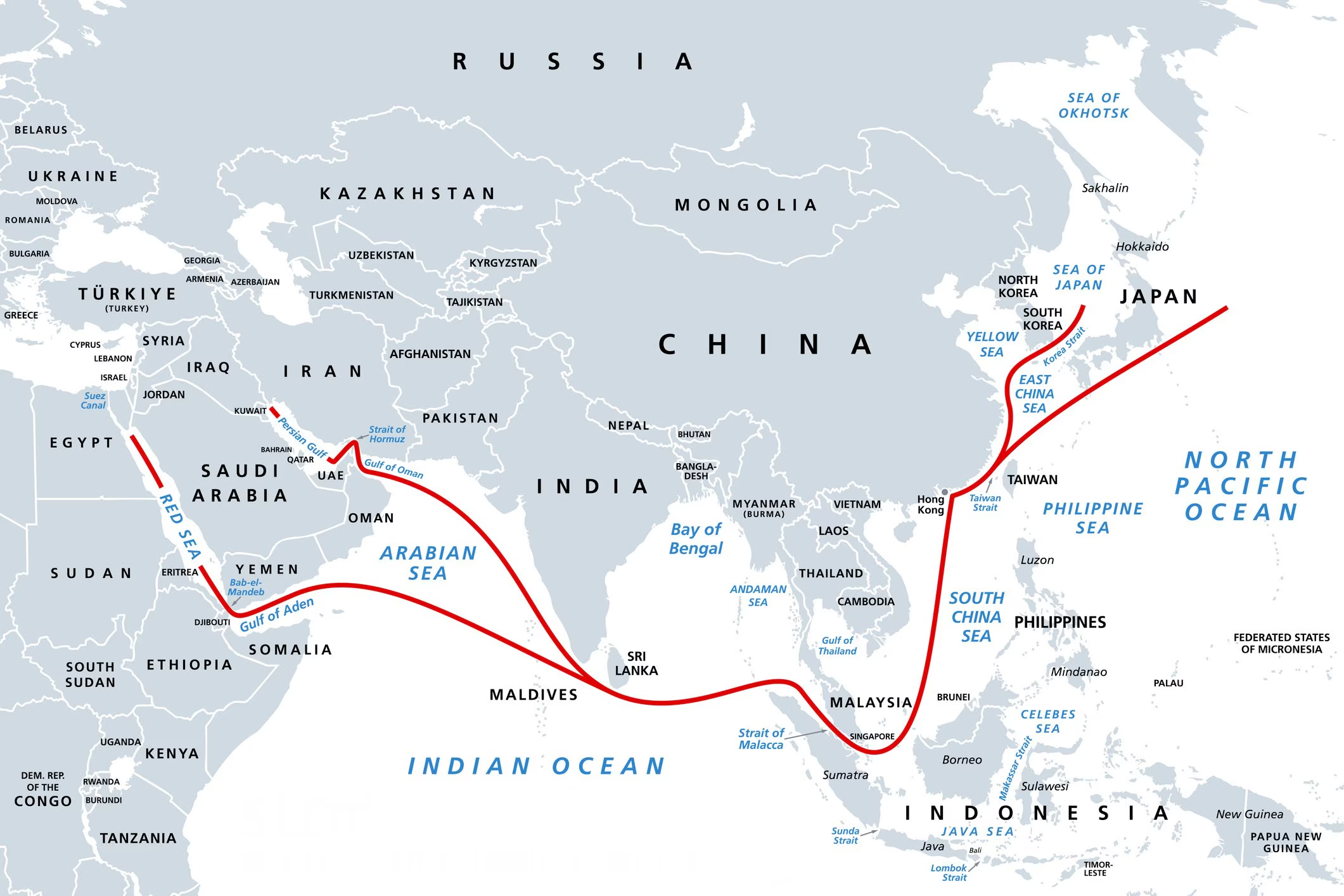
The Houthis, the armed group of Yemeni rebels supported by Iran, have conquered the strategic island of Mayyun (also known as Perim) and the port city of Mocha, gradually moving closer to controlling the entire Yemeni coast facing the Red Sea and threatening shipping through the Strait of Bab el-Mandeb, which connects the Red Sea to the Gulf of Aden towards the Indian Ocean.
As reported by Al Jazeera, the rebels are now aiming towards the Yemeni government’s strongholds in Marib (a province rich in oil and gas) and Taiz, after having also conquered the islands of Lesser Hanish and Greater Hanish, thus strengthening their position in control of the Bab el-Mandeb Strait.
For the moment, the Houthis have communicated that navigation in the Strait “remains free and safe” for everyone, except for Saudi ships and oil tankers. After Riyadh temporarily closed the East-West pipeline (which carries Saudi crude oil to the port of Yanbu on the Red Sea) damaged by a series of drone attacks, the price of crude oil soared above $107 a barrel.
As highlighted by experts, in reality the group of armed rebels does not even need to block Bab el-Mandeb: it is sufficient to increase the risks for navigation (linked to possible attacks against boats) to make insurance premiums skyrocket and make the passage through this strait no longer convenient.
A possible blockade of Bab el-Mandeb would also have serious repercussions on Europe: approximately 12% of world trade passes through here (including 11% of global oil transported by sea and 8% of liquefied natural gas). Cargo and oil ships would be forced to circumnavigate Africa, via the Cape of Good Hope, to reach Europe, with heavy consequences in terms of costs and delivery times.
The Houthi conquest of Perim island, the attack on the oil pipeline and operations against Saudi Arabia
The Houthis are in fact close to controlling the entire Yemeni coast overlooking the Red Sea, reaching within a few dozen kilometers of Africa: the rebel military group has conquered the city of Mocha, the last major western port internationally recognized by the Yemeni government, has occupied the island of Mayyun (or Perim), which naturally divides the Strait of Bab el-Mandeb into two channels, and has also taken control of the islands of Little Hanish and Great Hanish, located to the north of the maritime hub.
It’s not just about territorial conquests. The Houthis have been conducting targeted operations against Saudi Arabia for months, with a naval blockade announced last July and attacks against energy infrastructure. It is no coincidence that in recent days Riyadh has temporarily closed the Saudi “East-West” oil pipeline, due to a series of drone attacks that partially damaged it. According to Saudi Arabian authorities, the drones would have departed from Iraqi territory, where some pro-Iranian militias are active.
The news immediately pushed up crude oil prices, with Brent exceeding 107 dollars a barrel, and the reasons are quite clear: with the Strait of Hormuz blocked on and off since February 28 (following the joint attack by the USA and Israel against Iran), Saudi Arabia has gradually diverted 70% of its oil exports towards the Strait of Bab el-Mandeb, strengthening the East-West pipeline, which has already existed for years ’80.
This infrastructure transports crude oil from Abqaiq, located on the east coast (overlooking the Persian Gulf), to the port of Yanbu, located on the Red Sea. From here, most of the Saudi crude oil flows down the Red Sea, crossing the Bab el-Mandeb Strait to enter the Indian Ocean and reach Asia. The remaining part, however, goes up to the Suez Canal, then entering the Mediterranean.
What a possible blockade of the Bab el-Mandeb Strait means for Europe
To understand why Europe looks with apprehension at what is happening in Yemen we must start from geography. As anticipated, Bab el-Mandeb is the southern entrance to the Red Sea: those arriving from Asia and wanting to reach the Mediterranean (and therefore Europe) pass through here, go up the Red Sea and cross the Suez Canal, thus entering the Mediterranean. It is the shortest sea route between the two continents.
Approximately 12% of world trade passes through Bab el-Mandeb, including 11% of global seaborne oil and 8% of liquefied natural gas (LNG). Data from the US agency EIA show how important the strait is also for the energy sector alone: in 2023 it moved up to 9.3 million barrels per day of crude oil and petroleum products, a volume which then dropped in the latest measurements (around 4.1-4.2 million per day between 2024 and the first half of 2025) precisely due to tensions in the region.
But what happens if this bottleneck closes or navigation becomes too dangerous? The ships are forced to avoid the Red Sea and circumnavigate Africa via the Cape of Good Hope. It’s a huge diversion: according to Al Jazeera, it adds more than 20 days of sailing, resulting in a soaring global freight cost. And the impact is not theoretical: IMF PortWatch data indicates a decline of between 50 and 55% in volumes and tonnage transiting the Red Sea between 2023 and 2025, a period in which tensions in the Red Sea had intensified following Houthi attacks on merchant ships.
Then there is an important detail, highlighted by several analysts: the Houthis do not need to physically block the strait, it is enough to increase the risks to navigation. The increase in insurance premiums and the reduction in coverage can in fact make the transition commercially unprofitable, pushing companies to divert routes even without a formal closure. As reported by Eleonora Ardemagni, Senior Associate Research Fellow at ISPI, «without control of the coasts and islands of Bab el-Mandeb, the Houthis were already able to launch attacks on ships in transit there. The real goal of this advance may be to impose tolls by replicating ally Iran’s moves on Hormuz. As well as helping Tehran and strengthening its blackmail power over Riyadh.”
Among other things, the deployment of naval assets to Bab al-Mandeb and the Strait of Hormuz has created security gaps off the coast of the Horn of Africa, which organized maritime criminal groups have taken advantage of. Former naval officer Alexandru Cristian Hudisteanu highlighted how acts of piracy have increased, particularly along the Somali coast, due to international naval attention shifted to the Strait of Hormuz and Bab el-Mandeb.
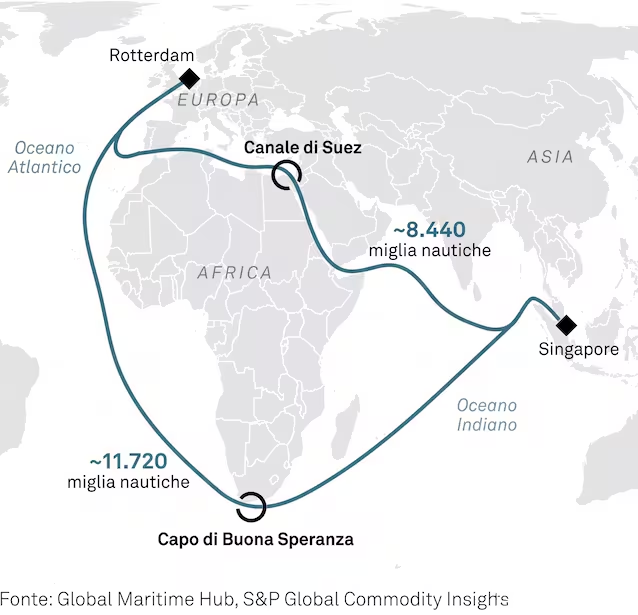
According to ORF Middle East, a double closure of Hormuz and Bab el-Mandeb would put at risk around $10 billion a day in global trade, blocking around 30% of global container traffic and threatening around 22% of the world’s oil supply.
Given the strategic importance of the Strait, the European Union is already present in the area with several naval missions, such as Operation Atalanta and EUNAVFOR Aspides, which guarantee maritime security in the Red Sea. According to Hudisteanu, however, the mission may have its hands tied due to mandate constraints that are too tight to intervene in case of new attacks and bureaucratic delays in updating mission mandates.