
The months have different durations due to a convention established over the centuries, due to the adaptation of the lunar phases with the duration of the earth’s revolution. We must consider that the Gregorian calendar we use today is a solar calendar, that is, it measures time based on the revolution motion of the Earth around our Earth, and has no connection with the phases of the moon. The concept of a month, i.e. a cycle of approximately 30 days, originates from lunar calendars, which measure the passage of time based on the phases of the moon. Each lunar cycle lasts 29 and a half days; therefore in a solar year of 365 days there are 12 cycles, which add up to 354 or 355 days. Consequently, the solar calendars that retained the concept of month, like the Gregorian one we use, had to add some days, bringing the months to 30 or 31 days, to make the year coincide with the earth’s revolution. Moreover, if you divide the duration of the year by 12, you have a duration for each month of 30 days and 10 hours, so it was necessary to adapt.
Solar, lunar and lunisolar calendars
To understand the reasons for the length of the months it is appropriate to briefly explain the difference between solar and lunar calendars. Solar calendars measure the passage of time based on the apparent position of the Sun in the celestial vault or, more precisely, based on the position of the Earth in its motion of revolution around the Sun. Solar calendars therefore last 365 days (or 366), which is the time it takes the Earth to complete a complete revolution. The dates are “fixed”: each day always falls in the same period of the year. Solar calendars are the Gregorian, used almost throughout the world, and the previous Roman and Julian calendars.
Lunar calendars, on the other hand, measure the passage of time based on the phases of the Moon (new, waxing, full and waning). A lunation, that is, a complete rotation of our satellite, lasts about 29 and a half days. Twelve lunations have a duration of 354 or 355 days and, consequently, the lunar year is shorter than the solar one. For this reason, the dates of the lunar calendars are “movable” and fall in different periods of the solar year. This is what happens, for example, in the Islamic calendar (just think of the month of Ramadan, which occurs at different times every year).
Many lunar calendars, however, use a trick: they add “extra” days to ensure that the calendar coincides with the solar year. Calendars of this kind are called lunisolar. The dates always occur in the same period, but not on the same day. A typical case is that of the date of Easter, based on a lunisolar liturgical calendar, which falls on the first full moon day after the spring equinox, i.e. between March 22nd and April 21st.
The origin of the duration of the 12 months
Our Gregorian calendar originates in Rome’s earliest history. The first calendar used in the eternal city, called the Roman calendar and developed in the time of the kings, was a solar calendar divided into 12 months, each of which lasted 31 or 29 days. Periodically, a thirteenth month (called the intercalary month) was added to adapt the duration of the year to the motion of the earth’s revolution.
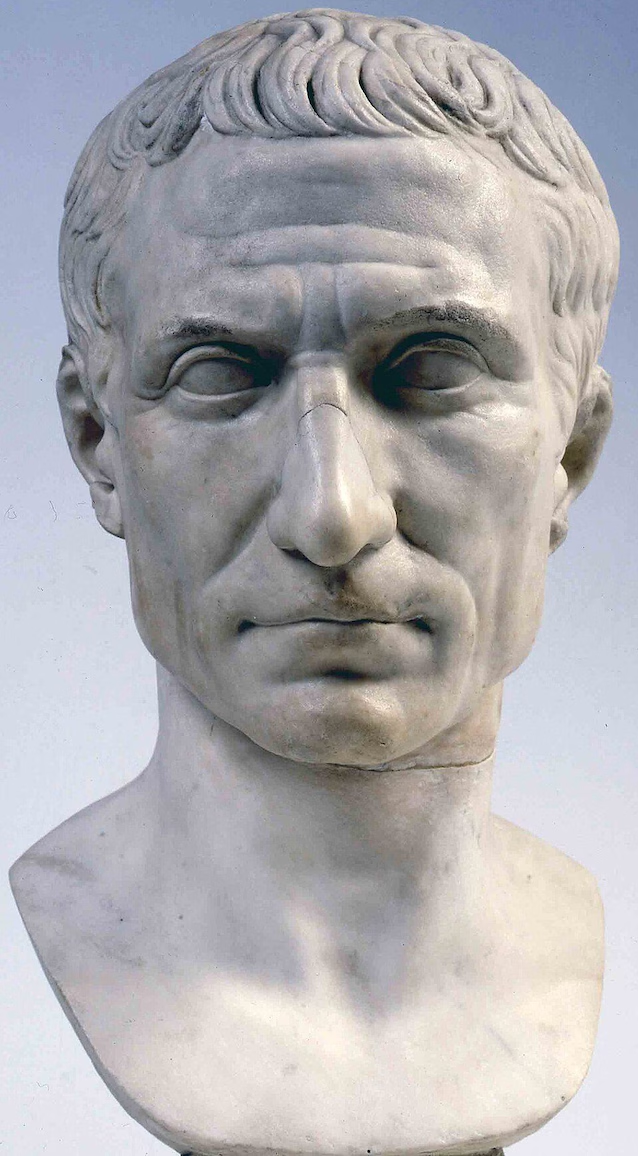
The Roman calendar was reformed by order of Julius Caesar in 46 BC. C. The new calendar, called Julian, added the leap year in place of the intercalary month and modified the duration of the months, introducing the duration still in force today: 7 months of 31 days, 4 months of 30, 1 month of 28 (29 in leap years).
More precisely, the Julian calendar divided the days in the following way:
- January 31
- February 28 (29 in leap years)
- March 31
- April 30
- May 31
- June 30
- July 31
- August 31
- September 30
- October 31
- November 30
- December 31
As you can see, it is the same distribution of days that we use today. It is from the Julian calendar, therefore, that the months last 31, 30 or 28 days.
In fact, the Gregorian calendar, introduced in 1582 and in use today, did not modify the distribution of days, but only changed the rule for determining leap years, making the calendar more precise than the astronomical year.
A legend about the duration of the month of February
A legend has it that Octavian Augustus subtracted a day from February to give it from August, the month dedicated to him (the name of the month was originally sextilis, but from the 1st century AD it was called Augustus in his honor). According to legend, the emperor made sure that “his” month had the same duration as July (Julius in Latin), dedicated to Caesar. This would explain why July and August are the only two consecutive 31-day months. However, the story is a baseless legend: since the time of the Roman calendar, the month of February had 28 days. Augustus made no changes to the length of the months.