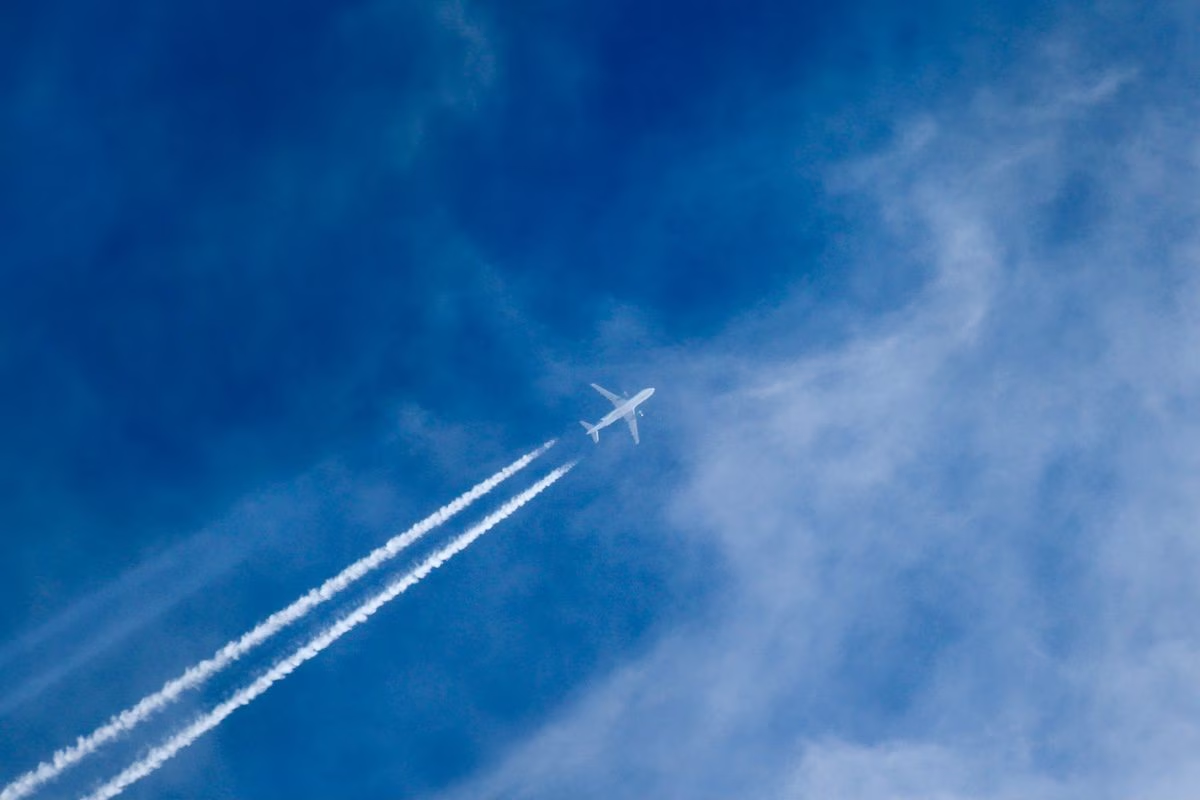
The white trails left by airplanes are not all the same from a climatic point of view. Some fade away quickly, while those that persist longer may contribute to warming the atmosphere. Precisely for this reason in recent years they have become the subject of projects that seek to reduce their presence without substantially modifying normal flight operations.
It is in this context that Google is experimenting with Cathay Pacific, a Hong Kong-based airline, its technology, which uses AI to identify where persistent contrails may form. The indications are made available to the crews, allowing them to avoid critical areas with small changes in altitude when operating conditions allow it.
AI technology to predict where airplane contrails will form
The main problem is to understand in advance where an aircraft will encounter the atmospheric conditions suitable for the appearance of a persistent contrail. In fact, it is not enough to know that it is cold at altitude. What counts above all is temperature and humidity, which can vary significantly even between nearby areas and over the course of a few hours.
The technology developed by Google combines weather, satellite and flight data with AI models to map areas of the atmosphere where the risk is greatest. The company also applies artificial intelligence to weather forecasts, but in this case the objective is much more limited and consists of estimating where the passage of a plane could generate a lasting trail.
With Cathay Pacific these indications can arrive directly in the cabin via the on-board Wi-Fi and theElectronic Flight Folderthe digital tool used by the company to provide pilots with operational information. Once a critical layer has been identified, it is not necessary to completely change the path. In some cases it may be enough to slightly rise or fall in altitude, similar to what already happens to avoid an area of turbulence. Any variation must however fall within normal safety procedures and take into account air traffic.
The results of the first tests from Google and Cathay Pacific
The first phase involved more than 100 selected flights in the company’s network. Of these, over 80 actually followed routes designed to avoid areas favorable to persistent trails. Then analyzing satellite images, Google estimated a reduction of about 40% in the heating effect associated with the contrails produced by those flights.
However, the data must be interpreted correctly. It does not mean that airplanes have reduced their overall climate impact by 40%, nor that CO emissions2 have decreased by the same amount. The percentage only concerns heating attributable to contrails in flights that followed avoidance routes.
Among the routes involved there is also the Hong Kong-Singapore route, where conditions favorable to the persistence of contrails occur quite frequently. According to Google, interventions made on this link accounted for more than half of the climate benefit estimated during the pilot test. The project now enters a larger second phase, which will include Asian and trans-Pacific routes. Cathay Pacific is Google’s first commercial airline partner in Asia to trial this technology on ultra-long flights.
Previous testing and the impact on fuel consumption
The one with Cathay Pacific is not the first experiment conducted by Google. In 2023, the company collaborated with American Airlines on 70 test flights: by using AI-generated cues and changing altitude when necessary, pilots achieved a 54% reduction in observed contrails compared to flights that didn’t follow those cues.
In 2026, the project was scaled up to a much larger scale, integrating the system into American Airlines’ regular schedule and involving more than 2,400 transatlantic flights. Among the 112 flights that managed to follow the avoidance plan, the contrail formation rate was 62% lower than in the control group.
However, there remains one aspect to evaluate. Changing altitude can require more fuel and, consequently, increase CO emissions2. In 2023, the aircraft that had carried out the maneuvers had consumed around 2% more, an increase that Google estimated at around 0.3% when compared to the entire fleet, because only part of the connections require modifications. In the larger 2026 test, however, there was no statistically significant difference in consumption between the flights compared.
The challenge, therefore, is not to eliminate any visible trail, but above all to recognize those that may persist and contribute to warming, intervening only when the expected climate benefit justifies the change in altitude. The new phase with Cathay Pacific will serve to understand whether this approach can work in the daily operations of a large airline and be extended to different routes and weather conditions.
Because some contrails last longer and can warm the atmosphere
Contrails are real clouds formed by ice crystals. They arise when the water vapor present in engine exhaust gases encounters air at very low temperatures. The water condenses and freezes around tiny particles emitted by the aircraft, making the distinctive white line visible.
Most of these tracks fade out quickly. However, if the surrounding air is cold and moist enough to be supersaturated with respect to the ice, the crystals can continue to grow. The artificial cloud can then persist much longer, expand and take on characteristics similar to those of cirrus clouds.
However, the consequences on the climate are not identical in every situation. During the day these formations can reflect part of the solar radiation back into space, contributing to cooling, but at the same time reducing the amount of infrared radiation emitted by the Earth that manages to reach space. At night the component linked to sunlight disappears and the heating component prevails. Considering the overall balance, scientific assessments indicate a net warming effect for persistent contrails and clouds that may result, although its magnitude remains subject to uncertainty.