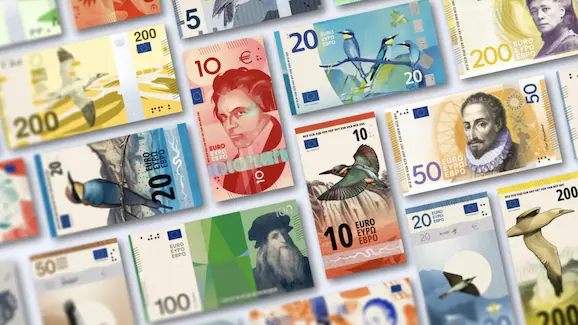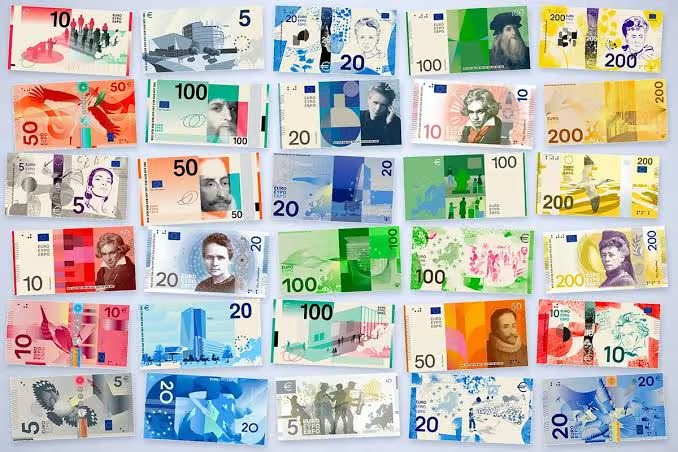
Today, 21 September, is the last day to participate in the survey and vote on the design of the new euros: European citizens will in fact be able to have their say on the future series of banknotes, which will have as their main theme “Rivers and birds” or, alternatively, the characters and elements of “European culture”. According to what was reported by Piero Cipollone, member of the executive committee of the ECB, over 9 million Europeans have already voted, which leads it to be considered one of the most successful European public polls.
The final decision rests with the Governing Council of the European Central Bank, which will communicate it towards the end of the year, but future banknotes will enter circulation in several years: they will first have to be further developed and tested to strengthen security requirements, so as to discourage counterfeiters.
However, this is a historic event, being the first complete redesign of the euro banknotes since they entered circulation in 2002: the second series, in circulation since 2013, maintains the same theme as the first.
How the ECB survey works and the competing designs
In addition to the online survey aimed at European citizens, the ECB has decided to have a parallel survey conducted by an independent research company, which will ask the same questions to a representative sample of euro area citizens. The idea is to collect two complementary photographs of public opinion: the European Central Bank, once the winning design has been selected, will publish a report with the results of both surveys.
There are 10 finalist drawings for which you can still vote, divided into two major themes. The first, rivers and birds, includes:
- 5 euros: wallcreeper and mountain spring;
- 10 euros: kingfisher and waterfall;
- 20 euros: bee-eaters and river valley;
- 50 euros: white stork and meandering river;
- 100 euros: avocetta and river mouth;
- 200 euros: Gannet and seascape.
The second theme proposed, however, concerns the figures of European culture:
- 5 euros: Maria Callas;
- 10 euros: Ludwig van Beethoven;
- 20 euros: Marie Skłodowska Curie;
- 5th euro: Miguel de Cervantes;
- 100 euros: Leonardo Da Vinci;
- 200 euros: Bertha von Suttner.
The announcement of the winning theme and the production of the new euro banknotes
Once the survey is closed, the ball is back in the ECB’s court. The Governing Council should make the final decision (also based on the outcome of the surveys and the parallel investigation) towards the end of the year: the winning proposal, however, will not arrive in our hands immediately, but will be further developed and tested and, only at a later stage, will it enter production.
The European Central Bank itself has specified that it will take several years before the new banknotes actually enter circulation.
In the meantime, the old banknotes will still retain their value and will circulate together with the new denominations, which will have dimensions and dominant colors similar to those we know, so as to facilitate the transition and contain the costs of adapting machines and machines.
For the new series, the ECB will not release more cash onto the market than usual: every year the Central Bank prints new banknotes to replace obsolete ones, to cope with expected increases in demand (such as seasonal peaks) and to manage any sudden increases. It is therefore likely that, once the official design has been decided, this production will take place with the new euros.