The Italian and global extra virgin olive oil market is experiencing a phase of profound transformation, in which the need to respond to the growing demand for the product clashes with increasingly higher quality expectations.
Oil mills working in the premium range are faced with an increasingly significant challenge: the price gap between oils intended for large-scale distribution and those aimed at premium markets continues to widen, consequently every process choice directly affects the positioning of the product and therefore its final profitability.
The quality of extra virgin olive oil is built in the field, but is preserved (or compromised) in the mill: the distance between a premium market oil and one on the shelf often passes through technological choices that many producers still underestimate, but which have a direct impact on the end-of-season budget.
Oil as a strategic asset
Let’s analyze the situation. Italian extra virgin olive oil is one of the national agri-food excellences with the greatest potential for valorisation. Preserving its organoleptic quality does not only mean protecting the characteristics of the product, but safeguarding the commercial value built along the entire supply chain. A strategic objective for a country like Italy, which confirms itself as the world’s second largest exporter of olive oil, with a share of approximately 20% of the global market and a commercial presence in over 160 countries.
The reference markets (United States, Germany, Japan, Canada) do not simply purchase a condiment: they purchase a guarantee of quality, a territorial identity for which they are willing to pay a higher price.
For an oil mill operating in this range, the management of the production process today becomes a direct component of the margin, no longer a secondary variable. The ability to bottle an oil with excellent parameters (low acidity, high concentration of polyphenols, intact aromatic profile) determines access to specialized distribution circuits and quality exports.
Invest in the right tools
The oil mill, therefore, goes from a simple place of transformation to the first link in a value chain that can be very profitable, provided it is managed with the right tools. Yes, because producing quality extra virgin olive oil requires significant investments along the entire supply chain: from the management of the olive groves to timely harvesting; from cold milling to filtration, ending with conservation in a controlled atmosphere.
Production costs have grown in recent years along with operational complexity, and producers often find themselves facing variables that are difficult to control, from climate to plant diseases, up to the instability of market prices. Arriving at the mill with quality olives is a necessary condition, but not a sufficient one: the process phase is the one in which months’ work can be valorized or wasted.
A poorly filtered oil loses stability over time, oxidizes sooner and drops in category, both product and organoleptic. For oil mills that aspire to be protagonists on the premium market, equipping themselves with the right filtration technology is not an expense: it is a positioning choice. It therefore becomes essential to have at your side not just a simple machinery supplier but a strategic partner who accompanies the manufacturer towards a certain, measurable and repeatable result over time.
The innovation of gentle filtration
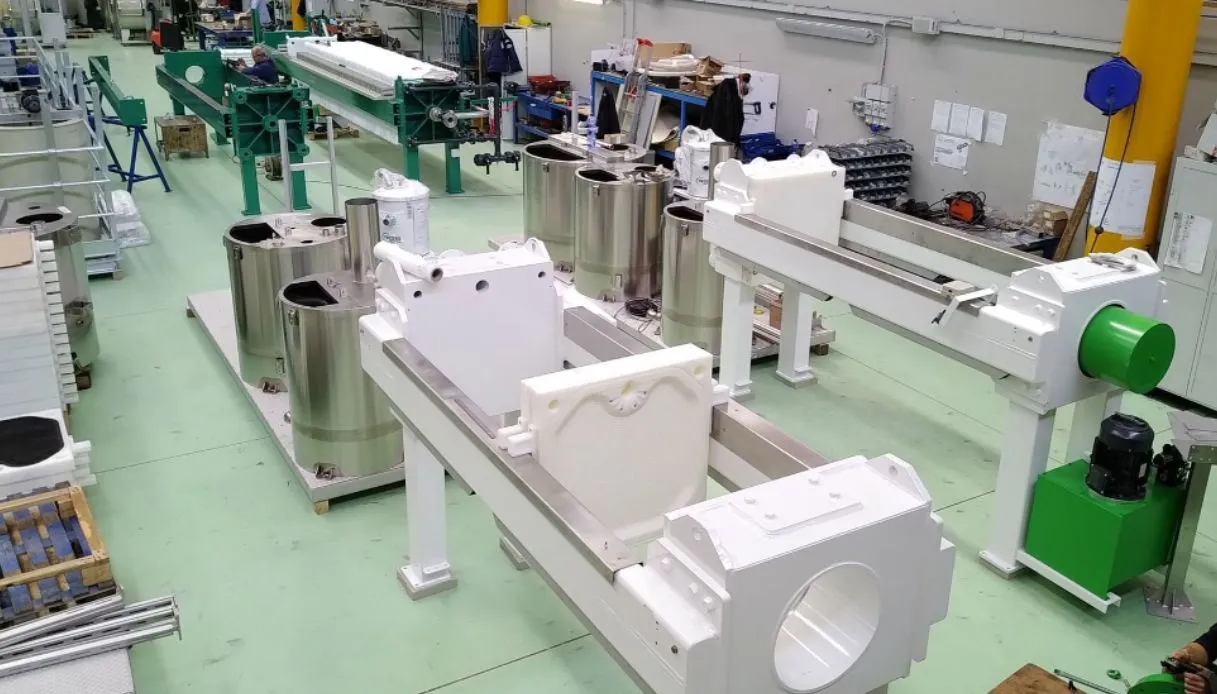
And speaking of strategic partners, none are more strategic than Exoos, a technological response designed for those who cannot afford to lose quality in the final phase of the process. Exoos Pratico, in particular, is a filtration system designed around a very clear principle: treat the oil with the same care with which it was produced. Filtration, in this vision, is not a mechanical cleaning phase, but a critical moment in which it is decided how much value will arrive in the bottle.
The system allows you to work in a zero oxygen environment, eliminating the risk of premature oxidation and preserving the original polyphenols and perfumes intact. The rigorous management of temperatures throughout the cycle avoids thermal shocks that degrade the organoleptic qualities, while the design of the system allows rapid and thorough cleaning operations between one batch and another.
The result is a brilliant and perfectly filtered oil obtained in a single step, with mechanical stress on the product reduced to a minimum and a yield that translates directly into more liters to market.
ROI and other benefits
The adoption of a filtration system such as Exoos Pratico generates a return on investment which is measured on three distinct levels. The first is the yield of the product: the single passage drastically reduces oil losses in the sludge, increasing the volume of marketable product for the same number of olives processed.
The second is the commercial value: keeping the parameters of premium oil intact (low acidity, absence of oxidation, intact organoleptic profile) means being able to access higher price ranges and more profitable distribution channels. The third is the reduction of operating costs: faster cleaning times, simplified management of the filters and less use of labor directly reduce the hourly budget of the mill.
Filtration, seen through this lens, stops being a process cost and becomes a margin lever. For mills working on quality, choosing the right technology means protecting the value of everything that came before and will come after: the work in the field, the harvesting, the milling and the commercial efforts.