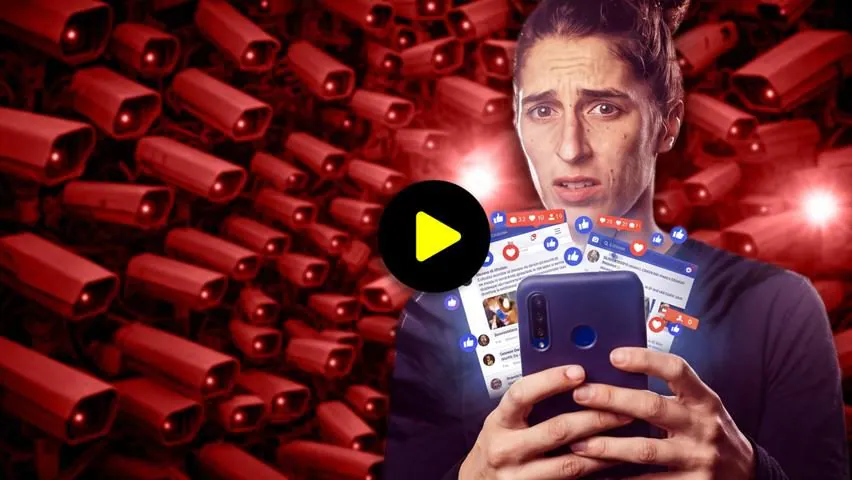
“Privacy no longer exists” is something we often hear today, in the age of social media. Nowadays, we are used to posting everything about our lives, but not only! How many times can you appear in photos or videos on social media without knowing it? And maybe many people found out we were in that moment, but we didn’t want to let them know?
In this article – and in the associated video – we talk about the “end of privacy”, how the internet has completely overturned the concept of private life, what the risks are of our constant online exposure – such as revenge porn or defamation – and what we can do on a practical level to best protect ourselves when our privacy is violated.
The boundaries of private life: before and after the internet
Before social media, the private sphere was delimited by precise boundaries, physical or virtual. From the walls of the house, those of the office, or from the telephone, that is, from calls or messages… in short, from the environment in which we found ourselves. And the only people who knew what we said or what we did were those who could see or hear us. The people we communicated with.
Today this is no longer the case. In the era of social media the walls of our homes – of our privacy – have fallen, because we have started to publish what happens inside these walls, that is, what happens in our private lives. In short, the boundaries of private life have become posts and stories.
Be careful, if we don’t publish our photos, others might. So privacy has not ended, but rather has become interdependent. That is, our privacy does not depend only on our choices, but also on those of others.
When there is no consent: examples of privacy violations on social media
There are situations where we compromise ourselves, but in this article we will focus on cases where others post to us without our consent.
- Case number 1: I didn’t know I was being photographed. So in this case not only did I not give consent to be posted, but not even to be filmed. A clear example is that of the Facebook group My Wife became famous in 2025: thousands of husbands posted photos of their wives, unaware that they had been filmed.
- There is also case 1b: you realize you are being filmed, but there was no consent either for the filming or for the publication. An example is that of the couple filmed during the Coldplay concert. In that case the so-called doxing had also taken place, i.e. the web had collected and published the personal information of the protagonists in order to mock them, leading among other things to very serious consequences such as dismissal and divorce.
- Case number 2: I give consent to be filmed, but the use of the content is out of my control. The extreme example of this practice is revenge porn, which is when a person’s intimate materials are disseminated, often by an ex-partner. In this case therefore, the problem is not the existence of the photo or video, but the use made of it.
- Case number 3: I know I was filmed, I am aware that the content was posted, but the use of my image is out of my control.
It happens, for example, every time a content goes viral and is stolen by other profiles, or becomes a meme. Think about it: there are faces that we all know because they have unconsciously become icons of the web – like that of the elderly gentleman with the cup.
Here, this is a “benevolent” example of what we called case number 3. There is instead an illicit practice which unfortunately has become very widespread on social media: that is, exposing the haters, also called call out. We are talking about that practice in which those who behave badly on social media are publicly shamed.
Publishing does not mean giving up rights to everyone
And here we come to a fundamental concept: publishing something on a social platform, therefore a public platform, does not mean that that thing becomes everyone’s property. Of course, by signing the Terms and Conditions of the platform we have given up some rights to our personal data, but we have not given them away to all users.
So when we comment on a public post, we are accepting that our name, surname and profile photo appear in the comments of that specific post, not elsewhere. And if someone takes our comment, with our personal data, and publishes it, they are committing an offense.
It is a violation of privacy, even if the person in question has behaved badly. And indeed, if we mock the protagonist of this photo it could even become defamation.
How to have a photo of yourself removed even by reporting it to the GPDP
The first step is to ask for removal directly, sometimes a message is enough. Clearly if the photo or video was posted by a friend of ours, it is quite obvious that he will accept and the matter ends here.
But if instead it is a stranger who is using our image improperly and does not respond to our messages, there are various actions that can be taken.
The first is to make a report to the platform. By European directive, all platforms must provide this possibility. It must be said, however, that this route is not very effective. It often takes a very long time and above all it can happen that the platforms follow their own guidelines, and less so the Italian law.
So in addition to this it is better to report the fact to the Personal Data Privacy Guarantor – or GPDP. This is an independent administrative authority that supervises the correct processing of the data of us Italian citizens and requests the removal of contents that violate our privacy. Let’s say that this is the quickest action to take to obtain the removal of the contents.
Then, if in addition to removal we want to obtain compensation because, for example, our reputation has been damaged, it is appropriate to take legal action. We must not forget that defamation and revenge porn are real crimes, covered by our Criminal Code.
Finally, in the specific case of revenge porn there is something very important to know: there is preventive protection. If you fear that someone is about to spread intimate photos of you – perhaps your ex-boyfriend or girlfriend – you can immediately report it to the Privacy Guarantor. The Guarantor will alert platforms (such as Meta) to block the circulation of those images in advance, before they even end up online.
In these cases, before reporting, it is essential to collect all the evidence: therefore take screenshots, in which the date and name of the person responsible for the publication are clearly visible and then report by contacting the police or a lawyer.