By 2049, there will be 12.1 million people with type 1 diabetes globally, 29 percent more than the 9.4 million in 2025. The estimate comes from the DIAMOND-T1D model which has outlined a true health emergency, increasingly also for pediatric and adolescents: in 2025 the 0-19 age group represented 42 percent of new cases of type 1 diabetes (37 percent percent in high-income countries and 49 percent in low-income countries).
Young people under 20 are also particularly at risk for type 2 diabetes: according to a US study by the Colorado School of Public Health, the rate of new cases has seen an almost tenfold increase since the beginning of the century, a figure which certifies that type 2 diabetes is no longer a pathology that exclusively affects middle-aged and elderly people. These are some of the most alarming data presented during the Congress of the European Association for the Study of Diabetes (EASD), currently underway in Milan, from 28 September to 2 October.
In Italy today there are almost 4 million people living with diabetes, to which must be added around 1.5 million people who don’t know they have it. Cases of type 1 diabetes, which are significantly lower in percentage than type 2, are expected to grow by 16 percent by 2049, reaching a total of over 239,000 people.
On the occasion of the EASD 2026 Congress, Milan therefore becomes the continental capital of the challenge to this disease, which is increasingly widespread and with a series of repercussions that go well beyond the simple increase in blood sugar, impacting on what is defined as “cardiometabolic” health precisely to explain how and to what extent the entire organism is involved in the picture, starting from the impact on the heart and vessels up to the kidneys and other systems. Lilly, engaged for 150 years in the research, development and provision of innovative therapies in the cardiometabolic area and beyond, promotes a series of initiatives spread across the city of Milan to bring medicine out of conference spaces and bring it closer to people’s daily lives.
A clear message
Our health depends on our habits, on the way we interact with others and take care of our body. The Lilly campaign, which pervades Milan, therefore represents an invitation to explore cardiometabolic health through experiences, conversations and concrete gestures: from scientific information to movement and nutrition, from health to everyday choices.
“Medicine isn’t just about sickness. Medicine is about health” (medicine isn’t just about treating illness, it’s about health) is the common thread around which the entire project was built and the claim of the awareness campaign launched by Lilly at a global level.
“Health is built every day, in the way people move, eat, live and relate: it is not only created in conferences, laboratories and medical practices. For this reason, Lilly wanted to ideally extend the conference, a venue for science and innovation, to the city, transforming Milan into a space for meeting, information and participation. What we hope is to bring medicine to the places where health takes shape, with activities and moments designed to directly involve the public and make the topics of cardiometabolic health more accessible”
explains Elias Khalil, President and CEO of Lilly’s Italy Hub.
A tailor-made installation
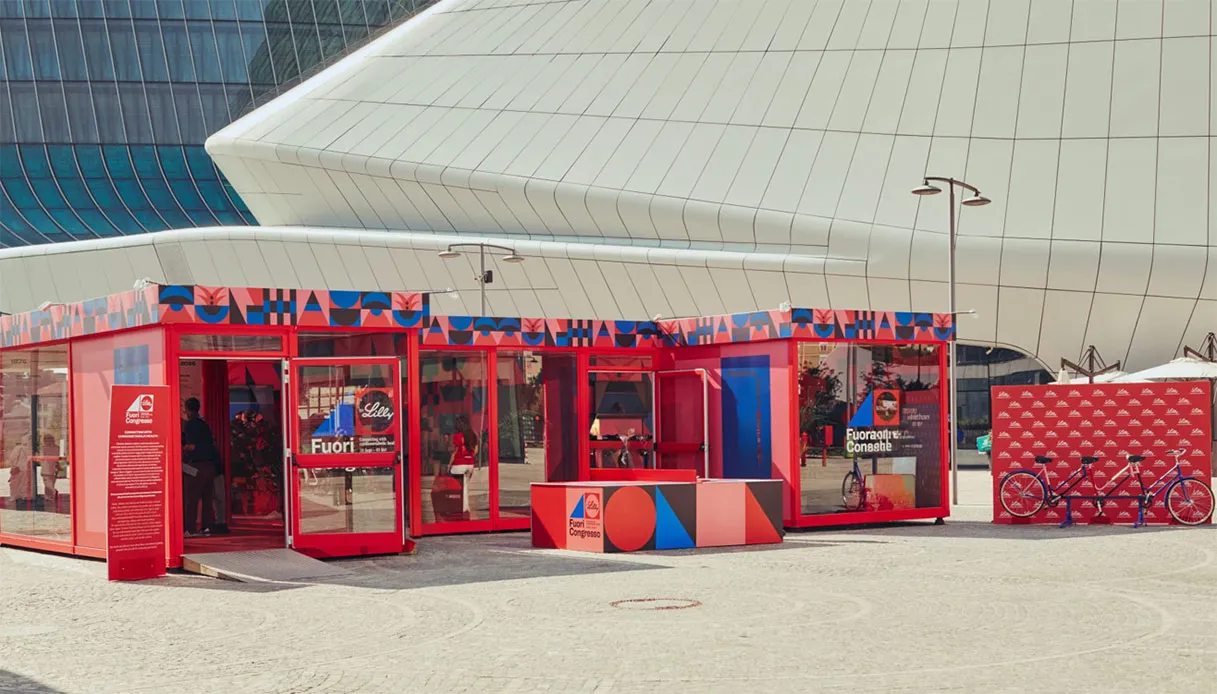
The beating heart of the project is the installation Out of Congress – Connecting with Cardiometabolic Healthwhich will preside over Piazza Tre Torri at CityLife until 2 October: a space open to the public designed to explain the connections between diabetes, obesity and cardiovascular risk in a clear and accessible way.
Cardiometabolic health concerns the integrated functioning of the metabolism, heart and blood vessels; obesity, diabetes and cardiovascular diseases are distinct chronic conditions, but they may be closely interconnected and are influenced by multiple biological, environmental, social and behavioral factors. Just as the Fuori Salone takes design beyond the pavilions and into the streets of Milan, Fuori Congress aims to be an extension of the EASD congress towards the outside: on the one hand it opens to the public an event that normally remains reserved for specialists, on the other it offers those arriving at the congress a real point of contact with the city and with those who live there. A moment in which the scientific community and citizens find themselves in the same space, around the same themes.
Fuori Congress includes a busy calendar of initiatives and activities, called Connecting Experiences. The prevention of cardiometabolic pathologies also depends on the commitment of the institutions, called to build a regulatory and cultural context that favors correct lifestyles, timely information and equal access to care, especially for people in conditions of socio-economic fragility. Regional council activity in Lombardy has been moving in this direction for some time.
From the congress you arrive in the centre
From MiCo to Piazza Tre Torri, Lilly’s initiatives reach the center of Milan, intertwining with the history of the city: 1876, the year of birth of Eli Lilly and Company, is also the year in which the first Milanese tram line was inaugurated. 150 years later, that meeting takes the form of the Lilly 150 Historic Tram, a free traveling experience open to the public.
On board the typical historic Milanese tram, a tour guide tells passengers, in Italian and English, how the evolution of the city is intertwined with the main stages of Lilly’s history, with a particular focus on diabetes care and cardiometabolic health. Stories, images and archive testimonies accompany passengers on a journey between past and present, between the walls dedicated to the history of the company and the display case with the original objects displayed on board. The tram always leaves from Piazza Castello, alternating two routes throughout the day: one towards the Darsena, the other towards the area of Piazza della Repubblica and Piazza IV Novembre.
In addition to Fuori Congress and the Historic Tram, Lilly’s presence on the Milanese territory during the days of EASD 2026 will also be marked by a Light Project (until 2 October, a pulsating red light transforms the Central Station into a visible sign, inviting those arriving to follow the story that unites Milan, medicine and daily life) and by the Walking Path: until 2 October, from the MiCo Congress Center, home of EASD 2026, to Piazza Tre Torri, eight totems build a path between Congress and Outside Congress and tell, through images and dedicated content, some of the most significant stages in the history of Lilly and the history of medicine.