People spend 86% of their waking hours without moving. This is the disheartening result of ASICS’ “Movement Conservation Report 2026”, a research on lifestyle habits that involved 34,000 individuals in 31 markets, with samples representative at a national level by age, gender and geographical area. Let’s find out together how this data was arrived at, why it has an impact on the cognitive-emotional sphere, what the Italian situation is, what the future scenarios are and how we can reverse the trend of sedentary lifestyle.
The research parameters and the verdict
The project is called “The Movement Conservation Project” and borrows the language of nature protection, dealing with the movement like a living being in danger of extinction. At its heart is the Movement Conservation Status, created by Professor Brendon Stubbs, an expert in the field of mental health and neuroscience. It is based on internationally recognized guidelines, including those from the World Health Organisation, Sport England, NHS England and the US Physical Activity Guidelines.
There are three categories. Anyone who does at least 150 minutes of moderate or vigorous physical activity per week is considered “active.” Anyone who stays between 30 and 149 minutes is “at risk”. Under 30 minutes you are “in danger”. The numbers come from ASICS’ State of Mind study, conducted in July 2026 with an online survey of 34,000 people in 31 countries. The verdict is that more than half of people, 53%, are “at risk” or “in danger.” Almost one in four, 23%, are in the worst range, with less than half an hour of activity per week. If nothing changes, by 2035 the share will rise to 56%, i.e. approximately 2.3 billion adults in the countries analyzed.
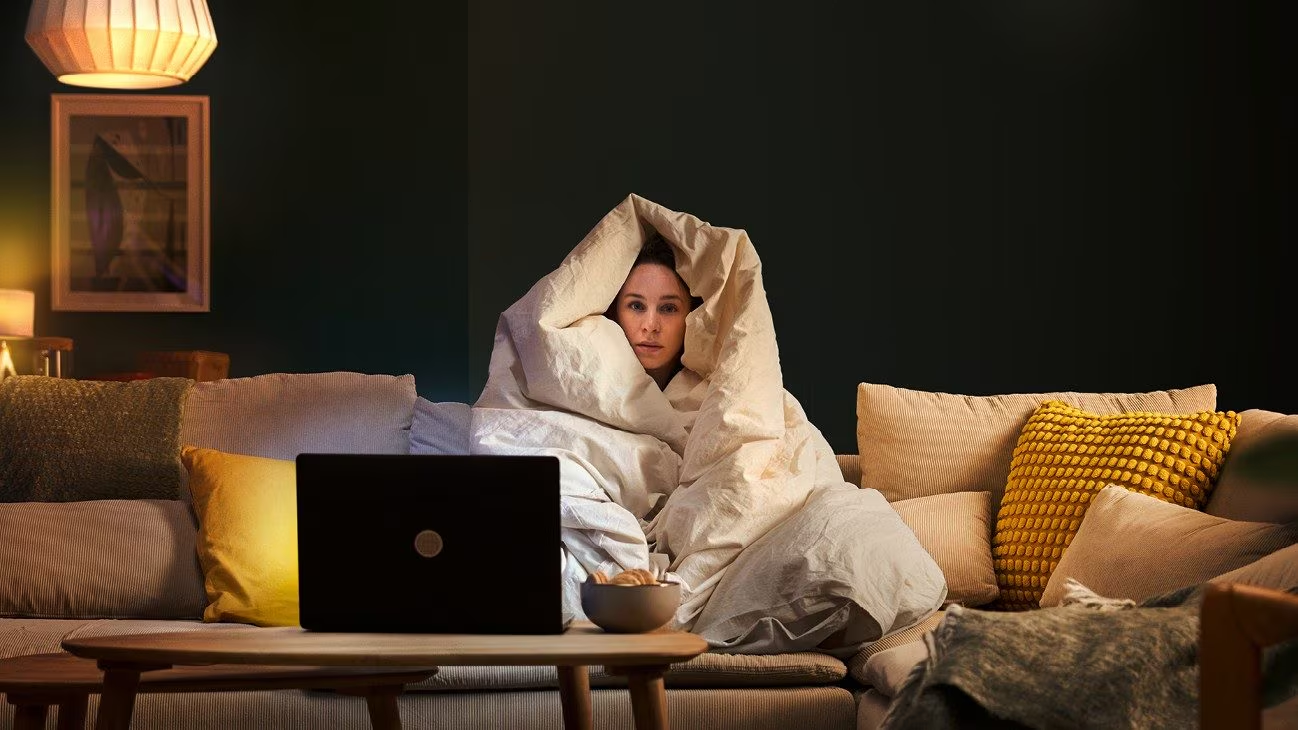
The research reveals an even more shocking side. The most steadfast are the boys. In the world, 57% of 18-24 year olds do not reach the recommended activity levels, compared to 47% of over 65s. Compared to their peers ten years ago, today’s young people are 40% more likely to find themselves “in danger”. 46% often spend long periods lying down watching content or scrolling the screen, 39% spend a lot of time in bed with their phone. Two in five (41%) often use AI to do things they used to do themselves – four times more than older adults (10%).
In Italy 27 million people at risk by 2035
Italy fares worse: 27 million people are at risk by 2035. Italians say they spend 87% of their waking hours without moving, one percentage point above the global average. Today half of the population, 50%, is “at risk” or “in danger”. With current trends, by 2035 it will reach 55%: an estimated 27 million adults. One Italian in three (34%) says they could easily not leave the house for three days or more, and among 18-24 year olds the figure rises to 44%. 36% run errands online instead of in person. 33% socialize mainly on the phone or on video calls, and among young people the share reaches 46%.
Less movement, more stress
The point is, it’s not just about muscles. The research also measures the State of Mind, an index from 0 to 100 built on ten cognitive and emotional dimensions. Those who are “in danger” stop on average at 60, those who are “active” reach 71. Those who move little feel 23% less energetic, 20% less calm, 17% less concentrated and 16% more stressed. Those who say they move much less than five years ago drop to 55, 17 points below those who move the most (72). Overall 81% of people have symptoms that they attribute to lack of movement. The most common are lethargy (37%), decreased motivation (33%), low mood (31%), worse sleep (29%), and more stress (28%). Even in Italy the gap is clear: 59 points for those who are “in danger”, 71 for those who are “active”. Those who often stay indoors for an entire day stop at 55, compared to 73 for those who never do so. And they are three times more likely to end up in the “endangered” range (51% vs. 16%).
The habitat that keeps us still
If movement disappears, the fault lies with the environment in which we live, which we ourselves have made so comfortable. Today you can eat, work, pay, shop, see friends and have fun without almost ever getting up. Nearly two in three people (64%) say it’s easy to spend an entire day moving very little. 44% could stay at home for three days or more, and among 18-24 year olds the figure reaches 51%. Technology accelerates everything: 41% run errands online, 39% socialize remotely, and in Generation Z this rises to 46%. When asked what took the place of the movement, the answers sound like a confession. In the lead is the smartphone (57%), then social media (53%), online shopping (50%), food delivery apps (43%) and working from home (43%). And the office doesn’t help: for 52% of workers the work environment favors sitting, and 51% can spend most of the day without needing to walk.
It only takes 15 minutes
To reverse the trend, little is needed. ASICS research indicates that 15 minutes of movement is enough for a measurable improvement in mental state. «We have built a world where movement has become optional”explains David Raichlen, professor of Anthropology at the University of Southern California. “We can work, shop, socialize and entertain ourselves without ever moving, and as convenient as this is, our bodies and minds still depend on regular movement to stay healthy. The findings remind us that movement is not an afterthought – it is fundamental to how we feel, think and function.”
«Movement has always been understood as something linked to the body, to the heart, to the muscles, to the lungs», explains Elisabetta Borgia, sports psychologist and clinician. «It’s time to start thinking from a more mental perspective. Small amounts of movement are enough to build our sense of self-efficacy, i.e. how much we feel capable of carrying out a task. Moving gives us a sense of control, and the more we feel like active actors in our lives, the better we feel. Runners know the positive effect of movement well: running is a powerful antidote to stress, it promotes mental processes and, if it doesn’t solve problems, it helps to deal with them in a more rational way. Today everything in our society seems aimed at bringing home the result, whatever it may be, with the least effort and in the shortest time possible. But all this is to the detriment of the process, of the pleasure linked to doing things. Having pizza delivered to your home is convenient, but you want to enjoy the pleasure of eating it in a pizzeria with family or friends, sharing your time with them.”