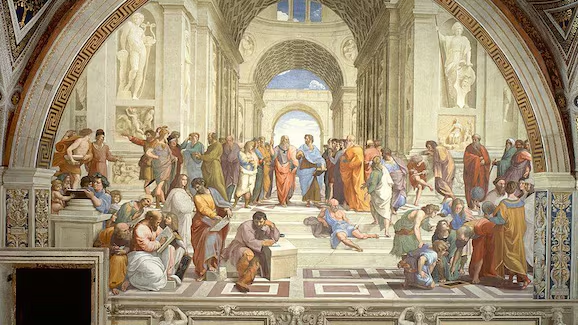
In Mieza, in ancient Macedonia (now northern Greece, near modern Naoussa, in the Ematia region), new excavation campaigns are providing further elements to identify the Royal Gymnasium with the place where Aristotle (384/383-322 BC) educated the young Alexander, future Alexander the Great (356-323 BC). The complex, located near today’s Naousa, dates back to the mid-4th century BC, to the time of Philip II (382-336 BC), Alexander’s father, and archaeological research has been conducted since 2024 under the direction of the archaeologist Angeliki Kottaridi.
According to the Greek Ministry of Culture, the new findings allow us to better understand the architecture and functions of the monumental gymnasium, intended for the education and preparation of young people belonging to the families of the Macedonian elite. The hypothesis that Aristotle’s school was located here is strengthened by the complex’s characteristics and its chronology. This was essentially an “elite school”, where young Macedonian nobles were educated in Greek literature as much as physical activity and military art.
One of the most important finds is a large complex of over 160 square meters, identified in the named area Didaskaleionthat is, the place intended for teaching, with real stone benches. The structure includes a central vestibule and two andronesrooms used for banquets. Both retain mosaic floors and raised platforms intended for banquet beds, i klinai. Each room had ten beds, allowing it to accommodate at least twenty diners in total.
The quality and technique of the mosaics present notable similarities with those documented in the royal palace of Aigai, seat of the Macedonian court. The excavations also revealed architectural elements belonging to the gymnasium, including parts of an Ionic frieze decoration, an element of an Ionic column and a capital. Particularly important is a corner fragment of a Doric architrave belonging to the peristyle, with its 200 meter long covered portico, which will be able to help reconstruct the original appearance of the gymnasium with greater precision.
The Mieza Gymnasium was therefore a complex intended not only for physical exercise, but for the education of young Macedonians. The Ministry highlights the role it had in preparing the future members of the kingdom’s elite, while new archaeological data is progressively defining its organization and functions. The identification with the school of Aristotle and Alexander is therefore strengthened by the new data, but the ministry statement presents it as a result of ongoing archaeological research, destined to be further explored with the continuation of the excavations.