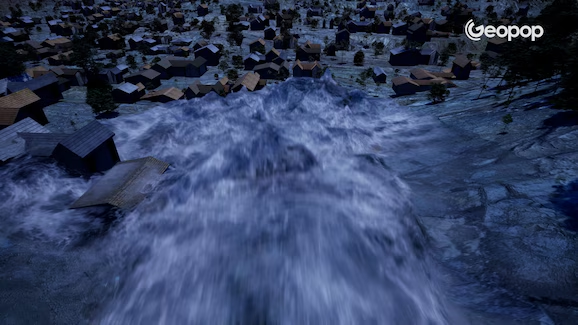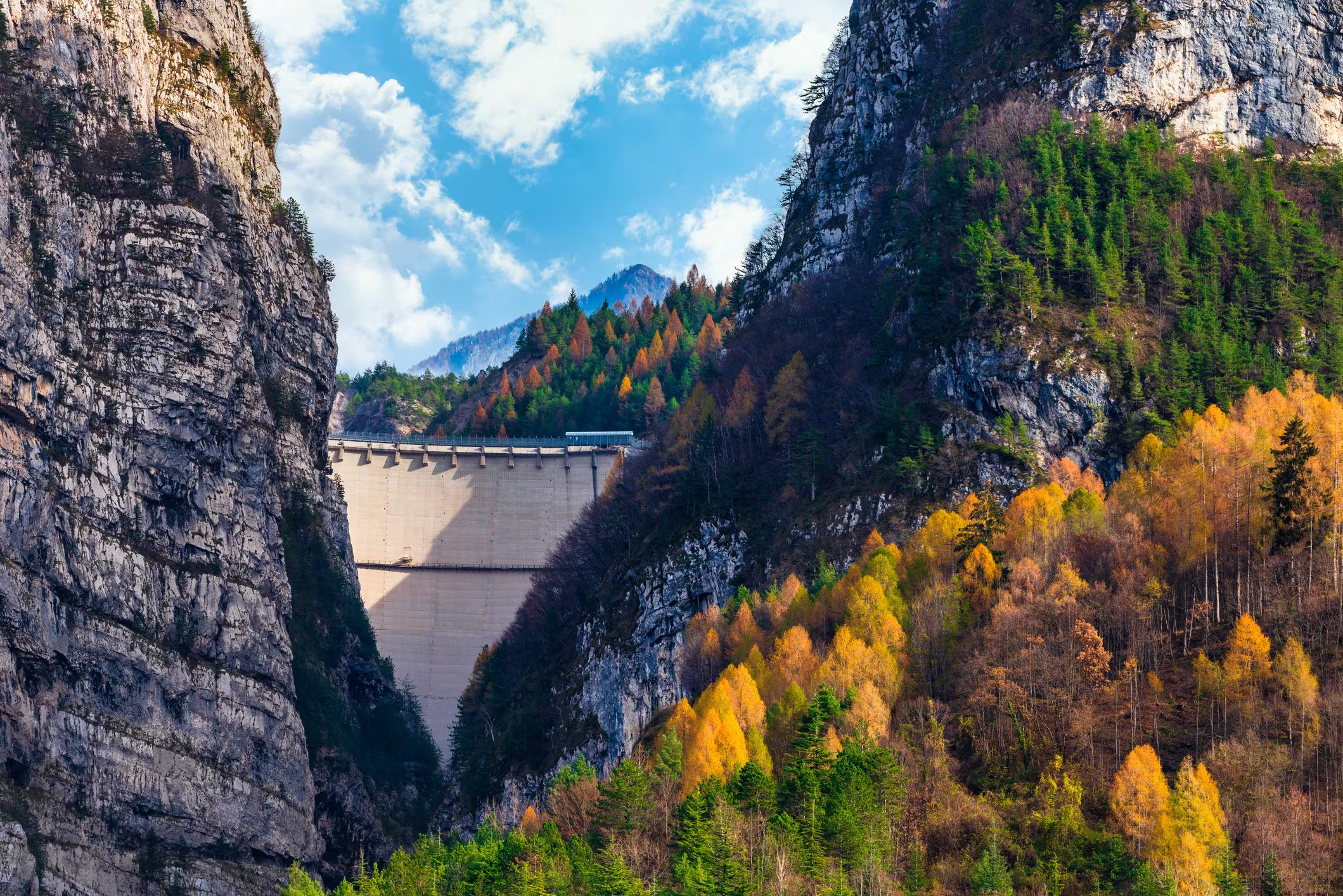
Today marks the anniversary of the Vajont tragedy, in Friuli-Venezia Giulia: on 9 October 1963, a landslide that detached from the slope of Monte Toc fell into the artificial lake created by the dam, generating an enormous wave of water that overflowed the reservoir and caused the death of almost two thousand people. 63 years later, the tragic event, during which 270 million m³ of rock broke away, still represents a case of great geotechnical and hydraulic complexity, the interpretations of which continue to evolve also thanks to new technologies. The debate on the possibility of predicting disaster remains central on a scientific, political and cultural level.
Geotechnical dynamics on the Vajont tragedy and the landslide
The Vajont landslide has been the subject of various scientific publications, testimony to its historical relevance and the physical complexity that continues to question current scientists and engineers. The original project of the dam was conceived in the absence of a specific and detailed analysis on the stability of the slopes of the entire valley. Indeed, even the first post-disaster geotechnical models were developed based on empirical data. For decades, interpretations of failure mechanisms have been conditioned by preliminary assumptions, limited by the use of simplified stratigraphic profiles and the lack of heterogeneity of mechanical behavior.
On the other hand, the current advancement of numerical modeling techniques and computing power has made it possible to ascertain that the failure process and its evolution are a combination of geotechnical and hydraulic mechanisms prolonged over time, related to the filtration processes within the slope.
What remains to be clarified about the landslide
Among the topics still subject to scientific debate are first and foremost the geometry of the sliding surface and the landslide speed. Historically, the slip surface was believed to have a shape to chairwith a sub-horizontal base and a more vertical rear section. Under these conditions, the collapse of the slope could only be explained by assuming relatively low values of mechanical resistance of the soil. Modern three-dimensional models instead suggest a concave geometry in a bowlalso considered more compatible with the actual mechanical characteristics of the materials present on the site.
The unstable mass reached estimated speeds of 20-30 m/s. Among the hypotheses put forward to explain such high values are thermo-hydraulic phenomena along the sliding surface, which could have led to an increase in the pressure of the interstitial fluids and, consequently, a reduction in frictional resistance.
The “classical” theory also hypothesized that a landslide had already occurred on the same slope in prehistoric times and that the unstable mass therefore rested on a surface characterized by relatively low resistance. Some recent studies, however, have questioned the paleo-landslide hypothesis, believing it difficult to explain protracted stability for very long geological times in the conditions predicted by traditional models.
The trigger for the collapse is now attributed to the combination of intense rainfall, continuous fluctuations in the level of the artificial lake and the poor mechanical characteristics of the clays present in the unstable substrate. Therefore, it is considered plausible that the 1963 landslide was the first major landslide event to occur on that side.
A disaster announced
Parallel to the geotechnical debate, the historical rereading frames the Vajont as an announced disaster, often interpreted as the result of a combination of economic pressures, management decisions, underestimation of the geological risk and poor consideration of the signs of instability that emerged in previous years. The state controls were in fact also based on geological assessments which deemed the continuation of the project safe, despite various warning signs, including tremors, explosions, anomalous animal behavior and the previous Pontesei landslide in 1959. In this context, the local communities mobilized to report the risks, also supported by the voice of the journalist Tina Merlin, who even ended up on trial for having reported the imminent danger.
The Vajont disaster has profoundly influenced the evolution of applied geology, slope geotechnics and risk assessment procedures linked to large-scale works, contributing to the development of methodologies now also used at an international level.