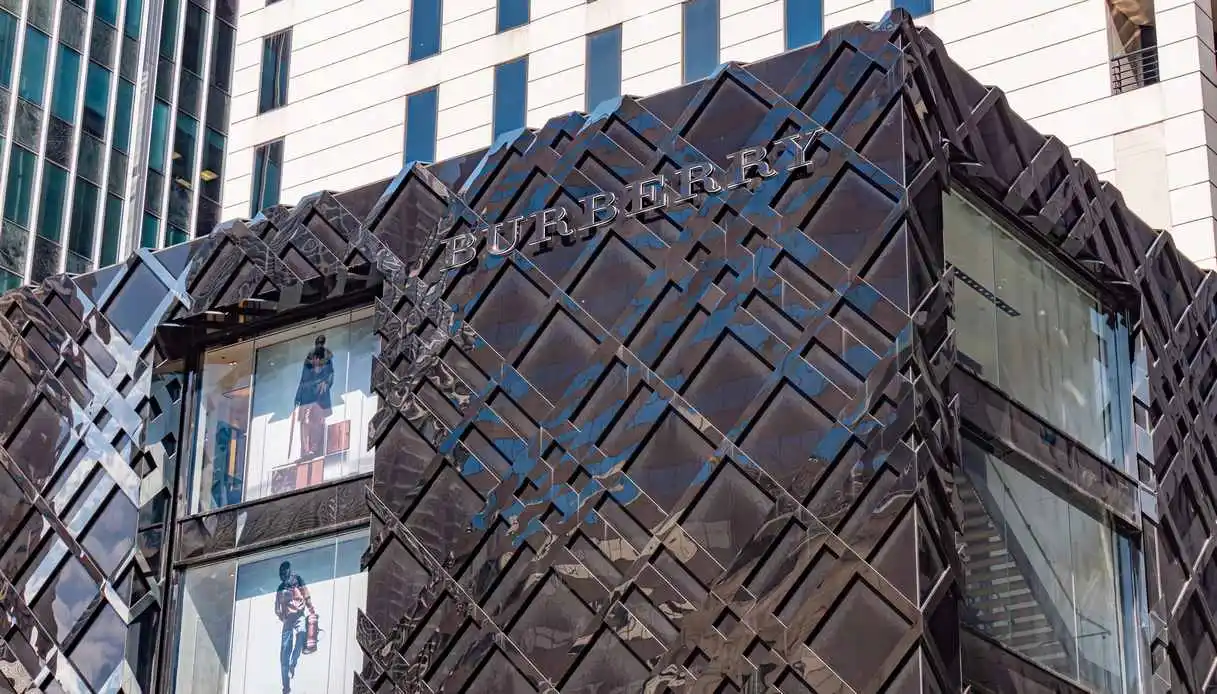
Frasers Group further increases its financial exposure to Burberry, bringing it to a value equivalent to 7.42% of the British fashion house’s voting rights. The data does not indicate that Frasers already owns 7.42% of the fashion house’s shares. It represents a financial exposure equivalent to around 27 million Burberry shares, built through contracts that could oblige the group to buy them under pre-established conditions. Frasers therefore does not currently have the corresponding voting rights, but has made a financial commitment which could turn into an effective participation.
It is a technical distinction, but it changes the financial meaning of the operation. Frasers collects a premium and accepts the risk of having to buy Burberry shares on pre-agreed terms if the counterparty exercises the options. It is not yet a takeover and does not demonstrate that a public offering is being prepared. It represents, however, growing exposure to a brand that is trying to emerge from a long slump just as Mike Ashley expands its luxury presence.
Frasers stake in Burberry rises to 7.42%
The relevant holdings disclosure published by Burberry indicates that Frasers crossed the new threshold on 8 October. The position corresponds to 27 million potential voting rights, equal to 7.420529% of the capital, but derives entirely from financial instruments.
Exposure increased rapidly:
| Date of communication | Frasers display | Prevalent tool |
|---|---|---|
| July 24, 2026 | 3.05% | Put options sold |
| July 27, 2026 | 4.16% | Put options sold |
| September 30, 2026 | 6.32% | Put options sold |
| October 8, 2026 | 7.42% | Put options sold |
The deadlines are distributed between October 2026, March 2027 and September 2027. Frasers is therefore expanding its exposure and, at the same time, spreading out over time the moment in which the obligation under the contracts could materialize.
How puts work sold by Frasers
A put gives its buyer the right to sell a security at an agreed upon price. Whoever sells the put receives the premium, but must purchase the underlying if the owner decides to exercise the contract according to the conditions provided.
The position can be interpreted as a favorable or at least not hostile strategy towards Burberry: whoever sells a put accepts the risk of receiving the shares at the established price. If the stock remains above that level, the option can expire without being exercised and the seller retains the premium. If it goes down, the seller may be called upon to buy.
The QuiFinanza Glossary on derivative instruments helps to understand why economic exposure can exist even without immediately owning the security. In the case of Frasers, however, an essential piece of data is missing to calculate convenience and risk: the exercise prices of the various options have not been made public.
| If at the deadline… | Possible consequence for Frasers |
|---|---|
| The stock remains above the agreed price | The put may not be exercised and Frasers retains the premium |
| The stock falls below the agreed price | Frasers may be forced to buy the shares |
| Contracts are renewed | The exposure can continue without immediately turning into direct participation |
| The shares are delivered | Frasers becomes an effective shareholder for the corresponding share |
The 7.42%, therefore, today does not equate to a shareholding with the same voting rights. It is, however, a financial commitment substantial enough to deserve attention.
Because Frasers is focusing precisely on Burberry
Burberry is no longer at the most critical point of its crisis. In the financial year ending March 2026 it recorded revenues of £2.42 billion, stable at constant exchange rates, and an adjusted operating profit of £160 million, compared to £26 million in the previous year. The operating margin rose to 6.6%, also supported by 80 million in cost savings.
In the first quarter of the new financial year, comparable sales increased by 5%. The “Burberry Forward” plan is bringing trench coats, scarves and British identity back to the fore, after a phase in which prices and positioning had driven away part of the customers. The most recent numbers indicate a recovery, not a transformation already completed.
It is precisely this intermediate phase that makes Burberry interesting: the brand retains global notoriety, but its valuation still reflects doubts about the speed of recovery. As already analyzed by QuiFinanza when talking about the possible change of direction in luxury with the return of Chinese demand, the normalization of the sector is not proceeding at the same pace for all fashion houses.
Mike Ashley’s luxury strategy
Frasers is no longer just the Sports Direct group. It controls Flannels and several premium brands, bought Harvey Nichols and said it wants to expand its European luxury business.
In the last financial year the group’s revenues grew by 8.7% to £5.33 billion. The premium division improved gross margin and Flannels returned to growth. Burberry could offer Frasers something that retail alone does not have: a global brand with creative production, intellectual property and a direct customer relationship.
The three possible scenarios
| Scenario | What it would entail |
|---|---|
| Financial investment | Frasers cashes in on premiums and maintains exposure to Burberry’s recovery |
| Strategic participation | The exercise of puts leads to the delivery of shares and an effective entry into the capital |
| Larger operation | The share becomes the basis for trade deals or further corporate moves |
The third scenario is the most suggestive. Burberry has not commented on the deal and Frasers has not announced a bid.
Mike Ashley didn’t openly buy 7.42% of Burberry, but he accepted exposure that could turn him into a major shareholder. It is a financial bet built gradually, with different deadlines and without revealing all the cards immediately. In European luxury, where prestigious brands and depressed valuations are attracting new capital, how you get into capital can also be a precursor to what comes next.