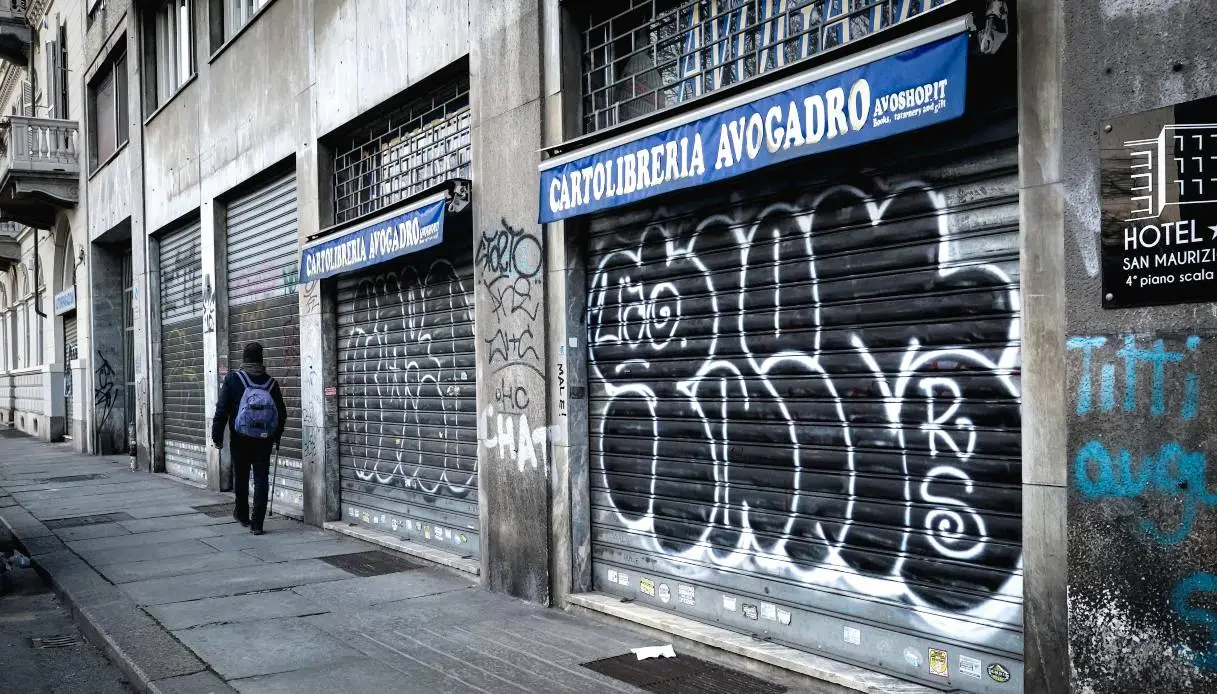
Italian cities are at risk of desertification. Local businesses and small businesses are giving way to multinational outlets or online purchasing. According to the estimate conducted by the Confcommercio Research Office in collaboration with the Tagliacarne Institute, by 2026 vacant shops in the country will reach 458,000.
The map that emerges from the data analysis conducted is that of a structural crisis that affects the country in an uneven manner, with profound critical issues especially in small businesses and services. And those who pay the highest price for this economic transformation, we read, are the small non-food businesses and the restaurant and bar sectors.
The numbers of the phenomenon
The dimensions of the phenomenon are important. The photograph taken by the Confcommercio office indicates 460,000 vacant commercial premises, of which one in four is in rural areas. The data goes hand in hand with the ownership of the premises themselves: only 1 entrepreneur in 3 owns the property.
The lowest share of restaurant ownership was recorded in Lazio (31.5%), while the highest share was recorded in Basilicata with 46.5%.
It is enough to walk around the cities to notice this ever-widening phenomenon, where the ones paying are above all small non-food businesses (171 thousand shops closed) and the restaurant and bar sector, where almost 90,000 empty premises are estimated.
The peaks are recorded in:
- traditional shops;
- clothing;
- footwear;
- household items;
- travel agencies;
- personal care (hairdressing and beautician salons).
Where are more stores closing?
The phenomenon, like others recorded in Italy, appears more profound and complex in the South, where it reaches 19.4% compared to the North-East which records the lowest incidence, equal to 13.8%. According to the analysis, the level of urbanization plays a crucial role in the stability of the commercial fabric.
In small municipalities or in rural or sparsely populated municipalities the maximum rate of 18.7% of shutters is lowered, while in large cities and intermediate urban centers the lowest percentage is recorded, around 16%.
Desertification, how much it costs us
What is worrying, however, is not only the number of closed shops, but also how long this phenomenon has been going on for. Between 2012 and 2023, the duration of non-use of a commercial space was calculated at 7.2 years. According to the Real Estate Market Observatory, the estimated average annual rent is around 16,000 euros at current prices.
An empty shop generates a total lost profit of 116,000 euros over the entire vacancy period. This translates, for the Italian economic system, into a loss of 53 billion euros overall, equal to approximately 4.4 billion euros per year (0.2% of the national Gross Domestic Product).
Paolo Testa, head of the Urban Planning and Urban Regeneration sector of Confcommercio, commented:
The neighborhood shop is going through a profound cultural and political transformation: it is no longer considered simply as a business activity, but as a real civic infrastructure indispensable for urban life.
Urban redevelopment: the strategy
This is where projects like that of Confcommercio are born which wants to bring the social value of local businesses back to the center of the agenda of national and European institutions. It is called “Cities”, and it underlines how a neighborhood venue guarantees protection, including safety thanks to its lit windows, creates human bonds that feed the invisible welfare network in the neighborhoods and contributes to keeping the public space well-kept, alive and livable.
For Confcommercio it is necessary to intervene on the general conditions of liveability, safety, attractiveness and quality of living to encourage citizens to return to live, visit and shop in their own neighborhoods. We need each city to equip itself, we read in the report, with its own territorial action plan designed to reopen vacant premises and revitalize historic centres, restoring energy to the peripheral neighbourhoods.
To make it work, municipalities need resources to reopen empty neighborhoods. The Government, asks the president of Confcommercio, must allocate adequate resources to the Municipalities to implement plans to support local economies, with the aim of reopening empty premises and encouraging new activities to revive communities.