A being hidden under the bed, a creature that arrives when darkness falls, a black man ready to take away disobedient children. The name, appearance and rules change, but figures of this type recur in folklore and children’s narratives of very distant societies. In Italy there is the Black Man, in the Hispanic world the Coco or Cucuy, in Central Europe the Krampus, elsewhere there are supernatural beings, spirits and fantastic animals occupy comparable narrative functions.
However, it would be simplistic to conclude that “almost all cultures” have invented monsters with a single pedagogical function. I monster is rather an extraordinarily adaptable cultural form: it can explain what is not understood, personify a danger, indicate a moral boundary or give a body to fears that do not have one.
In the volume “Monster Theory: Reading Culture” (1996), the scholar Jeffrey Jerome Cohen proposes to read monsters as products of the cultural context that generates them: anxieties, desires, prohibitions and social categories take shape in their characteristics. The monster told to a child, therefore, does not just talk about what is found in the woods or in the darkness. It also tells what a particular society fears, what behaviors it wants to avoid and where it decides to draw the line between what is safe and what is not.
The function of monster as guardian, “don’t go there!”
One of the most obvious functions of terrifying creatures aimed at children is to transform an abstract norm into a concrete consequence. “Don’t go far away”, “don’t go out at night”, “don’t go near the water”, “don’t go into the woods”, are all prescriptions that a small child can only partially understand. An imaginary being who lives just beyond that limit makes the danger memorable.
The monster thus becomes a sort of symbolic guardian of the border. This function can be interpreted through one of the theses formulated by Cohen: the monster tends to guard the limits of what a culture considers possible or permitted. Its narrative effectiveness derives precisely from the ability to convert a rule into an image: we must not cross the border because something lives on the other side.
But this pedagogy of fear is ambivalent. The monster can transmit useful information for survival and coexistence, but it can also transform itself into an instrument of discipline: it does not necessarily teach why a conduct is dangerous or wrong, it teaches that a punishment will follow the transgression.
It is here that childhood folklore also reveals the adult society that produces it. Creatures who punish children who are noisy, disobedient, greedy or inclined to wander away from home materialize a model of desirable childhood and, by contrast, what adults consider deviant behavior. In short, the monster monitors a social norm.
Why children need monsters: studies
But why tell something scary to someone who is already afraid of the dark? An important answer comes from studies on fairy tales and child development. In the famous “The Uses of Enchantment” (1976), the psychoanalyst Bruno Bettelheim argued that traditional fairy tales allowed children to symbolically deal with deep conflicts, fear of abandonment, rivalry, aggression, separation, death, transferring them into a narrative world populated by witches, giants and threatening creatures.
The intuition that fiction can create a symbolic distance from fear also finds interesting correspondences in contemporary studies on children’s literature. Researcher Mary-Louise Maynes, analyzing the monsters in bedtime stories, has shown how they can represent common childhood fears, especially those associated with the night, and how narration can offer strategies to deal with them.
There is a decisive difference, in fact, between feeling an undefined fear and encountering that fear in the form of a creature. The unknown noise in the room has no rules, but the monster in the story does. It has an appearance, appears in certain circumstances and, above all, can be defeated, tricked, tamed or even transformed into a friend.
Narrative thus makes anguish representable and manipulable: what in reality is indistinct acquires a name, a face and a conclusion.
From Krampus to Coco: each culture gives a different face to fear
If the function of monsters presents some similarities, their bodies instead tell deeply singular and local stories.
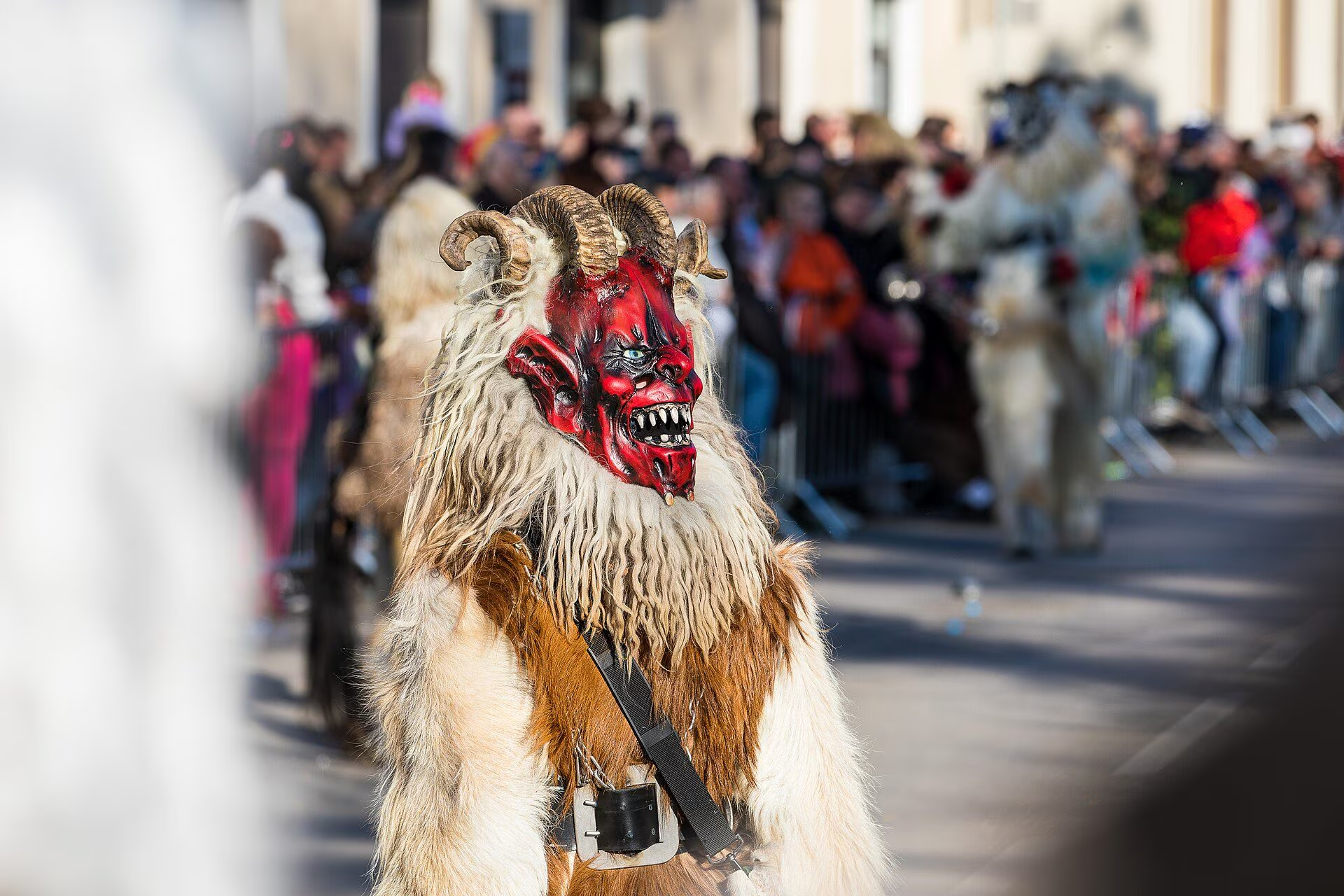
In Alpine Europe, the Krampus, a horned creature that accompanies Saint Nicholas in traditions widespread especially in Austria and neighboring regions, symbolically threatens or punishes children who have behaved badly.
In the Iberian peninsula and in many Latin American societies, however, the Coco, or Cuco, appears, a much less physically defined presence: something that comes to take the child and does not sleep or does not obey, a magical force. In British folklore, by contrast, we find the Bogeyman, while numerous traditions have creatures associated specifically with water, woods or night.
All these figures belong to that vast family of beings that the folklorist Marina Warner, in “No go the Bogeyman” (1989), analyzes as tools through which societies simultaneously describe fear, authority and transgression.
There is therefore no “universal monster” hidden behind all these creatures. On the contrary, their differences are anthropologically significant. Each monster incorporates elements of the environment, religion, family structures, and concerns of the society that chronicles it.
As Jeffrey Jerome Cohen argues in “Monster Theory” (1996), the body of the monster is always a cultural body: it is born in a specific historical moment and concentrates within itself fears and tensions that belong to that context.
Studying the monsters told to children therefore means indirectly observing the society that invented them. What shouldn’t a child do? Where shouldn’t it go? Whom to be wary of? The answers change, and the creatures change with them.