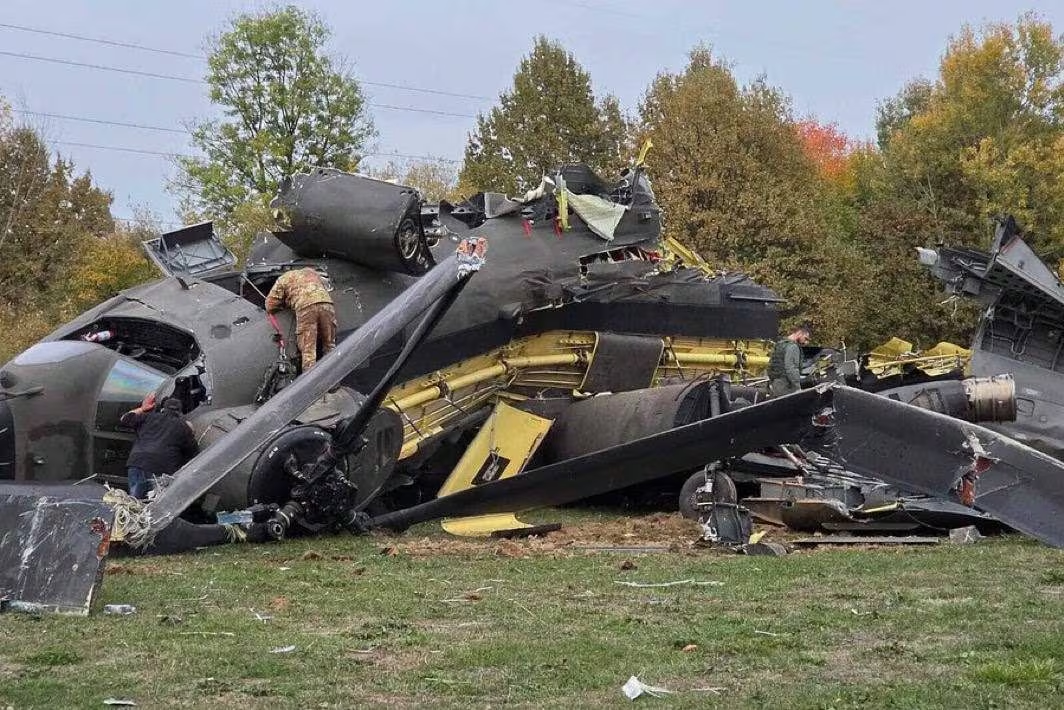
An Italian CH-47 Chinook military helicopter crashed in the north-east of Bosnia-Herzegovina, in the Brčko area, on the border with Serbia. As confirmed by the Ministry of Defense, there were a total of 15 people on board the aircraft. Four of them, unfortunately, lost their lives: they are Army Aviation sergeants Simone Ruggia and Claudio Marchesi, both serving in the first “Antares” regiment of the Viterbo Army Aviation Command, and two members of the Italian Red Cross Volunteer Military Corps, Lieutenant Franco Adriano Zecchillo and Sergeant Laura Procacci. The other 11 occupants were injured, but none of their lives were in danger.
The helicopter was used in the EUFOR Althea operation, the European Union military mission active in Bosnia-Herzegovina since 2 December 2004, which carries out stability support and training tasks for the Bosnian armed forces. More than a thousand soldiers from 24 countries are participating in the mission: among these, the Italian contingent is the largest (around 200 soldiers), and since the beginning of 2026 Italy has held command, entrusted to Major General Maurizio Fronda. The accident, according to initial reconstructions, occurred immediately after take-off from Brčko airport, during a routine exercise.
The causes of the accident and the complete dynamics have not yet been reconstructed: as clearly visible in the video above, the helicopter began to rotate repeatedly, apparently losing control before losing altitude and crashing to the ground.
What do we know about the possible dynamics of the accident in Bosnia
As mentioned, the dynamics of the accident have not yet been officially clarified, but various testimonies allow us to reconstruct, at least in part, what happened. The CH-47 Chinook helicopter left on the morning of 28 October from the base of the first “Antares” regiment of the Army Aviation in Viterbo and, after a stop at the military airport of Pratica di Mare (in the municipality of Pomezia, near Rome), reached Bosnia.
According to what was declared by the Italian ambassador to Bosnia-Herzegovina and confirmed by Foreign Minister Antonio Tajani, the accident occurred during take-off from Brčko airport, therefore in the very first moments of the flight. EUFOR confirmed that the aircraft was carrying out a routine exercise.
The videos released on the web show the helicopter which, shortly after take-off, begins to twist on itself in a downward movement while flying at low altitude. According to some eyewitnesses, the Chinook made several turns before hitting the ground. The impact with the ground was extremely violent: from the images released after the accident, the aircraft appears to have broken into three parts. From the videos and official communications, however, there are no explosions or fires.
According to some experts who analyzed the videos, the circumstance, together with the type of spin observed in the videos, suggests the hypothesis of a mechanical failure, which would have caused the aircraft to lose stability or direction control. More in detail, the behavior of the helicopter seems compatible with the blockage or an operating anomaly of one of the two rotors, which would have caused the uncontrolled rotation of the fuselage. Meanwhile, the possibility of the helicopter having hit high-voltage cables also emerged: it must be said, however, that these are hypotheses which have not yet been officially confirmed and which will have to be further investigated during the investigations.
The weather conditions, however, appear to have been good at the time of the accident, with few clouds, no rain and winds below 5 km/h.
The crashed Italian military helicopter: the Boeing CH-47 Chinook
From a technical point of view, the CH-47 Chinook is a medium transport helicopter, easily recognizable by its double rotor tandem configuration: this means that it has two large rotors (what in common jargon are often incorrectly called propellers) positioned one at the bow and one at the stern of the fuselage, rather than the classic main rotor plus tail rotor. As confirmed by the Italian Army, this design solution eliminates the need for an anti-torque rotor and allows the entire fuselage to be used as a cargo compartment, making it extremely versatile for the transport of men, vehicles and materials.
Designed and developed by the American Boeing, the Chinook is one of the longest-lived and most widespread military helicopters in the world: the first model entered service in 1962 and since then over 1,200 examples have been produced, used by the armed forces of dozens of countries, from the United States to Europe, from the Middle East to Asia.
The Italian Army has been using the Chinook since 1973, when it acquired the first CH-47Cs through construction under license by Helicopters Meridionali (later merged with Agusta, now Leonardo). The delivery of the new ICH-47Fs began in 2014 (Improved Cargo Helicopter), the most modern variant, developed jointly by Boeing and Leonardo (then AgustaWestland). In total, the Ministry of Defense has ordered 16 examples (with an option for another 4), for a value of approximately 900 million euros.
The cruising speed is between 260 and 290 km/h (depending on load conditions), with a maximum speed that can reach approximately 315 km/h, a value that makes it one of the fastest transport helicopters in the world. The operational autonomy, however, reaches up to approximately 600 km.
The standard crew, however, is made up of 2 pilots and 1 on-board technician, with the cargo cabin capable of accommodating up to 33 equipped soldiers or, alternatively, 24 stretchers for medical evacuation.