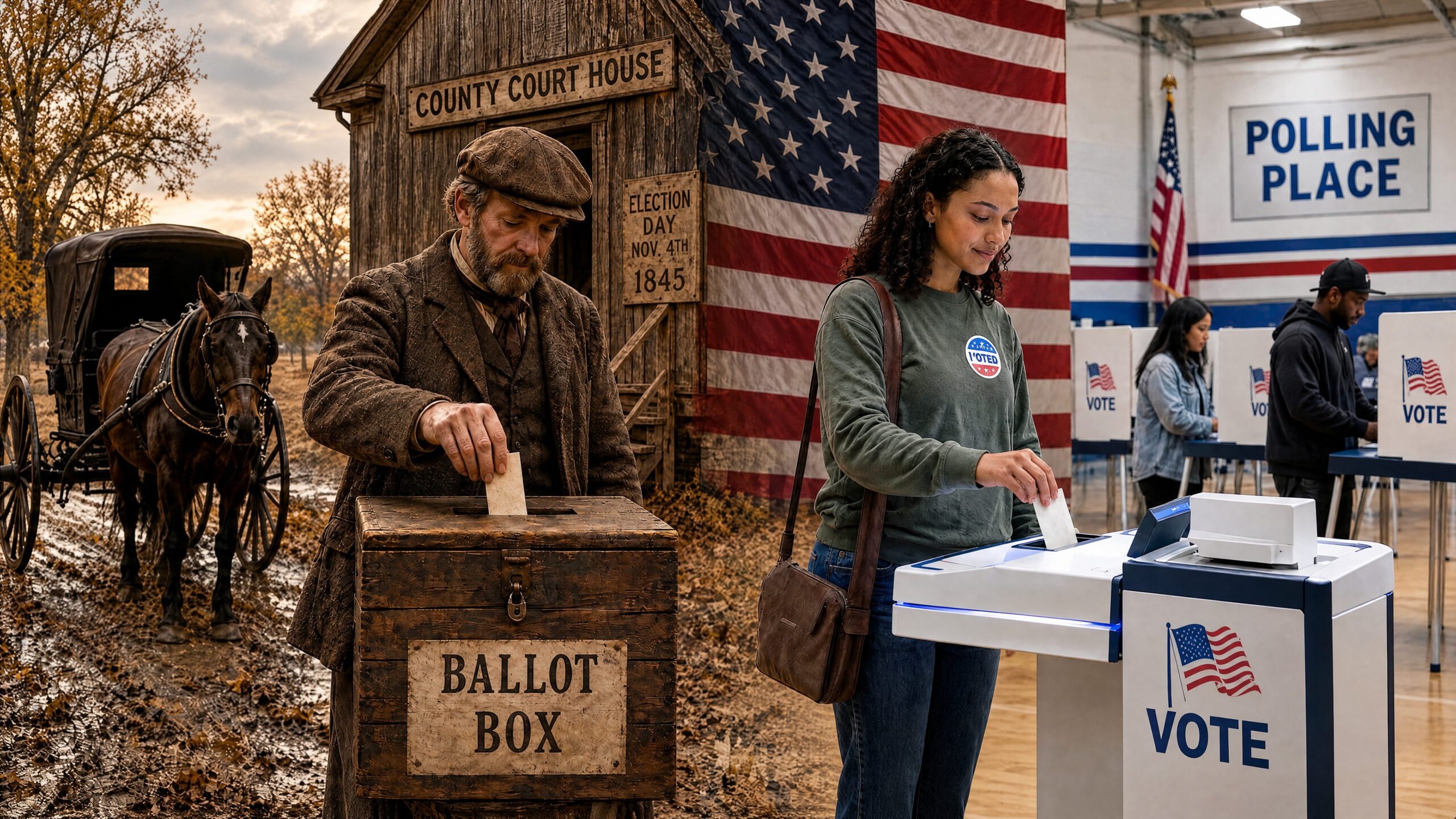
Today, Tuesday 3 November, Americans will go to the polls for the midterm elections (the “mid-term” elections), so called because they take place halfway through the four-year term of the President of the United States. In the United States they always fall on the first Tuesday after the first Monday in November, but where does this tradition come from?
For us Italians, who always vote on weekends, it may seem strange, but there is a very specific reason for this choice, which has been going on since 1845 as a result of a federal law tailor-made for the logistical and religious needs of nineteenth-century rural America.
The chaos before the 1845 law: the inconvenient 34-day window
Before the aforementioned federal law, voting meant chaos.
Already then people were voting in November, and the month had not been chosen by chance: the autumn harvests were over, and the farmers could breathe a sigh of relief after months of hard work. But not only that: although it was starting to get cold, the climate was still mild and the harsh winter that made the roads impassable due to fog and snow had not yet begun. That’s why November was the perfect month to vote.
Why was it chaos, then? The American Constitution left each individual state the right to decide when and how to vote, but it had to be done within a time window of approximately 34 days, so that voting for the election of the President of the United States was concluded by the first Wednesday of December.
The problem came with the spread of the railways and, above all, the telegraph, because the results of the first states also reached the others, and risked influencing the vote of those who would vote in the following days. To avoid influencing voters and prevent fraud, the government decided to approve a single federal date, which had initially been set only starting from the presidential elections of 1848 (the year in which it was applied for the first time), but which was also extended to the House (1872) and the Senate (1914).
The significance of Tuesday for elections
Getting to the polling stations wasn’t exactly a walk in the park at the time, and to reach your county seat and vote often required a day or a day and a half of travel by horse or buggy.
It was therefore necessary to choose a day of the week that was convenient for everyone. Sunday was excluded from the start, because many of the voters – male, white and landowners – were profoundly Christian, and reserved that day to rest, go to Mass and celebrate the Lord’s Day. Thus both Sunday and Saturday were excluded, which would have been dedicated entirely to the journey to arrive in the County. But Monday was also excluded, since no one would have traveled on Sunday.
Not even Wednesday could be chosen, however, because in several counties it was market day, and farmers sold their crops in the cities. The first available day, therefore, was Tuesday, and from then on the elections were set for the first Tuesday after the first Monday of November, to avoid election day falling on All Saints’ Day, which not only was a time of celebration and meditation, but for traders and banks it was the day of closing the balance sheets and accounts for the month of October.
Voting on Tuesday: is it an anachronistic choice?
Although Tuesday was chosen for convenience, voting on that day is now seen by many as an obstacle: after all, less than 2% of Americans today work in agriculture, and many people work on Tuesdays.
As observed by theOverseas Vote Foundationthis antediluvian system also has an impact on voter turnout: hourly workers or those with low incomes, in fact, have great difficulty obtaining permits, and cannot afford to lose hours of salary to queue interminably at the polls.
For these very reasons, some have proposed moving the election to the weekend, while others have suggested keeping Tuesday’s Election Day but making it a paid federal holiday, but so far no federal bill has made it past the Congressional vote.
To get around the rigidity of this ancient federal law, some states have strengthened alternative tools (provided for by local laws):
- Early voting in person (In-person early voting): Polls open weeks in advance, including weekends. There are only three states that do not provide it to all citizens, namely Alabama, Mississippi and New Hampshire. In these states, early voting is only permitted as absentee voting, or requires specific documented excuses.
- Voting by post (Mail-in ballot and absentee ballot): in the mail-in ballot each registered voter automatically receives the ballot at home by post, without the need to request it (the vote is then also perfected for citizens abroad via UOCAVA and platforms such as the aforementioned Overseas Vote Foundation), and the voter can return the ballot by ordinary mail, post it in special armored boxes in the area (ballot drop boxes) or in any case go to a polling station in person. There are eight states that adopt this system: California, Colorado, Hawaii, Nevada, Oregon, Utah, Vermont (for general elections) and Washington DC. In the case of the no-excuse absentee ballot (postal vote without justification, adopted in 28 states), however, the ballot does not arrive automatically: the voter must request it online or via form, but without providing a justification for obtaining it, as happens instead for the Excuse-Required Absentee, where it is necessary to certify a valid reason recognized by law of one’s State, such as a chronic disease, a serious and certified disability, or detention without loss of civil rights. This system is only adopted in 14 states (Texas, Indiana, Tennessee, Kentucky, South Carolina, Missouri, Louisiana, Arkansas, Connecticut, Delaware, Alabama, Mississippi, New Hampshire and West Virginia).