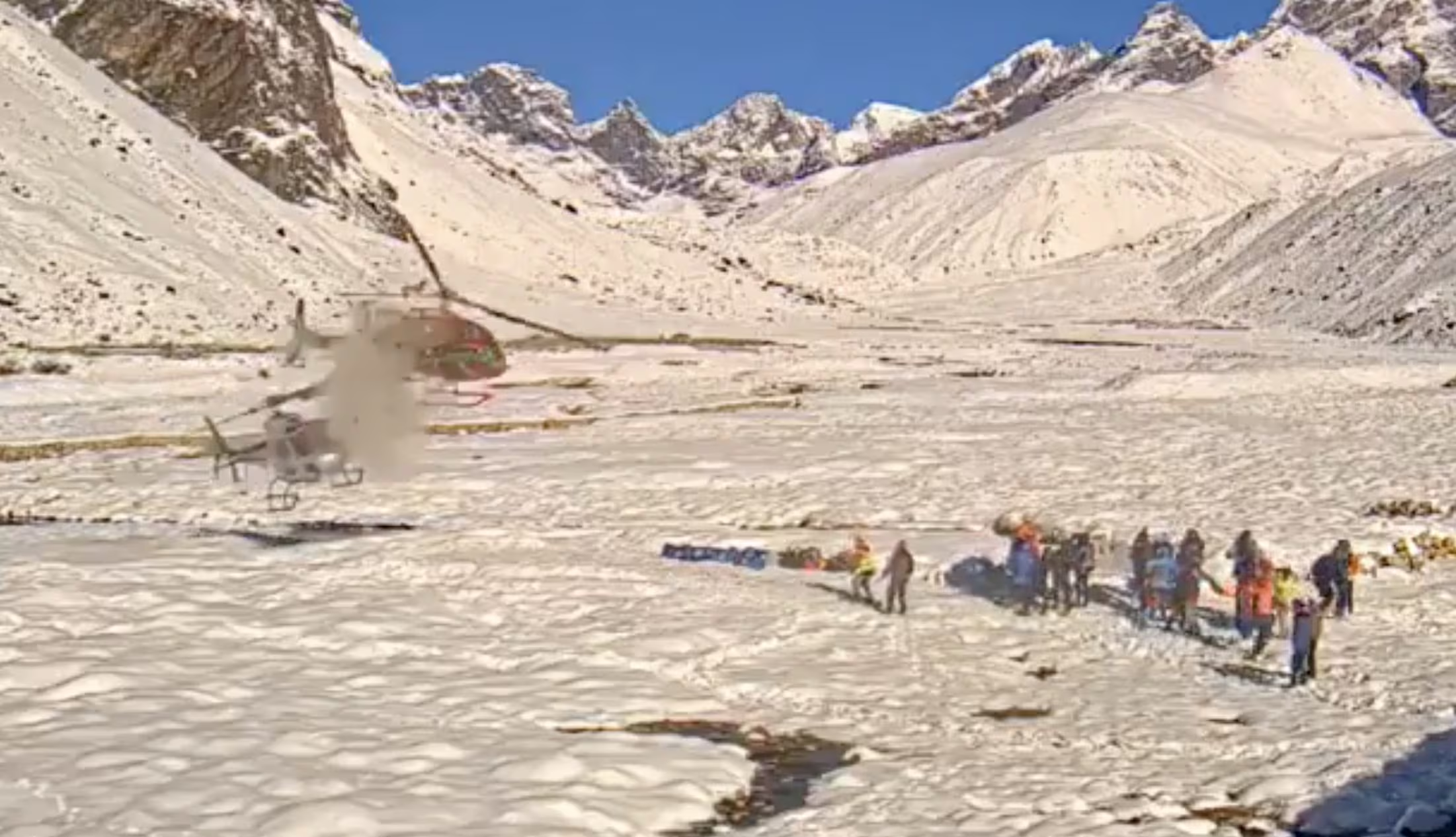
Today, 3 November 2026, two AS350 helicopters collided while landing at the Pheriche heliport, in the Everest region, at approximately 4,200 meters above sea level: one passenger died and three people were injured. The two aircraft belonged to the companies Fishtail Air and Air Dinasty: the causes are still to be ascertained, but the accident is an opportunity to understand why flying by helicopter in the high mountains, where the air is rarefied and there is normally no control tower to regulate traffic, is so difficult.
Article updated November 3, 2026. Information on the accident is still preliminary and may change as the investigation progresses.
What happened to the two helicopters that collided in Nepal
According to the Civil Aviation Authority of Nepal (CAAN), the collision occurred shortly after 08:00 (local time). The two helicopters were arriving at Pheriche from different directions: the Air Dynasty one from Lukla, without passengers, the Fishtail Air one from Gorakshep, with two foreign tourists on board. According to initial reconstructions, the rotors would have come into contact during landing; the scene was filmed by a weather webcam and by some witnesses. In the videos released online, available just above, the two helicopters are seen, low on the ground, approaching the pad from different directions.
The dead passenger, an Indian tourist, was on the Fishtail Air helicopter. The injured are the other passenger and the two pilots, who were evacuated by helicopter. The accident occurred in the middle of the autumn trekking season, one of the busiest periods in the area.
Because it is difficult to land at 4,200 meters on Everest, without a control tower
At 4,200 meters the air has about two-thirds the density it has at sea level. For a helicopter it is a double problem: the rotor must move more air to generate the same thrust, therefore it requires more power, while the engine, breathing rarefied air, produces less.
Furthermore, the power required is maximum when the helicopter is almost stationary in the air, i.e. right on approach and landing. The difference between the power that the engine can give and that needed to stay in flight is the pilot’s true margin of maneuver: it is what allows him to correct a gust, stop a descent or abort the landing. At altitude this margin is reduced on both sides.
For this reason, in Nepal the AS350 B3 is mainly used, a light single-engine aircraft with an Arriel turbine that is very powerful for its weight, electronically controlled (FADEC), and a three-bladed rotor made of composite material. It is certified to fly up to around 7,000 meters and in 2005, with test pilot Didier Delsalle, he was able to land on the summit of Everest, at 8,848 metres. Even for the helicopter best suited to the mountains, however, a landing at 4,200 meters remains a maneuver with little margin for error.
Where there is a control tower, it is the controller who authorizes trajectories and approach sequences and the separation between aircraft becomes a shared job between pilots and controllers. In a mountain heliport like Pheriche, as a rule, there is no tower. These flights take place visually, according to VFR rules: the pilots coordinate with each other via radio, communicating position and intentions, and the key principle is “see and avoid”, i.e. the responsibility of each crew to keep an eye on the other aircraft.
In the high mountains this system has obvious limits. The narrow valleys leave few possible approach trajectories, the slopes can hide every last helicopter and the pads are small, while the rotor of an AS350 measures almost 11 meters in diameter: when two helicopters operate on the same pad, the margins of space are greatly reduced. During the trekking season, traffic between Lukla, the villages and the base camp increases.
What investigators will check
Nepalese authorities have launched an investigation and have not yet indicated any causes. As in any investigation conducted according to the standards of ICAO, the UN agency for civil aviation, the investigators will first collect the facts and only then analyze them: the trajectories of the two helicopters, reconstructed also thanks to the videos, the radio communications, the coordination procedures between the operators, the wind, the wreckage. The ICAO manual for investigators (Doc 9756) dedicates a specific chapter to helicopters. An accident almost always arises from a chain of events and the method serves precisely to reconstruct it without being guided by first impressions.
The accident brings attention to the safety of helicopter flying in Nepal: according to a 2025 government report, in 63 years of operation the country has recorded 40 accidents and 92 victims. The causes, however, will be left to the investigation. Annex 13 of the Chicago Convention, which sets the international rules of investigations, is clear: the sole objective of an investigation is to prevent future incidents, not to assign blame or responsibility.
A risk to manage
In aviation, risk cannot be eliminated: it is managed. ICAO and EASA, which has dedicated a specific guide to helicopters, describe it with the model Threat and Error Management (TEM). Threats are conditions external to the crew that make flight more complex: in the mountains, for example, wind, thin air or another aircraft in the same valley; errors are actions or omissions by pilots that deviate from their intentions; if they are not intercepted, they can lead to an unwanted state of the aircraft, in which safety margins are reduced. It’s a funnel sequence: at each step the margins tighten, but up until the unwanted state the crew can still intervene and bring the flight back to safety. Beyond that, the accident remains.
Recognizing threats and intercepting errors before they become accidents is the job that every pilot does on every flight and understanding what happened to Pheriche serves to make it safer for everyone who takes off again tomorrow.