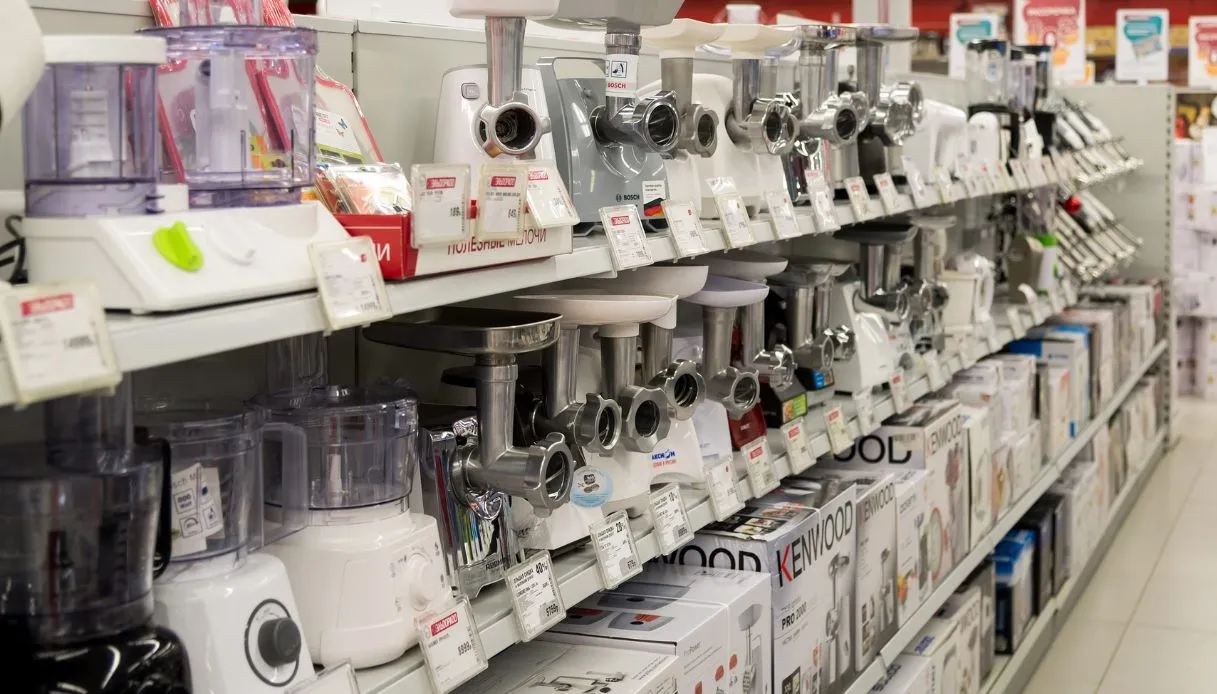
Families continue to buy washing machines, refrigerators, dishwashers and ovens, but more and more consumers are choosing products imported from Asia, especially China. Low prices are the main reason that is putting EU producers in crisis. According to what Electrolux explained to the unions and the Ministry of Business and Made in Italy, Asian competitors are constantly gaining market share thanks to a combination of lower production costs, public support and greater commercial aggressiveness.
Home appliances, sales numbers
From what emerges from a report prepared by GfK for Beko Europe, in 2025 household appliances imported from Asia reached 44% of sales in the European market, surpassing for the first time products made by European brands, which remained at 43%. Just a few years ago the situation was completely different. In 2019, European brands controlled over half of the market, with an advantage of almost twenty percentage points over their Asian competitors.
In 2026, market data from March shows that appliance sales volumes in Europe remain positive almost everywhere (with the exception of kitchen hoods). However, looking at the economic values of the market, widespread signs of weakness emerge, because more pieces are being sold, but at lower average prices, with increasingly reduced margins for European producers.
The only exception is represented by dryers, which recorded an increase of 4.7% also in terms of value. For the rest of the sector, however, competitive pressure is very high.
The industrial crisis
Competitive pressure is already having an impact on European industry. Electrolux has spoken openly of “unsustainable costs” to continue producing in Europe, fueling strong concerns in the territories where the production plants are located.
The crisis in the sector does not only affect the budgets of multinationals, but also employment. In recent months, union protests and institutional discussions have multiplied to try to safeguard jobs and industrial sites.
Beko Europe also announced an important redundancy plan, which was then partially scaled down thanks to the mediation of Mimit. However, the symbolic blow of the closure of the Siena plant was not avoided, which represents one of the most evident signs of the difficulties of the sector.
The problem, according to European producers, is that competition does not take place on equal terms. European companies are faced with significant increases in energy, raw material and logistics costs. A situation that makes it increasingly difficult to maintain competitive prices without sacrificing margins or reducing production.
The “hidden duties” that penalize Europe
Akin Garzanli, CEO of Beko Europe, spoke of a competitive distortion that penalizes European producers. According to the manager, companies that produce in Europe have to bear much higher costs to import raw materials and components, effectively suffering a sort of hidden duty.
Steel, energy and many raw materials used in the production of household appliances are in fact more expensive in Europe than in China. Furthermore, while finished products imported from Asia enter the European market without any particular tariff barriers, European producers face much higher industrial costs throughout the supply chain.
The situation has also worsened after the trade war started by the United States during the Trump presidency. The difficulties of exporting to the American market have in fact pushed many Chinese producers to strengthen their presence in Europe, increasing the pressure on European brands.