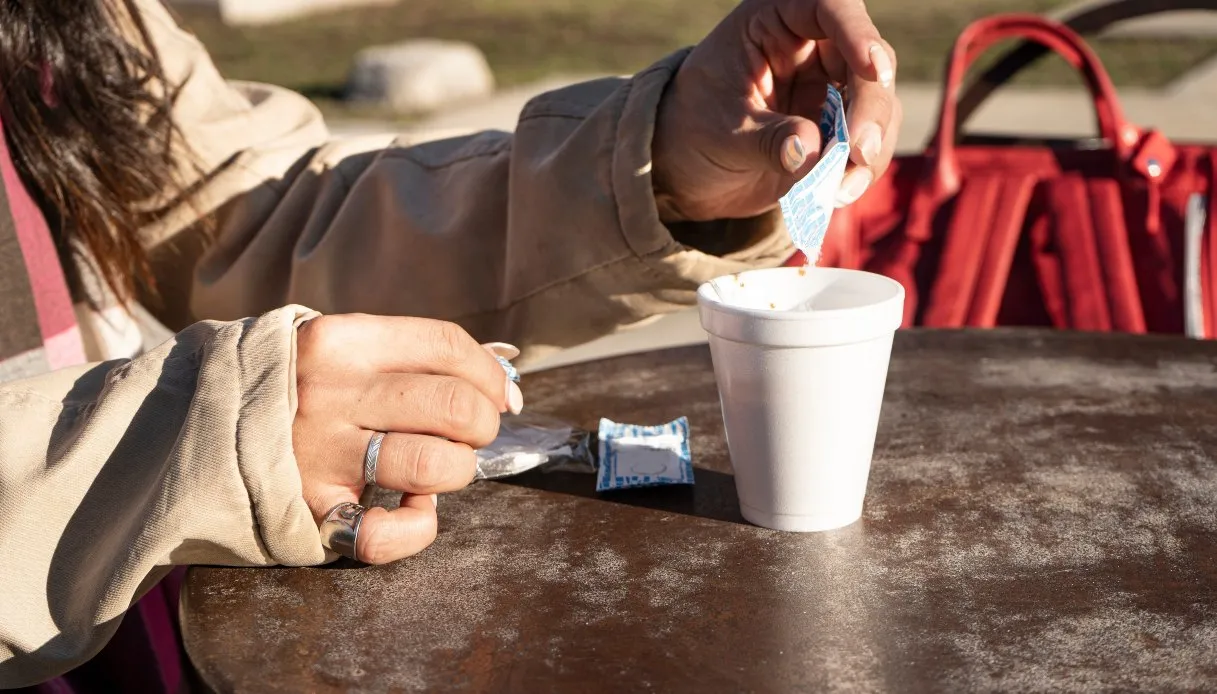
Will aspartame be banned in Europe? EFSA could make a long-awaited decision in September. In fact, a scientific opinion is awaited for the reevaluation of the aspartame-acesulfame salt (E 962), which also includes new studies on aspartame (E 951). Foodwatch, last February 2025, launched a petition to ask the European Union to ban aspartame: over 400 thousand signatures have already been collected.
There is therefore a certain pressure from below, but also a possible scientific breakthrough.
EFSA towards a ban on aspartame
Is EFSA about to ban aspartame? Not exactly. In reality the research concerns the safety of aspartame-acesulfame salt (E 962). The analysis will also bring data on aspartame E 951 under observation, which has already undergone a full evaluation in 2013.
What is aspartame
The best-known aspartame is the one labeled with the acronym E 951. It is a low-calorie artificial sweetener, used as a sweetener for various drinks and snacks.
In 2013, the Authority concluded that E 951 was not dangerous to health if it remained within the recommended exposure levels, i.e. within an acceptable daily dose of 40 mg per kilogram of body weight per day.
Where is it located
Aspartame is a widely used food additive and has been available on the market for over thirty years. It is used because of its low calorie content and the sweetness effect it is able to give. In fact, aspartame is about 200 times sweeter than sugar, and therefore very little is needed to sweeten foods.
Therefore aspartame is used as a sugar substitute for the production of foods with reduced energy value or without added sugar. It is labeled with the letter E and the number 951.
In particular, it can be found in:
- non-alcoholic drinks
- pastry and confectionery products
- low-calorie products
- chewing gum
- snacks and snacks
- carbonated drinks
- yogurt
- ice creams
- dairy products
What are the negative effects
Aspartame is considered “possibly carcinogenic” to humans. It is in fact included in group 2B, which means that for those who consume it in normal quantities it is not considered carcinogenic.
As Dr Edoardo Mocini explains, inclusion in group 2B means that there is limited evidence of the potential risk and that there is no solid evidence in humans.
In the same group there are many substances, mixtures, plants and more. Examples are aloe vera leaves, even some pickles and the cell phone you hold in your hand every day.
All substances within this group are not directly linked to cancer and do not necessarily make you ill, but are kept under observation.
Aspartame E-951 is considered safe by both the WHO and the European body within a daily limit. We already mentioned it: up to 40 milligrams per kilogram of body weight per day.
An example that Dr. Mocini gives is the following:
It means that a person weighing 70kg can consume up to 14 diet sodas per day without exceeding this threshold.
What happens in September
What will happen in September, therefore, is not directly a ban on aspartame in Europe. It will depend on the evaluation, but above all on the possible new elements that have emerged that might make it necessary to modify the previous security framework.
The European Commission, in response to the campaign promoted by Foodwatch, explained that it could adopt, if necessary, risk management measures based on the updated EFSA reassessment.
For now, therefore, aspartame, as we know it in confectionery products and beyond, is not at risk of being banned. However, September could become the month of discoveries capable of changing the safety assessment of aspartame.