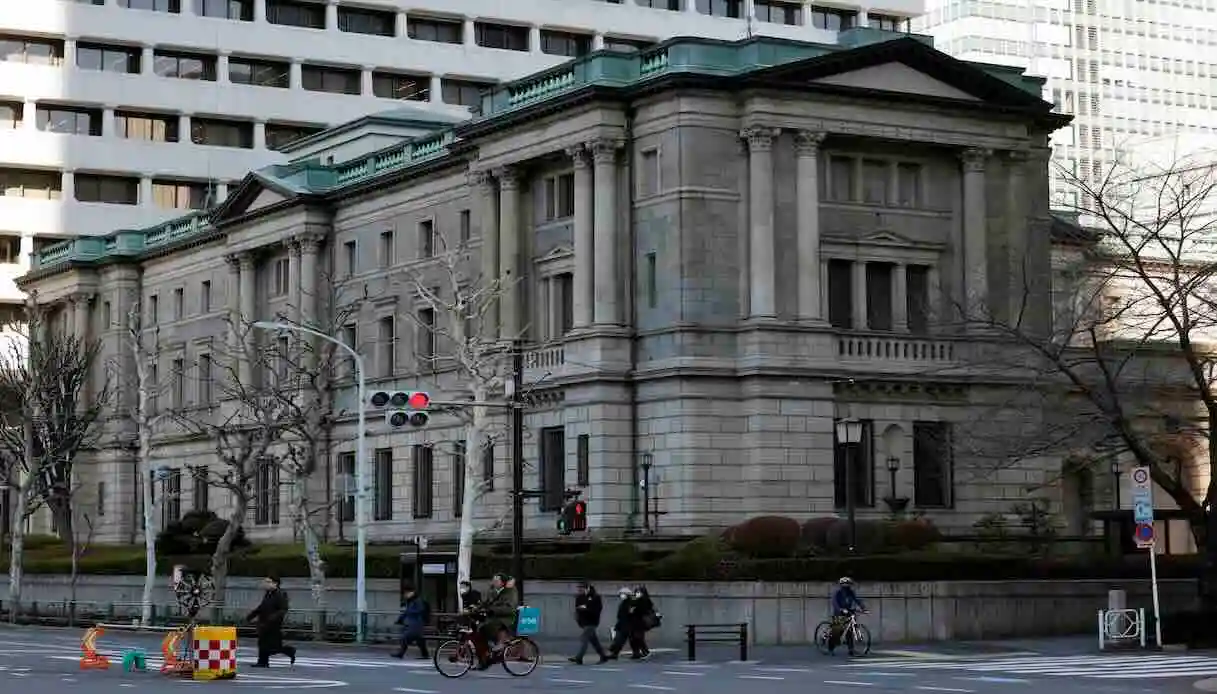
The Bank of Japan left its key interest rate unchanged at 0.75%, as per market expectations. However, the Monetary Policy Committee’s 6-3 vote represents the greatest divergence of opinion during Kazuo Ueda’s tenure, suggesting growing pressure to normalize monetary policy.
Furthermore, in the quarterly report on economic prospects, the central bank revised its forecasts for core inflation upwards, bringing it to 2.8% for the current fiscal year, against the +1.9% estimated last January. Economic growth forecast for the period is now 0.5%, revised downwards from the 1% previously estimated.
The vote
In today’s monetary policy meeting, the following voted in favor of maintaining the rate at 0.75%: Ueda Kazuo, Himino Ryozo, Uchida Shinichi, Koeda Junko, Masu Kazuyuki and Asada Toichiro. Voting against: Nakagawa Junko, Takata Hajime and Tamura Naoki.
Nakagawa Junko believed that while the situation in the Middle East remained uncertain given economic developments, risks to prices were tilted to the upside amid accommodative financial conditions. Takata Hajime considered that the price stability objective had been more or less achieved and that risks to prices in Japan were already tilted to the upside due to the second-level effects of price increases resulting from developments abroad. Tamura Naoki believed that, with price risks tilting significantly to the upside, the central bank should set the key interest rate as close to the neutral rate as possible. He proposed that the bank set the guideline for money market operations as follows: The bank would encourage the unsecured overnight interbank rate to remain around 1%. The proposals were rejected by a majority.
The outlook
The Bank of Japan believes Japan’s economic growth is likely to slow in fiscal 2026, as rising oil prices, reflecting the impact of the situation in the Middle East, are expected to reduce corporate profits and real household income through factors such as deteriorating terms of trade. However, the economy is expected to continue to grow moderately, albeit at a slowed pace, as it will likely be supported by factors such as various government measures and accommodative financial conditions, as well as developments such as maintaining high levels of profit in the corporate sector. Japan’s economic growth rate is likely to increase moderately starting from fiscal 2027, as the negative effects of high oil prices are expected to subside and the virtuous cycle between income and spending is expected to gradually intensify.
Inflation
The annual rate of increase in the consumer price index is likely to be between 2.5% and 3.0% in fiscal 2026, as rising oil prices are expected to push up prices, primarily of energy and goods, as strategies of passing on wage increases to sales prices continue. Thereafter, as the effects of high crude oil prices fade, the growth rate is expected to decline to a range of 2.0% to 2.5% in fiscal 2027 and to around 2% in fiscal 2028. Meanwhile, given the persistent perception of a strong labor shortage, the mechanism by which wages and prices increase moderately interacting with each other is expected to be maintained, and inflation expectations to medium-long term will increase. In this situation, underlying inflation (consumer price index) is expected to increase gradually, reaching a level generally consistent with the price stability objective between the second half of fiscal 2026 and fiscal 2027, and then remaining around that level.