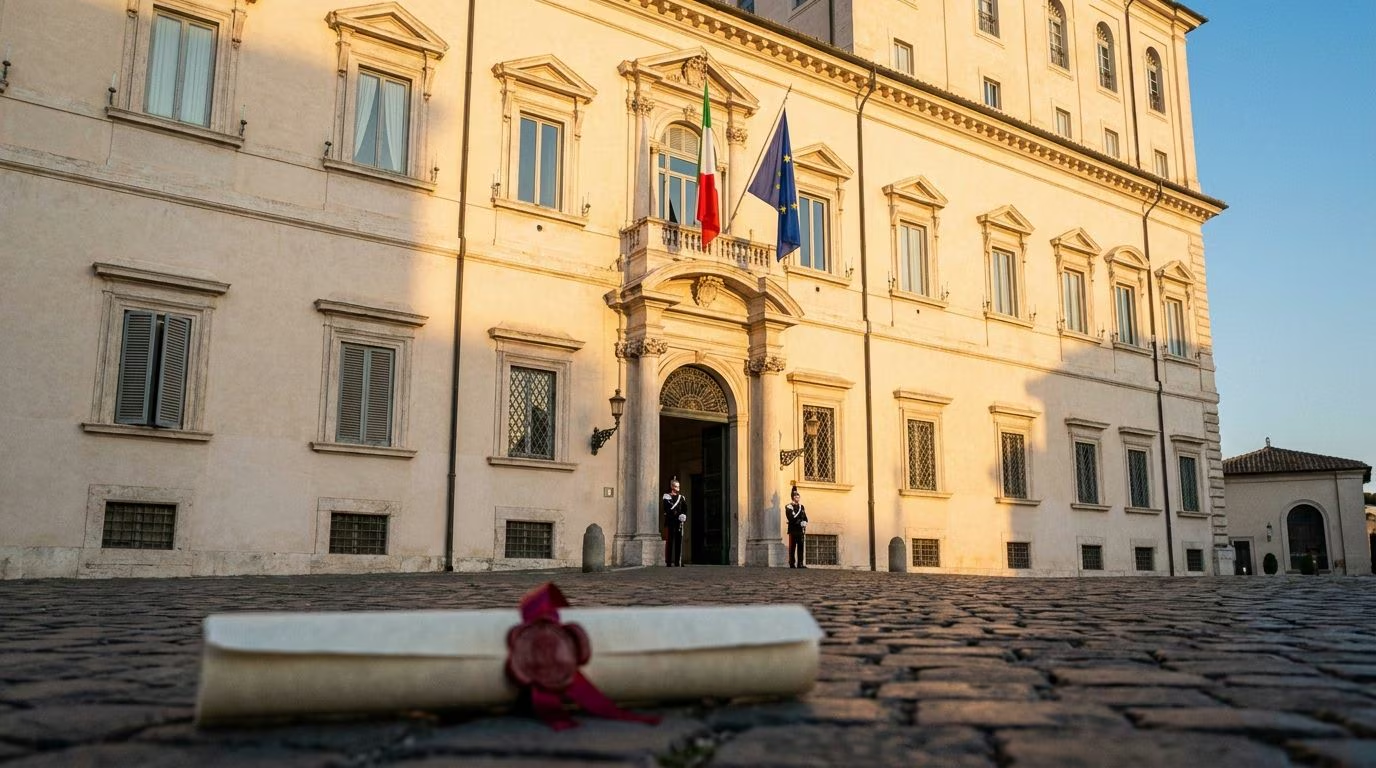
Every year hundreds of requests for pardon are also submitted to the President of the Republic, on which he is called upon to decide whether to grant it or not. This power is provided for by article 87 of the Constitution, in paragraph eleven, according to which the President of the Republic can, in fact, by decree “grant pardons and commute sentences”. It is an individual act of clemency, which concerns a specific person, convicted of a specific crime, who is “pardoned” with this extraordinary act: the conviction is not cancelled, but the sentence to be served is cancelled, or it is transformed.
In the 1970s and 1980s, a few hundred pardons were granted per year, while from the 1990s onwards the number decreased: according to data from the Ministry of Justice, during the 2000s many Presidents granted fewer than five pardons per mandate. There are hundreds of applications submitted every year, the majority of which are rejected or remain unanswered. Since taking office in the second mandate (29 January 2022), President Sergio Mattarella has adopted 36 individual clemency measures, including, recently, that last February relating to Nicole Minetti, whose sentences of 3 years and 11 months for aiding and abetting prostitution and embezzlement were cancelled, but on whom new investigations have been requested in recent days due to doubts relating to the documentation presented, it is necessary to evaluate the granting for humanitarian reasons. But can the pardon now granted be revoked or annulled?
What is a presidential pardon: art. 87 Constitution and 681 cpc
Pardon is an individual measure of clemency that extinguishes, in whole or in part, the sentence inflicted on a convicted person, or commutes it, i.e. transforms it, into a different and less serious type of sentence. It can concern both custodial sentences such as imprisonment and life imprisonment, pecuniary penalties (fines) and, in some cases, also accessory penalties such as disqualification from holding public offices.
It is an institutional act of mercy, provided for by article 87 of the Constitution, paragraph 11, and governed by art. 681 of the criminal procedure code, which is granted exclusively upon request: that is, it must be requested by the convicted person himself, by his family members, by his lawyer, by his guardian or curator, or, in some cases, by the judge who supervises the execution of the sentence. The request for pardon is addressed to the President of the Republic, and must be presented to the Minister of Justice.
It is important to specify that the pardon does not erase the crime, nor the conviction, it is not a retroactive acquittal. In fact, those who are pardoned do not become innocent: the sentence remains in the criminal record, the crime has always been committed, but the State, through its Head, decides not to allow the sentence to be served, or to have it only partially served.
How to obtain it: the procedure
The request for pardon must be submitted to the Ministry of Justice, which processes it through the Department of Penitentiary Administration (DAP) and the competent supervisory court. The convicted person’s case file, reports on his behavior in prison, the opinions of the management of the penitentiary institution, the opinion of the public prosecutor who followed the case and, in some cases, that of the victim or his family are collected. Traditionally, factors such as the health conditions of the convicted person are taken into account, especially when serious or terminal, age, demonstrated repentance, behavior during detention, the length of the sentence already served and reasons of a humanitarian or family nature. In some cases of international importance, diplomatic considerations also come into play.
The file processed by the Ministry is then sent to the Quirinale, where the President evaluates whether or not to grant the pardon, according to the art. 87 of the Constitution. There is no maximum deadline within which you must respond: times can be long, and many questions are simply archived without a formal response. For a long time it was discussed whether the President could act autonomously or whether the approval of the Minister of Justice was also necessary, through the “ministerial countersignature” provided for many presidential acts by article 89. The question remained open for years, until the Constitutional Court, with sentence no. 200 of 2006, did not state that the pardon is essentially a presidential act, of which the Head of State is the holder not only formally. This sentence arrived on May 18, 2006 following the conflict of powers raised by President Carlo Azeglio Ciampi against the Minister of Justice Roberto Castelli, who had refused to countersign the pardon of the American citizen Joseph Provenzano, convicted of murder.
In the legal ruling that the exercise of the power of pardon responds to essentially humanitarian purposes and serves “to temper the rigorism of the pure and simple application of the criminal law by encouraging the offender’s amendment and his reintegration into the social fabric”. The President of the Republic is therefore not bound to the potentially contrary opinion of the Minister of Justice and can grant pardon even against the will of the Keeper of the Seals, provided that the Minister nevertheless formally countersigns the decree. If the President of the Republic grants pardon, the competent public prosecutor takes care of its execution, ordering, if necessary, the release of the convicted person.
The individual clemency measures adopted by Italian Heads of State until 31 December 2025
- Luigi Einaudi (1948–1955): 15,578
- Giovanni Gronchi (1955–1962): 7,423
- Antonio Segni/Cesare Merzagora (1962–1964): 926
- Giuseppe Saragat (1964–1971): 2,925
- Giovanni Leone (1971–1978): 7,498
- Sandro Pertini (1978–1985): 6,095
- Francesco Cossiga (1985–1992): 1,395
- Oscar Luigi Scalfaro (1992–1999): 339
- Carlo Azelio Ciampi (1999–2006): 114
- Giorgio Napolitano I (2006–2015): 23
- Sergio Mattarella (2015–2022): 35
- Sergio Mattarella II (2022–present): 36 in December 2025
What are the cases in which the pardon is revoked or annulled
Generally, in pardon or sentence commutation decrees, the (resolution) condition of revocation of the act of clemency is included in the event of the commission of a non-negligent crime by the beneficiary within 5 years of the presidential decree (10 years in the case of a pardon concerning a life sentence). The revocation of the pardon, “conditional”, is ordered by the execution judge and in this case the pardoned sentence becomes executable again. So, theoretically yes, it is revocable, even if in Italian history it has rarely happened.
The most famous precedent for revocation is that of Graziano Mesina, the Sardinian bandit considered the head of the Anonymous kidnappings group. After the pardon received in 2004 from President Carlo Azeglio Ciampi, Mesina was sentenced in 2016 to thirty years for criminal association aimed at drug trafficking, and the pardon was revoked by Sergio Mattarella.
The general principle is that pardon, once granted, produces definitive effects on the execution of the sentence. However, the pardon decree may provide conditions or obligations for the pardoned person (for example, the obligation to reside in a certain place, not to frequent certain environments, to undergo medical treatment): if these conditions are violated, the pardon can be revoked. Likewise, if it were to emerge that the pardon was granted on the basis of false or hidden assumptions, a new ministerial proceeding could be opened aimed at evaluating the validity of the original decree, as is now happening with the Nicole Minetti case, to whom the pardon was granted in view of the adoption of a sick child (the main humanitarian reason on which the choice for clemency is based) on whose case there are doubts raised by an investigation by The Daily Fact.
To date, it has never happened that a pardon was revoked because the supporting documentation during the preliminary investigation phase was wrong or in some way not relevant to the truth, incomplete or misleading. For this reason, the Quirinale has asked the Ministry of Justice to urgently acquire further elements to verify the validity of what emerged. On 27 April 2026, a letter addressed to the Ministry of Justice was published on the website of the Presidency of the Republic, in which it was written:
«With reference to the decree granting clemency to Mrs. Minetti adopted by the President of the Republic, on the favorable proposal of the Minister of Justice, on 18 February 2026, and the consequent press reports regarding the supposed falsity of the elements represented in the request for clemency, on the indication of the Mr. President I ask you to kindly acquire the necessary information suitable to verify the validity of what is represented by a press organ.»
In this case, rather than “revocation”, we are talking about a possible “annulment” due to original defects in the act, i.e. linked to the lack or falsity of the assumptions on which the decision was based.