The intensification of clashes between the United States and Iran is fueling questions about a possible widening of the conflict. According to US officials quoted by Reutersthe operations conducted so far could represent “shaping operations”, that is, preparatory actions that create favorable conditions for subsequent and more massive military operations.
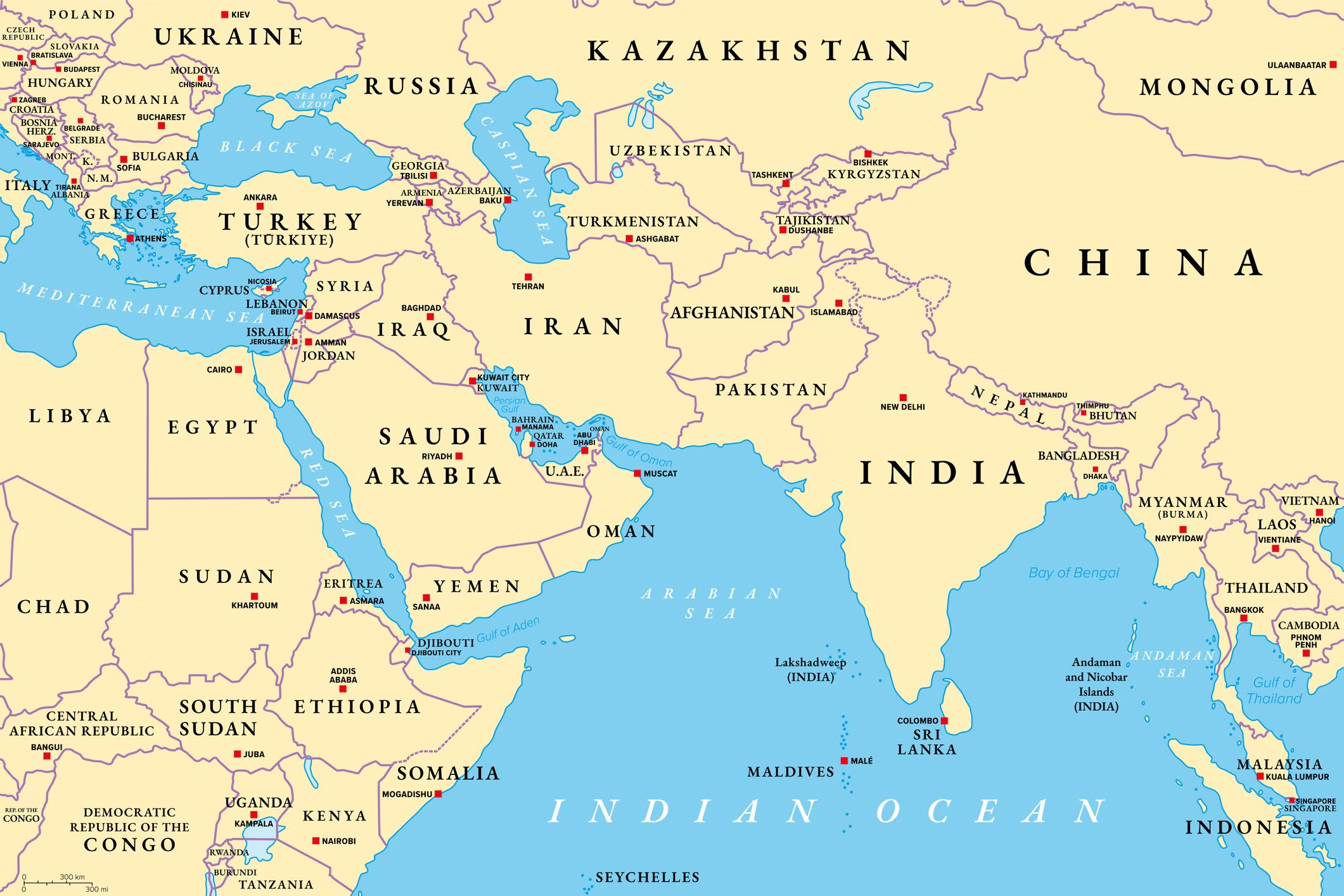
This does not mean that the decision to launch a land offensive or a large-scale operation has been made or confirmed, but it highlights how the conflict has entered a new phase, in which the hypothesis of a regional escalation appears very likely. The most relevant aspect does not concern so much the single military objective, but the geography of the Middle East: a region in which military bases, energy infrastructures and straits with strategic sea routes are concentrated in a few hundred kilometres, making any escalation potentially capable of producing effects that go well beyond the borders of the area.
The Persian Gulf as a key point of escalation: the scenarios
If the conflict were to escalate further, the first theater affected would most likely be the Persian Gulf. Here, in fact, the United States maintains one of the largest concentrations of military bases outside its territory: the US Navy’s Fifth Fleet is based in Manama, Bahrain, and is responsible for naval operations in the Persian Gulf, the Red Sea, the Gulf of Oman and part of the Indian Ocean.
Just to the south, Al Udeid Air Base, Qatar, is home to thousands of U.S. military personnel and is the primary operations center for U.S. Central Command (CENTCOM) in the region. Added to these are Camp Arifjan and Ali Al Salem in Kuwait, the Jebel Ali naval base in the United Arab Emirates and numerous smaller installations. This distribution means that a possible Iranian response could hit US targets without having to reach American territory, increasing the risk of a rapid expansion of the conflict.
In this context, a possible escalation between the two countries would not necessarily imply a land invasion. Many analysts believe an increase in operations against strategic targets, including radar installations, coastal missile batteries, naval infrastructure or logistics hubs, is more plausible.
Among the hypotheses that have circulated in recent days there is also that of limited land operations against strategic islands in the Gulf, such as Kharg island, which are however considered highly risky scenarios and not officially confirmed. Kharg is about 25 km from the Iranian coast and hosts the country’s main oil terminal: before the increase in international sanctions on Iran, over 90% of Iranian crude oil exports passed through this island and it still represents the main logistical hub for oil exports today.
The Strait of Hormuz: Why a local conflict could have global effects
The main element of concern, however, remains the Strait of Hormuz, the maritime corridor that connects the Persian Gulf with the Gulf of Oman and the Indian Ocean. The Strait of Hormuz represents one of the main energy chokepoints on the planet. According to the US Energy Information Administration, on average about 20 million barrels of oil pass through it per day, equal to about a fifth of the world’s trade in liquid oil. Around 20% of global trade in liquefied natural gas (LNG) also passes through the same maritime corridor, coming mainly from Qatar.
In the last few hours, following the intensification of US attacks, the semi-official Iranian news agency Fars declared that the Strait will remain closed as long as the attacks continue. But even without a complete closure of the Strait, an increased risk to shipping (due to attacks on commercial vessels, naval mines or drones) would be enough to reduce maritime traffic, increase insurance premiums and impact energy prices. Reuters has already documented a significant decrease in the number of oil tankers in transit in recent days, a sign of how even a limited crisis can produce immediate effects on international trade.
A conflict that could spread beyond the Persian Gulf
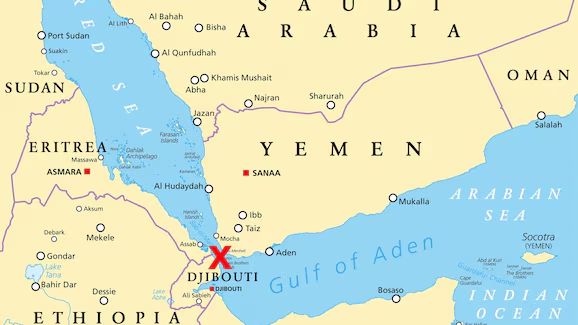
The other element that makes this crisis particularly complex is the network of alliances and armed groups that gravitate around Iran: a possible intensification of US operations could trigger indirect responses through pro-Iranian militias active in Iraq and Syria, but also Hezbollah in Lebanon or the Houthis in Yemen. Since November 2023, in fact, the Houthis have launched dozens of ballistic missiles, drones and anti-ship missiles against commercial vessels in the Red Sea and the Gulf of Aden, declaring they intend to strike ships believed to be linked to Israel or its allies. The attacks forced numerous shipping companies, including Maersk, MSC and Hapag-Lloyd, to divert routes around the Cape of Good Hope, increasing journey times by around 10-15 days.
In this case, therefore, the theater of operations would expand well beyond the Persian Gulf, also involving the Red Sea and the Strait of Bab el-Mandeb, another of the main passage points for international maritime trade. The news of the last few days already shows signs of a geographical expansion of hostilities and a growing involvement of neighboring states, increasing the risk of a regional war.
What is the most likely scenario?
From a military point of view, a real invasion of Iranian territory by land is generally considered a more remote hypothesis, although not impossible. The size of the country, the shape of the territory and the response capacity of the Iranian armed forces would make such an operation extremely expensive and difficult to sustain: Iran is a state with a surface area of approximately 1.65 million km², a population of over 90 million inhabitants and a territory characterized by vast mountainous and desert areas that would make any prolonged land campaign extremely complex.
A scenario characterized by a progressive increase in military pressure through targeted attacks, naval operations, actions against strategic infrastructures and attempts to limit Iran’s ability to control the sea routes of the Gulf appears more realistic.
For its part, Iran today has an arsenal of ballistic missiles and drones with a range sufficient to reach the main American installations in Iraq, Syria and the Gulf countries, making this one of the most plausible response scenarios in the event of further escalation. It could also follow a strategy already tested in recent years, leveraging the so-called Axis of Resistance, i.e. the set of allied armed groups active in Lebanon, Iraq, Syria and Yemen, as well as increasing pressure on the maritime routes of the Persian Gulf and the Red Sea.
Geography certainly continues to be one of the main factors determining the evolution of the crisis: in fact, some of the most important energy infrastructures on the planet, military bases belonging to various powers and one of the main “bottlenecks” of world trade are concentrated in the Persian Gulf. For this reason, a possible escalation between the United States and Iran would not have consequences limited only to the two countries involved. The real question, therefore, is not just whether the conflict will continue to widen, but to what extent the geography of the region will affect the possible effects of the widening conflict.