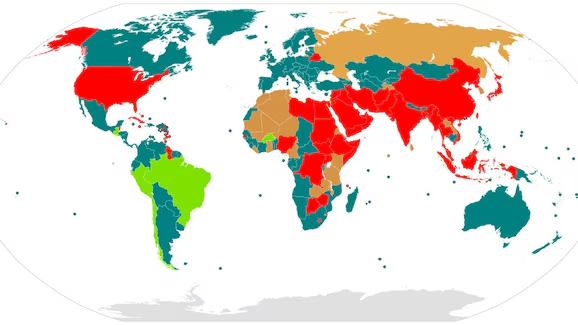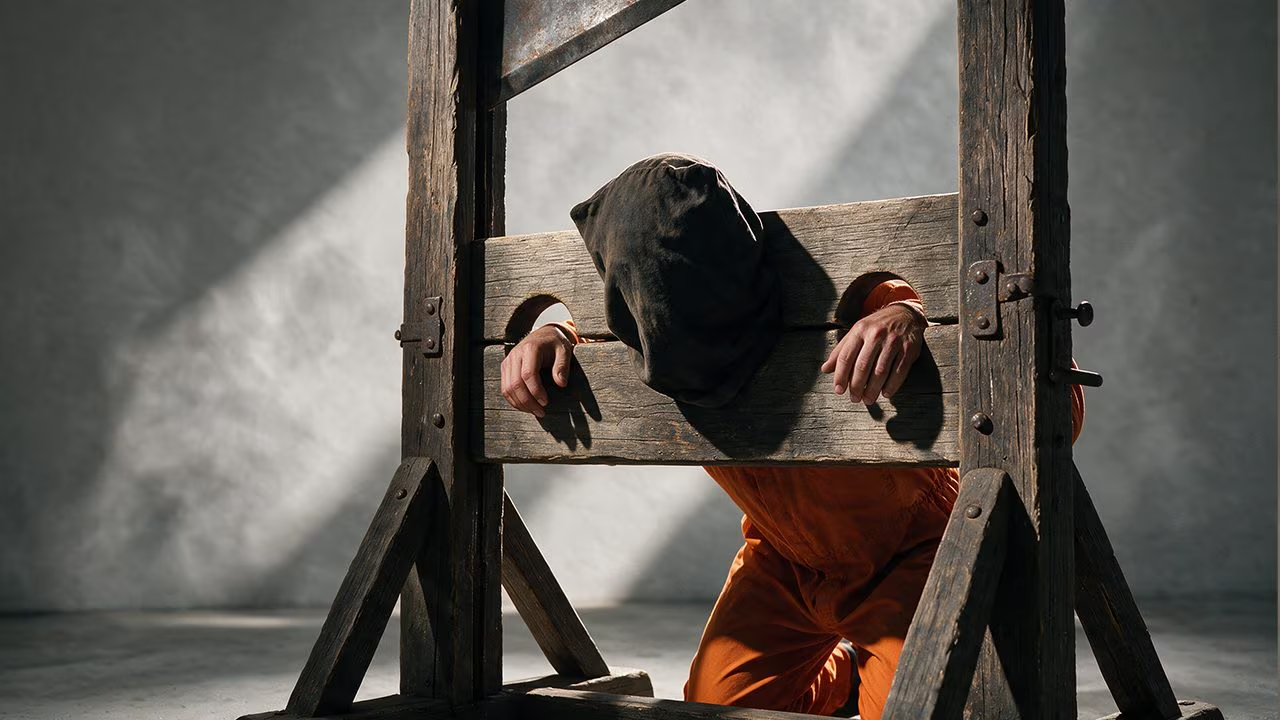
The death penalty has practically always existed. It was widely used throughout ancient civilizations, which often used cruel methods to execute the condemned. Even in the centuries of the Middle Ages and the modern age, almost no one questioned the legitimacy of capital punishment, which was inflicted for numerous crimes. Only during the Enlightenment did a current of thought against the death penalty develop, also thanks to the famous Of crimes and punishmentspublished in 1764 by Cesare Beccaria. In the nineteenth century the punishment was still foreseen in almost all states, but in the following century the number of abolitionist countries progressively grew. Today the penalty is applied in 52 states.
In Italy, the death penalty, abolished for the first time in the nineteenth century but reinstated by fascism, was definitively abolished with the entry into force of the Constitution. In the military code, however, the death penalty was eliminated only in 1994 (despite having no longer been applied since the end of the Second World War).
Why does the death penalty exist in some countries and for which crimes is it inflicted
The death penalty, as we know, is a criminal sanction consisting in killing a convicted person. Being inflicted by courts, it is considered a “legal” killing, although the boundary between “legitimate” execution and murder is not always clear (think, for example, of cases in which the punishment is inflicted by authorities and institutions of dubious legitimacy).
In the states where it is in force, capital punishment is justified by various reasons. According to its supporters, it is a deterrent capable of reducing crimes and protecting society, because it eliminates those who commit crimes and discourages other potential criminals. However, the data shows that this motivation is unfounded, because in countries where the death penalty is in force the number of crimes is no lower than in other states.
In reality, capital punishment is inflicted above all as a form of revenge, to punish those who have harmed another person or the community. It is no coincidence that in some societies it is up to the relatives of the victims to inflict the punishment or participate in the judgment (today, however, this custom is much less widespread than in the past).
The death penalty can be imposed for numerous crimes. Generally it is foreseen for murder (aggravated or simple depending on the case), for crimes related to terrorism, sometimes also for drug trafficking, espionage in favor of enemy countries, in some cases even for homosexuality and apostasy. The systems for killing convicts today are generally less cruel than in the past. The most common include lethal injection, hanging, decapitation and shooting.
The Hammurabi Code of 1700 BC: From the Ancient World to the Modern Age
The death penalty has existed since the dawn of time. Already the code of Hammurabi, which dates back to 1700 BC and is the oldest known collection of laws, provided for capital punishment for numerous crimes: murder, espionage, theft, sacrilege and others. In subsequent centuries, the death penalty was widely used in Greek and Roman civilizations, where it was imposed for crimes such as treason, murder, sacrilege, and many others, based on the idea that it was a legitimate tool for maintaining social and political order. Punishment was carried out with deliberately brutal methods, which served to inflict pain and humiliation on the condemned. Among the systems in use there were being torn to pieces by wild animals, quartering, burning, impaling, and crushing with horses or elephants. Crucifixion was widespread in Rome, widely used, among other things, after the repression of the slave revolt led by Spartacus in the 1st century BC. C., as well as, as we all know, to punish Jesus.
In the centuries of the Middle Ages and the modern age, the application of capital punishment became even more frequent. Since the political systems were very fragmented, the punishment was inflicted by a plurality of authorities: not only the States, but also the great feudal lords or ecclesiastical institutions. The methods varied. Among the most widespread were hanging and beheading.
The slow path towards abolition
Until the modern age, the death penalty was foreseen almost throughout the world and there was no current of thought against its use, with the exception of a few theologians and intellectuals. Only in the eighteenth century, at the time of the Enlightenment, did a debate begin on the usefulness of torture. The main study against the punishment was the famous one Of crimes and punishmentspublished in 1764 by Cesare Beccaria, according to which the death penalty was both inhumane and useless in reducing crime.
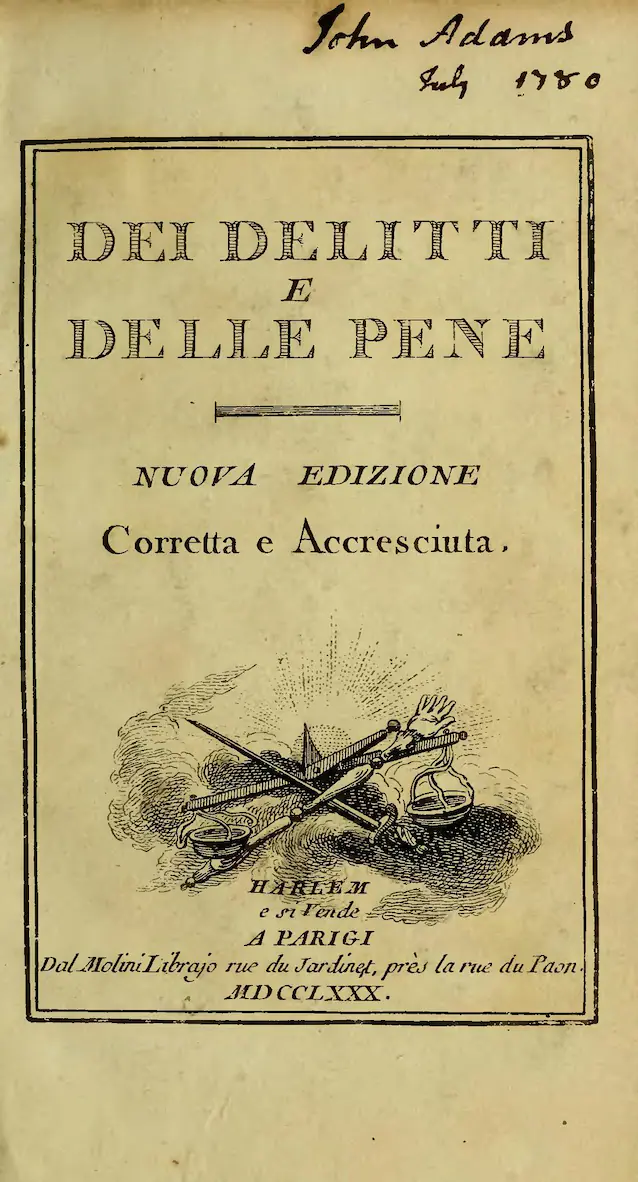
At the time, Beccaria’s ideas found little application. One of the very few states to abolish capital punishment in the eighteenth century was the Grand Duchy of Tuscany, which banned it in 1786.
The vast majority of states, however, regularly applied capital punishment, foreseen for numerous crimes. During the French Revolution, punishment was widely used by all the governments that followed one another in power and, as we know, an instrument was invented that was destined to become a symbol of revolutionary France: the guillotine
As the years passed, the ideas of Beccaria and the other abolitionists slowly gained ground. Some states abolished the death penalty during the nineteenth century, although these were exceptions: in most countries the penalty was foreseen and regularly applied.
In Italy it was abolished in 1889 by the Zanardelli Code
In Italy the punishment was abolished in 1889 by the Zanardelli Code for all crimes, with the exception of those provided for by the military code. Not surprisingly, the punishment was used extensively by the armed forces, without regular trials, during the First World War. Subsequently, capital punishment was reinstated in 1930 by the fascist dictatorship. During the years of the regime, more than one hundred sentences were carried out, partly for political crimes, partly for common crimes. The penalty was applied even after the fall of the regime. The last execution was decreed for a common crime, the Villarbasse massacre, a robbery that caused the death of ten people. Three of the guilty were shot in Turin in March 1947. The following year, the entry into force of the Constitution abolished capital punishment for all crimes. In the military code, the punishment was officially abolished in 1994 (but had not been applied since the end of the Second World War).
The progressive decrease in the number of countries that apply the death penalty
Starting from the second half of the twentieth century, the number of countries that have abolished capital punishment has progressively increased, although the trend in the number of executions is less linear.
In Europe the death penalty has been abolished almost everywhere. Among the last countries to do so were France, which continued to carry out sentences, by firing squad or guillotine, until 1977; and Spain, which carried out its last sentences in 1975, when Franco’s dictatorship was still in power. Today the only European country that applies capital punishment is Belarus.
The death penalty is provided for in the laws of 52 countries. Some abolitionist states, however, sometimes carry out extrajudicial executions, that is, carried out without due process by the police forces, the secret services, the armed forces or even by specially hired common criminals.