ISTAT data show a new acceleration in inflation: in October 2026 food prices increased compared to the same month in 2025 and the so-called shopping cart began to grow more rapidly again. Currently, a kilo of bread costs on average more than 5 euros in Padua and just over 3 euros in Florence. And the differences do not only concern bread: between cities but also between different supermarkets and types of shops, there are many products with significantly different prices, especially among fruit and vegetables. The final amount on the receipt therefore depends both on the general increase in prices and on the place where we shop.
Food inflation accelerates again: what the ISTAT data say
According to definitive data released by ISTAT, in October 2026 the national consumer price index increased by 1% compared to September and by 5.5% compared to October 2025.
Food prices also accelerated: food recorded an increase of 2.6%, compared to 1.7% in September. The difference is above all in the component of unprocessed products, such as fruit, vegetables and other fresh foods: in October they increased by 7.5% compared to the same month of the previous year, after +5.5% in September. For processed foods, however, the annual variation remains negative: -0.5%, after -0.6% in the previous month.
Overall, the so-called shopping cart, which includes food and home and personal care goods, went from an annual increase of 1.5% in September to one of 2.3% in October. The data indicates that price pressure is intensifying again, but it does not mean that all foods are increasing at the same rate. Categories and individual products can in fact follow different trends.
Bread exceeds 5 euros per kilo: where does it cost more
Bread is one of the most common foods on Italian tables, but its price can change a lot depending on the city and the point of sale. This is shown by the latest survey by Altroconsumo, which in October 2026 collected 933 prices in 161 points of sale in ten Italian cities, including supermarkets and traditional bakeries.
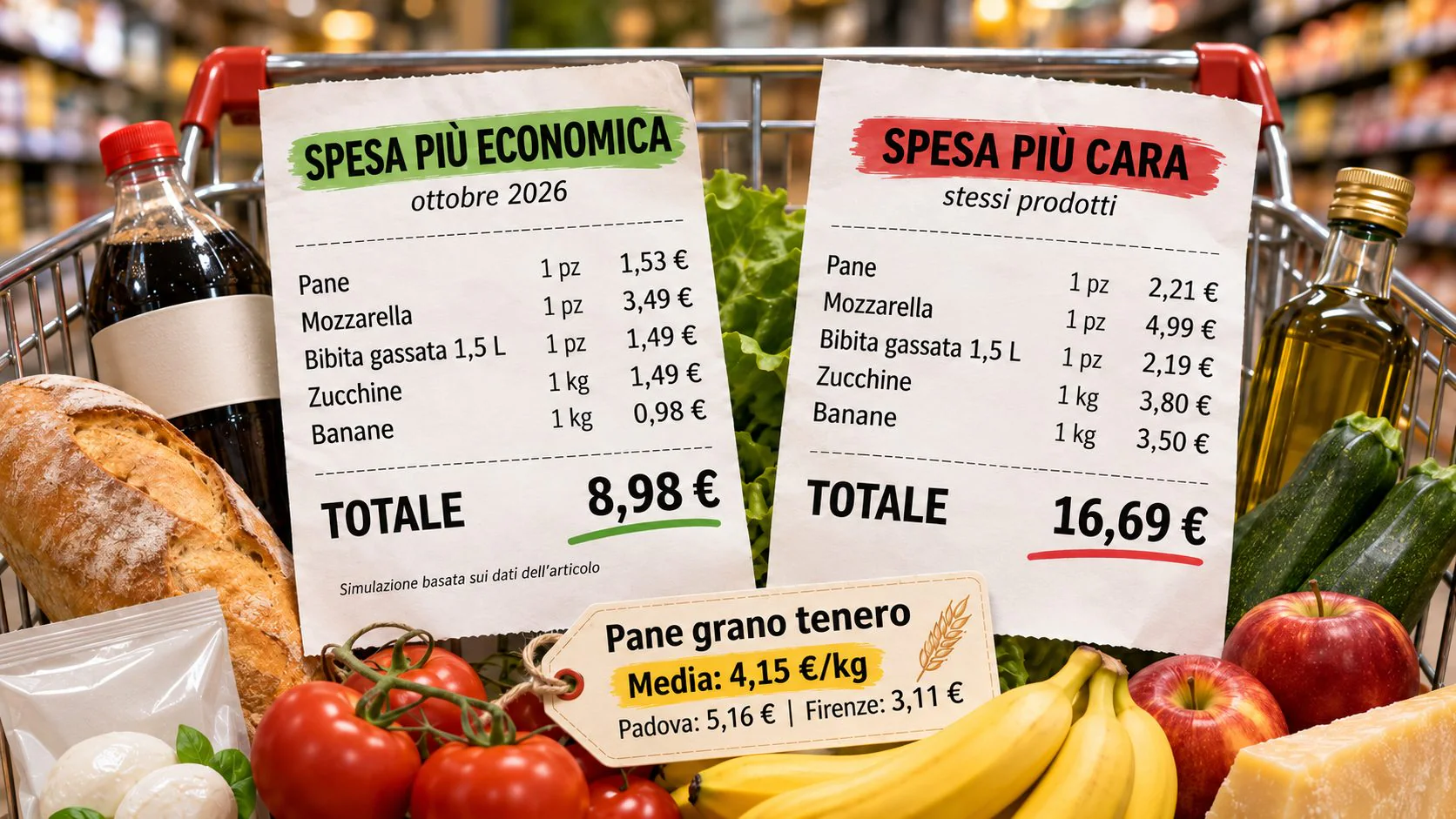
The product taken into consideration for the comparison is soft wheat bread, the cheapest type among those analysed, with an average of 4.15 euros per kilo.
Padua is the city where the average cost per kilo is highest (5.16 euros), while the cheapest bread is found in Florence, where you spend on average 3.11 euros per kilo. Between Padua and Florence the difference therefore exceeds 2 euros per kilo: bread costs 66% more in the Venetian city than in the Tuscan one.
In fact, to establish the cost of bread, there are many variables at play: from the cost of wheat, to the transformation of wheat into flour, the processing of the dough, cooking, packaging and distribution. Added to these are the costs of the energy used by the ovens, staff, rent for the premises and transport costs.
The size of the business and the type of distribution can also influence the final price. A neighborhood bakery incurs costs and has different production methods than a supermarket that purchases large quantities and can benefit from economies of scale. For example, according to Altroconsumo, soft wheat bread costs on average 3.61 euros per kilo in large-scale retail trade and 4.70 euros in bakeries. The difference is 28%. In Turin the gap reaches 74%, while in Bari the ratio is reversed and bakeries are on average cheaper than supermarkets.
The Altroconsumo comparison then shows that prices do not always move in the same direction. Compared to 2023, the average price of soft wheat bread in the nine cities present in both surveys decreased by 3.2%. In five out of nine cities, however, it increased. If we look at 2017, the average price went from 3.15 to 4.15 euros per kilo: an increase of around 32%.
How much does the price change from one supermarket to another and which ones are the cheapest?
The Spenda Price Observatory for October 2026 analyzed more than 2 thousand receipts voluntarily uploaded by users, for a total of more than almost 20 thousand distinct products, 1,128 points of sale and 196 signs.
The survey results show that the differences do not only concern cities or the type of product offered. Even if you choose the exact same brand product, the price can change depending on the brand. For example, Pane Grande Impero was found on sale at €1.53 at DEM and at €2.21 at Ipercarni: 44% more for the same product.
Among the other branded products compared for which significant price differences emerge are Vallelata mozzarella, found at 3.49 euros at Rossetto and 4.99 euros in some Coop stores, and 1.5 liter Coca-Cola, which in the sample varies from 1.49 to 2.19 euros.
The differences are even more evident for some types of fruit and vegetables as the sample includes both discount stores and greengrocers and organic shops. For courgettes, for example, the readings range from 1.49 to 3.80 euros per kilo; for bananas, from 0.98 to 3.50 euros/kg.
These numbers do not constitute a national ranking of the cheapest supermarkets. They are prices actually paid and reported in the receipts collected by Spenda: they can therefore include promotions, discounts linked to loyalty cards and differences between points of sale. Furthermore, Spenda’s October sample is mainly concentrated in Northern Italy and is therefore not representative of the entire country.
However, an interesting fact concerns the comparison between discounters and supermarkets. In the October sample, out of 72 products present by both Eurospin and Lidl, the prices are almost aligned: Eurospin is cheaper in 36 cases, Lidl in 30, while in six cases the prices are the same. The median difference is less than 1%.
The picture changes when comparing different signs. Out of the 65 products present at both Esselunga and Lidl, for example, Lidl is cheaper in 47 cases and the median difference is 29%. But this result should also be read with caution: it only concerns the comparable products in the sample, not the entire shopping cart.