There is a risk of a double increase in interest rates. This is according to a Bloomberg survey, conducted between 4 and 7 May 2026. Those who responded are convinced that the increases will take place between June and September, in line with the prospects of the market in crisis in 2026. The reason will be inflation, fueled precisely by the war against Iran.
So far, ECB officials have been rather cautious and have refrained not only from making the hikes, but also from commenting on them in a concerned manner. In the meantime, however, inflation, which according to analysts is managing to resist in Europe, is expected to accelerate this year to 2.9%, therefore well above the 2% target set by the European Central Bank.
What the ECB will do: the prediction
In a survey by Bloomberg the hypothesis emerges of an increase in interest rates due to inflation fueled by the war against Iran. There would be two meetings that would confirm the increases of a quarter of a point.
The first could happen as early as the June meeting, while the second in the September one. By the end of this year, therefore, the direction of ECB officials could reverse.
After so much caution to avoid increases due to the economic damage caused by the immediate conflict, it may become necessary to intervene on monetary policy.
Executive board member Isabel Schnabel had already stated last week that:
Monetary policy will have to be tightened if the energy shock worsens.
Rise also in 2027
The survey does not only talk about 2026, which however sees the issue of the opening of the Strait of Hormuz as one of the points to be discussed in the June meetings; we are already looking to 2027, the long wake of the crisis, even if the war were to end today.
In fact, the survey suggests that a cut could only arrive next March, in response to the worsening economic outlook.
In this regard, analysts have revised their growth forecasts for 2026 downwards, bringing it to 0.8% and forecasting a Eurozone expansion reduced to 1.3% in 2027 and 1.5% in 2028.
Inflation increases
We know that the mechanism is based on inflation and on looking at it; the European Central Bank’s objective is to keep it at 2%. At the moment, however, it continues to accelerate.
With the continuation of the energy crisis and the consequences of the conflict against Iran, the return of inflation sees a continuous slowdown and the set objective is increasingly distant.
However, inflation expectations are different between citizens and analysts, who look at one, three and five years. Economist and member of the ECB executive committee Piero Cipollone explains:
The ones that are very important for us are the medium-term ones. While those at one year have risen significantly, those from three to five years have remained anchored.
What Luis de Guindos said
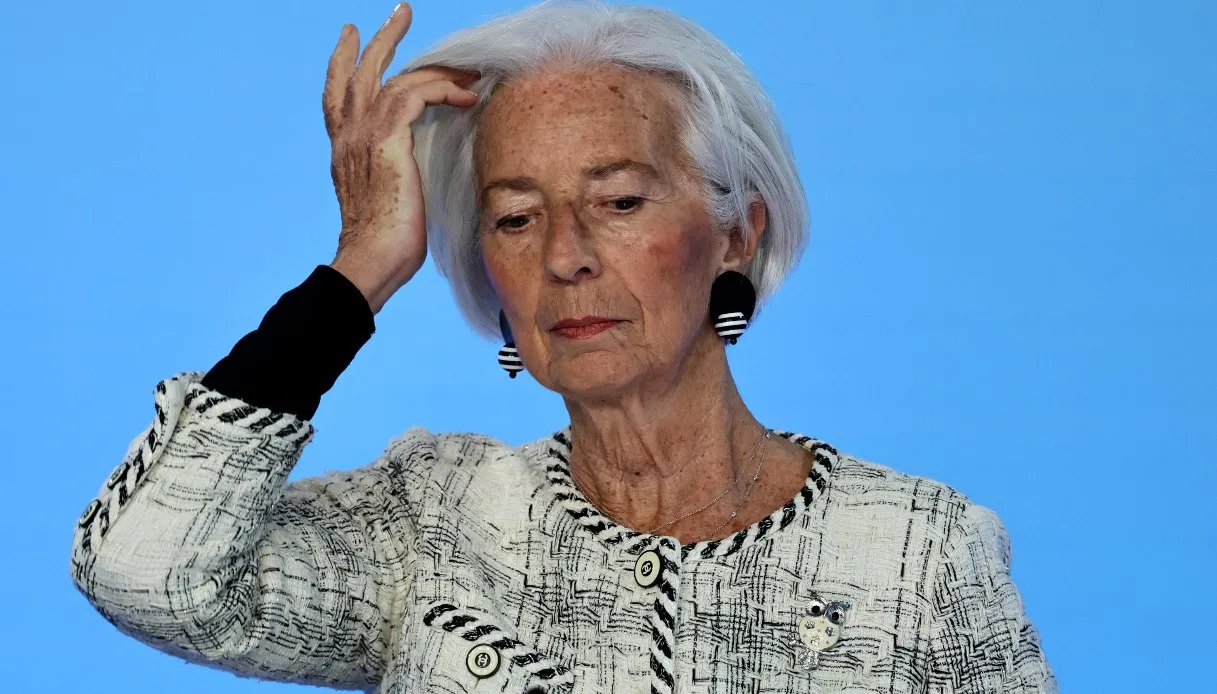
Christine Lagarde remained balanced on positions, even on polls or on rate hike hypotheses. Instead, the outgoing vice president of the ECB, Luis de Guindos, decided to give an interview to the Financial Times.
However, the direction is the same, that of a language that avoids alarmism. Indeed, he invites his colleagues to maintain a prudent attitude before the meeting on 11 June, which will decide on interest rates in a scenario of general economic weakening.
For their part, investors are betting on an increase in the rate, and if the markets are betting on new increases the situation is different.
Declares:
I think we need to wait before deciding on the next move on interest rates. We need more clarity on the conflict in Iran. We will have new screenings in June.
From his experience he also adds:
My impression is that the growth data in the coming weeks will not be positive.