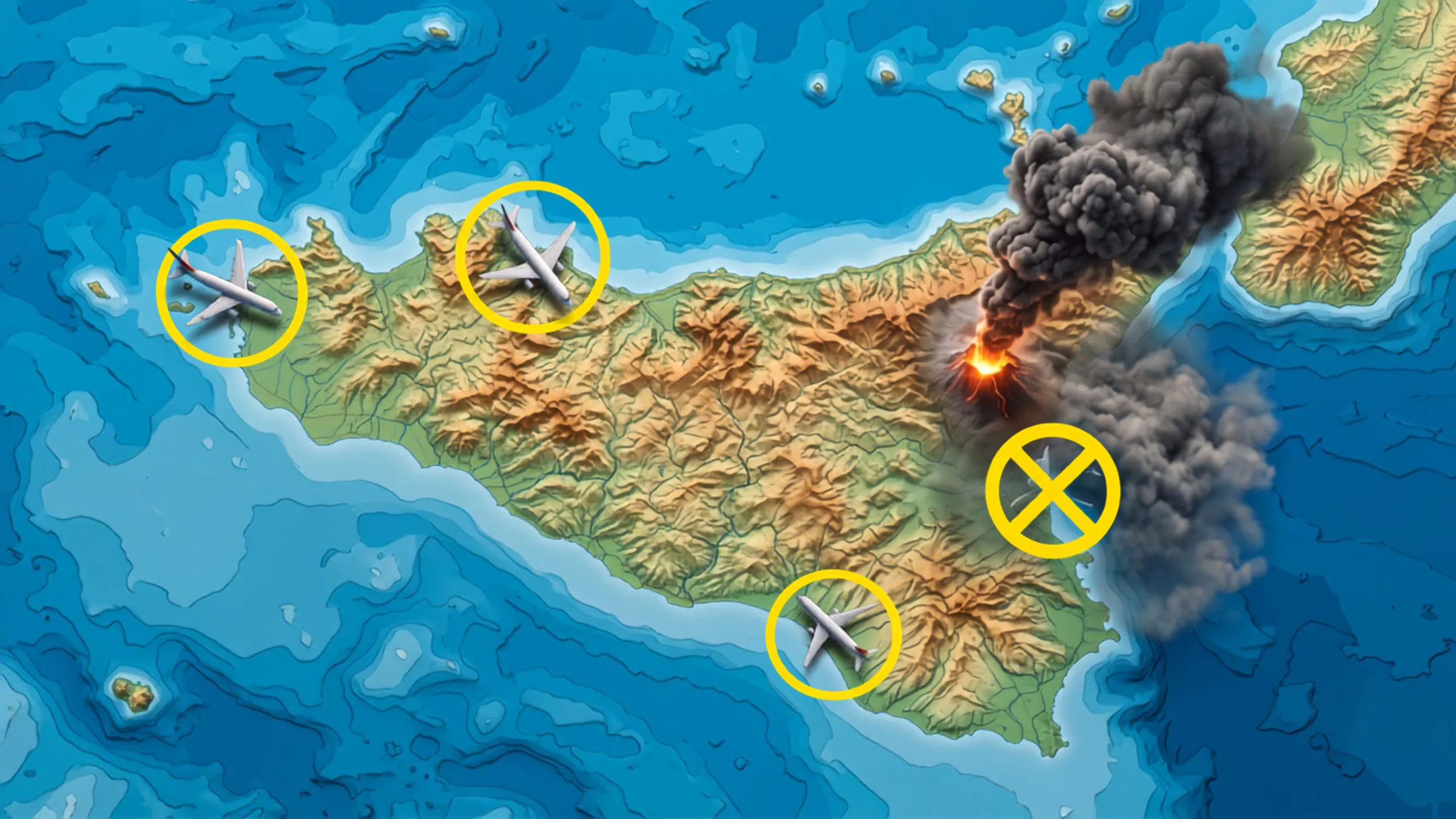
The SAC, Catania airport company, has once again extended the closure of the Fontanarossa “Vincenzo Bellini” airport, extending it until 2:00 am on August 15th. Over the last week, starting from the new eruptive phase of Etna, hundreds of flights have been canceled and there have been diversions to other Sicilian airports due to the critical issues caused by the volcanic ash present in the atmosphere.
The latest update from the INGV Etna Observatory, released yesterday 13 August at 5.37pm, reports that the effusive activity of the eruptive vents at an altitude of 2750 m and 1900 m continues, while that at an altitude of 2090 m has ceased. What has forced the extension of the closure of the airport is above all the explosive activity at the Voragine crater, which has shown a significant increase since 4.55 pm yesterday, with emission of ash dispersing in the southern quadrant and lava flows in the Valle del Bove reaching an altitude of 1300 m, attracting hundreds of visitors. For the director of INGV-OE, Stefano Branca, it is “absolutely impossible to predict the duration of Etna’s activity”.
Flights canceled and diverted to Catania
Between 6 and 12 August, around 630 flights were diverted to the other airports of Palermo, Comiso, Trapani (and now also Lamezia Terme in Calabria). According to what was released by SAC, the Catania airport sees the transit of at least 40 thousand passengers per day in this period and around 1,974 flights were scheduled, of which around a third (36%) were cancelled, with passengers stuck in Fontanarossa waiting for days to be able to leave.
This is, Sac told Ansa, “the most severe emergency of the last 20 years in terms of impact on the airport infrastructure, but also the system’s ability to activate alternative solutions and manage, through coordination between the Sicilian airports, a significant part of the flights affected”.
Alternative stopovers to Catania-Fontanarossa airport
But why is Catania airport, the fifth Italian airport for passenger traffic and the second in the South, right there and so busy, if every year it is held in check by the activity of Etna? “It is not the volcano that is out of place, but the airport,” said Nello Musumeci, minister of civil protection and former president of the region.
Many are now relaunching an old hypothesis, resuming a project almost twenty years old that has never seen the light: an intercontinental airport between Catenanuova and Dittaino, in the central-eastern area of the region, between Enna and Catania. In 2013, Comiso airport, the first military base, north of Ragusa, was opened to civilian traffic as an alternative airport, although it was too small to absorb direct flights departing from Fontanarossa.
Fontanarossa airport celebrated its hundredth birthday on May 11, 2024. The idea to build it came in 1912 to Ignazio Lanza di Trabia, who was looking for a flat area near the city that was large enough to host an airfield for military use. The apparently perfect terrain was south of Catania and arose from lava flows, on which the sediments of the Dittaino, Gornalunga and Simeto rivers had been deposited. Inaugurated in 1924, 5km south of the city, the airport suffered serious damage due to the bombings of the Second World War: it was then rebuilt and expanded to respond to the growing commercial air traffic.
Until the 1980s, with airplanes equipped with propeller engines, the problem was not so widespread: with the spread of jet engines – i.e. the ones we use today – the risks increased. The volcanic ash, in fact, can damage them and cause them to fail during the flight and every time the cloud moves southwards, reaching the southern area of Catania, the airport must be closed for safety reasons. The monitoring is carried out by the Etna Observatory, which transmits it to the Civil Protection, which then communicates with the Sac, so that it can order the blocking of flights.
In the National Airports Plan of the Ministry of Infrastructure and Transport and of Enac (National Civil Aviation Authority) for the decade 2026-2035 it is reported that the active improvement plans for the upgrading of the Catania and Comiso airports are not «sufficient to intercept traffic demand by 2035; it follows that it will be necessary to evaluate the sustainable and quality development of any new infrastructures”. The debate will certainly grow, together with the hypotheses of new ports for Sicily. As reported in the plan, «a political-institutional evaluation may be carried out on the creation of a new airport in the Agrigento area if its economic-financial sustainability is demonstrated».
Hundreds of people on Etna due to the lava flow
Meanwhile, while air traffic suffers from volcanic activity, many citizens and tourists are flocking to the area to watch the spectacle of the lava flows, in particular the one that reached an altitude of 1340 meters in the Valle del Bove, with Codacons (Coordination of associations for the defense of the environment and the rights of users and consumers), which has asked for coordination between the authorities to manage the influx of visitors, proposing mandatory guides and digital information to ensure maximum safety in access management to the volcano.
Many tourists, in fact, are reaching the area independently (also due to the inability of volcanological guides to cope with the very high demand), often with inadequate equipment. The National Alpine and Speleological Rescue Corps (CNSAS) – Sicily Regional Service, following accidents and recoveries of inexperienced hikers, has recommended the utmost caution, excursions on the volcano, particularly in the evening and night hours, inviting you to turn to professional guides; to face the excursion with adequate equipment, with suitable footwear and headlamps; to use protective helmets; not to get close to the edge of the ridges and exposed points to observe the lava flows and to take all the precautions one would take to undertake a safe excursion.