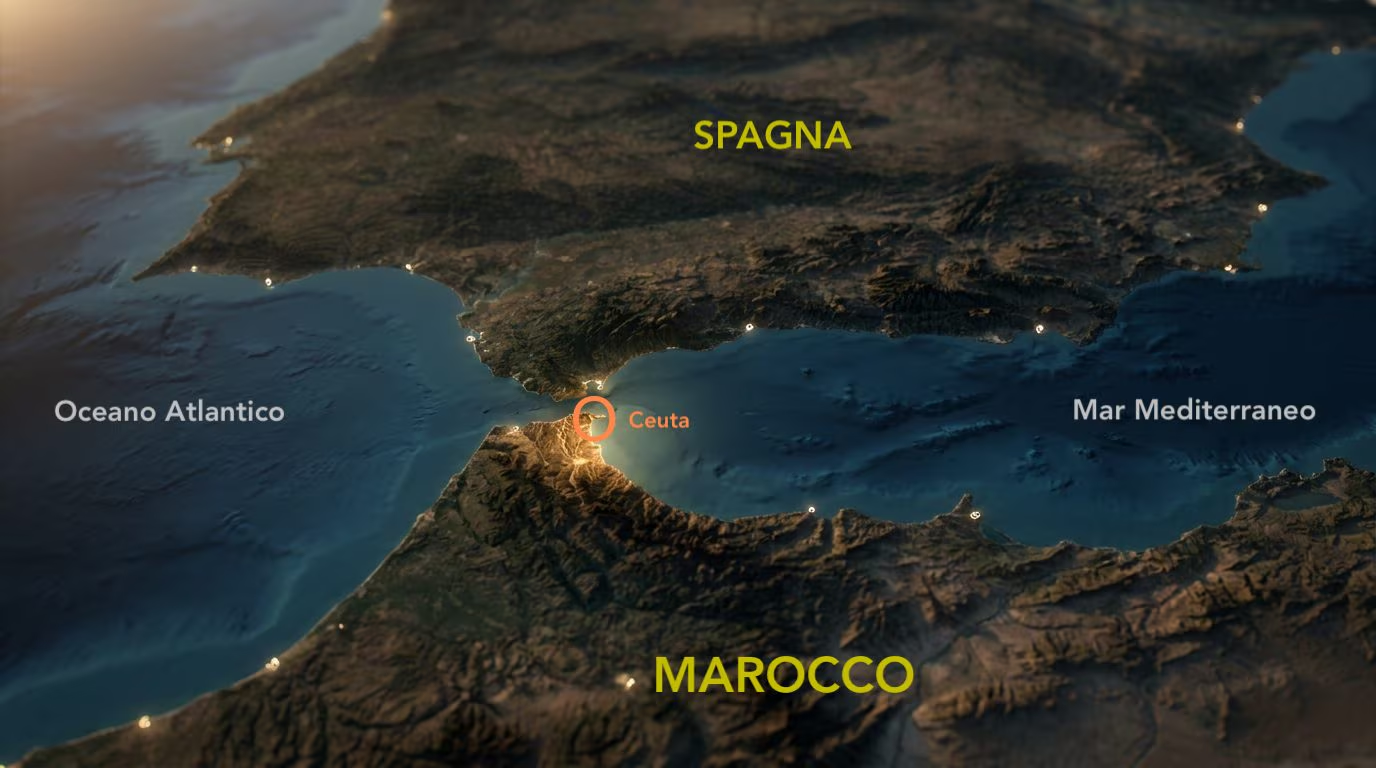
The situation in Ceuta, an autonomous Spanish city on the northern coast of Morocco, on the southern shore of the Strait of Gibraltar, has returned to the center of the European migration crisis and is not yet considered completely resolved: the Spanish and Moroccan authorities are in fact preparing the border in view of August 15, the date indicated in numerous appeals spread through social networks as that of a new mass entry attempt. This does not mean that a new wave of migration will necessarily occur, but it is a hypothesis considered plausible by the authorities based on information collected online.
Last July 30, tens of thousands of people attempted to cross the Moroccan-Spanish border, using both the land border and the stretch of sea that separates the Spanish enclave from Morocco. Estimates of those involved varied in the early hours and following days: Reuters reported a figure of around 72,000 people who crossed the border or attempted to enter, while Moroccan authorities gave an estimate of around 40,000 people. However, the episode has created a situation of critical pressure for a city of around 83,000 inhabitants. Because a new wave of migration is feared on 15 August
The new alarm arises above all from the circulation on social networks of messages inviting people to reach Ceuta on August 15th. According to a check by RTVE (the Spanish public radio and television group), numerous online contents were identified indicating dates, possible routes and ways to organize a new border crossing attempt. Moroccan authorities have intensified controls and arrested people suspected of aiding or abetting irregular crossings. The phenomenon shows a now important element in contemporary migration crises: social networks have a key role as a mobilization tool, sometimes extremely rapid. In the case of Ceuta, in fact, according to various reconstructions the first major mobilization at the end of July was also fueled by false information on the alleged opening of the border. The Associated Press reported that thousands of people moved after rumors spread online that the border would be opened. For August 15, therefore, it is important to distinguish between a certain forecast and a risk monitored by the authorities: currently it is not possible to know whether a new mass entry will occur, but it is precisely the possibility of a new attempt that explains the preventive strengthening of security.
What happened in Ceuta on July 30th
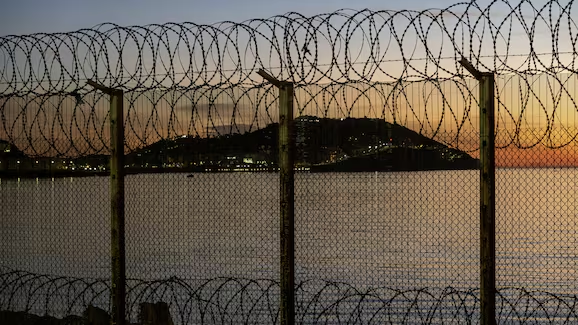
Ceuta is a particular case within the European Union: it is a Spanish territory and therefore belonging to the European Union, but it is physically located in North West Africa and is separated from Morocco by a fortified land border. Together with Melilla it represents one of the only two land borders of the European Union with the African continent. On July 30, thousands of people tried to reach the city: the attempt caused victims and put local reception systems under pressure. According to Reuters, the president of Ceuta Juan Jesús Vivas subsequently spoke of around 100 deaths during the wave of migration, while other international reconstructions provided different tolls, confirming the difficulty of quickly establishing a certain and definitive number in a similar emergency situation. The pressure also particularly affected unaccompanied minors: on August 7, the Spanish government announced that it had registered 1,342 minors and started a plan to transfer some of them from the city to mainland Spain. Local structures, designed to accommodate much smaller numbers, were severely overloaded and this aggravated the migration crisis. The European Commission considers the management of the Ceuta border an integral part of the European external border control policy, while the EU Agency for Fundamental Rights has repeatedly highlighted the critical issues linked to the pressure on reception systems and the protection of the rights of migrant people.
Why does the crisis in the Spanish city in North Africa involve Italy
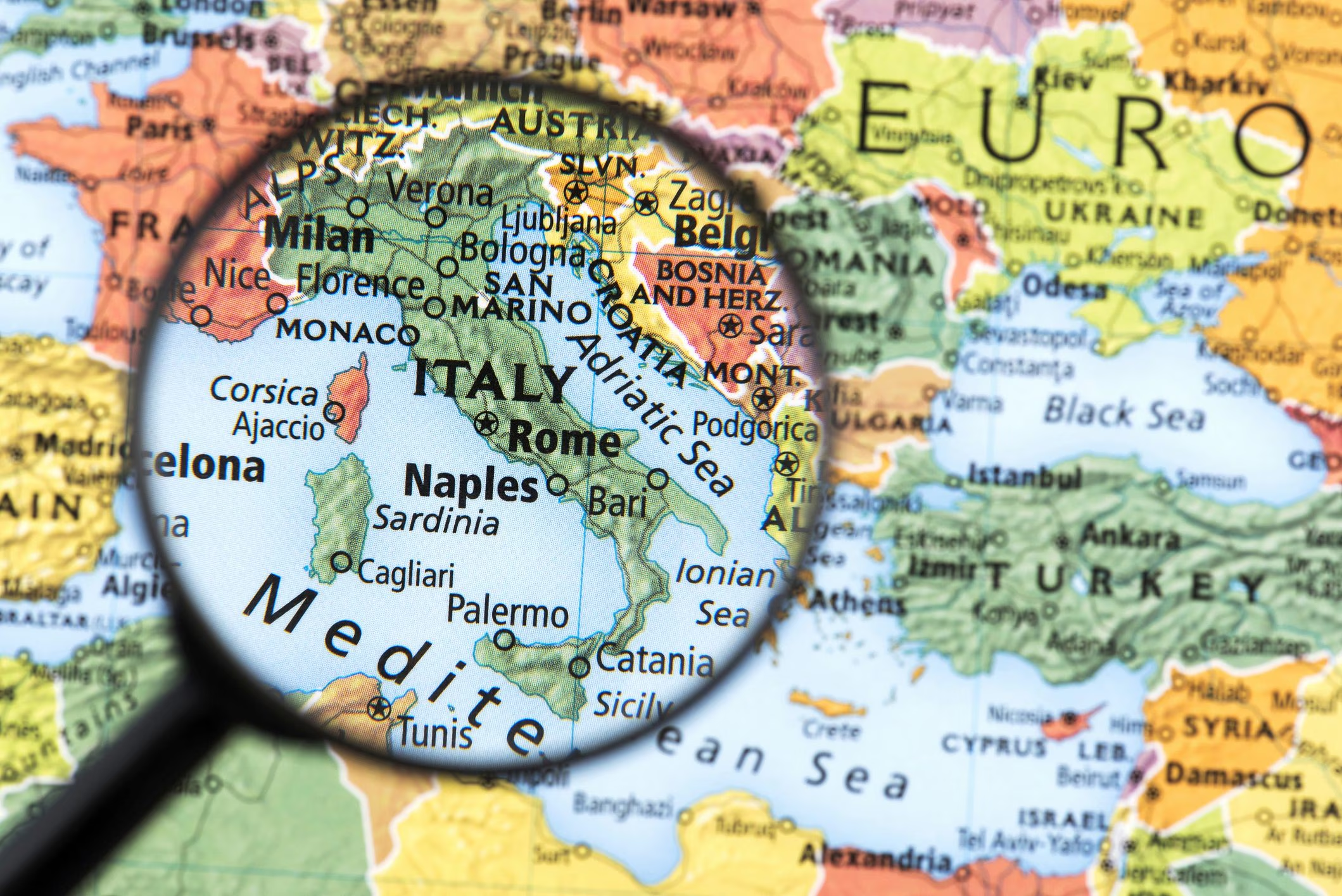
The consequences of the Ceuta migratory crisis have also spilled over to a European level: Italy has decided to temporarily reintroduce controls on travelers coming from Spain, motivating the choice with security reasons and with the fear that the migratory situation could also have repercussions on other European countries. The Italian decision came into force on 1 August and particularly concerns citizens of non-EU countries arriving from Spain. The Italian government initially indicated August 15th as the end of the checks, but left open the possibility of extending them if safety conditions were still problematic. Spain contested the Italian justification, arguing that the measure was based on misleading assumptions and that most of the people who entered Ceuta had already returned to Morocco. Subsequently, he decided to respond with a reciprocal measure: from 9 August the Madrid government introduced controls on travelers arriving from Italy through airports and ports, with checks on documents, nationality and visas. The measure was announced to be valid until 7 September 2026. The result is an unusual situation within the Schengen area: Italy and Spain, two countries normally connected by internal borders without systematic checks, are instead carrying out additional checks on travellers.
What changes concretely for those traveling between Italy and Spain
For the Italian traveller, the most important news is the temporary reintroduction of border controls, meaning that the passenger can be subjected to a document check upon arrival in Spain. The first practical effect is therefore the possibility of longer waiting times at airports and ports, especially during busy periods. Reuters reported that on the first day of the Spanish checks, around 200 travelers from Italy were checked at the six main affected airports: Madrid, Barcelona, Seville, Bilbao, Alicante and Valencia. For those who are Italian or European Union citizens, the control does not equate to the loss of the right to free movement: it means that you may be asked to show a valid identity document. For citizens of third countries, however, the requirements relating to passport, visa and entry conditions can also be verified. It is therefore prudent and recommended to leave with a valid and easily accessible document and to consider a certain margin of additional time, especially for those who have connections or travel on days characterized by heavy traffic.
Can Schengen suspend free movement?
Free movement within the Schengen area is not an absolute principle: European rules allow Member States to temporarily reintroduce internal border controls in exceptional circumstances, for example when there is a serious threat to public order or internal security. The European Commission recalls that this possibility is provided for by the Schengen Borders Code but must be used as a temporary and proportionate measure: it is therefore not a question of a country’s exit from the Schengen agreement, nor of the cancellation of free movement, but of a temporary suspension of normal controls absent at internal borders which, however, must be reasonably justified and motivated and have a temporary duration. Ceuta also has an important peculiarity: it is part of the Schengen area, but the border with Morocco constitutes an external border of the area. Furthermore, for Ceuta and Melilla there are specific rules that require document checks when leaving the enclave towards mainland Spain or other Schengen countries.
A local migration crisis with European effects
The Ceuta affair therefore shows how a crisis concentrated on a border outside the Schengen area in Spanish – and therefore European – territory can produce consequences far beyond the territory directly affected. On the one hand there is the management of the EU’s external border, the relations between Spain and Morocco and the pressure on reception facilities, on the other a political dispute between European governments which has already had consequences on the mobility of citizens. August 15th now represents a date of particular attention, but it is not possible to automatically consider it as the day of a new crisis: the authorities are increasing surveillance precisely to prevent the appeals circulated online from turning into a new mass crossing. Meanwhile, for travelers between Italy and Spain, the most concrete effect of the crisis is already visible: free movement remains in force, but for a limited period it is accompanied by additional documentary checks. The Ceuta affair is therefore also crucial for the functioning of the Schengen area: it demonstrates how quickly a migration crisis at the external borders can transform into a question of security, diplomacy and mobility within the European Union.