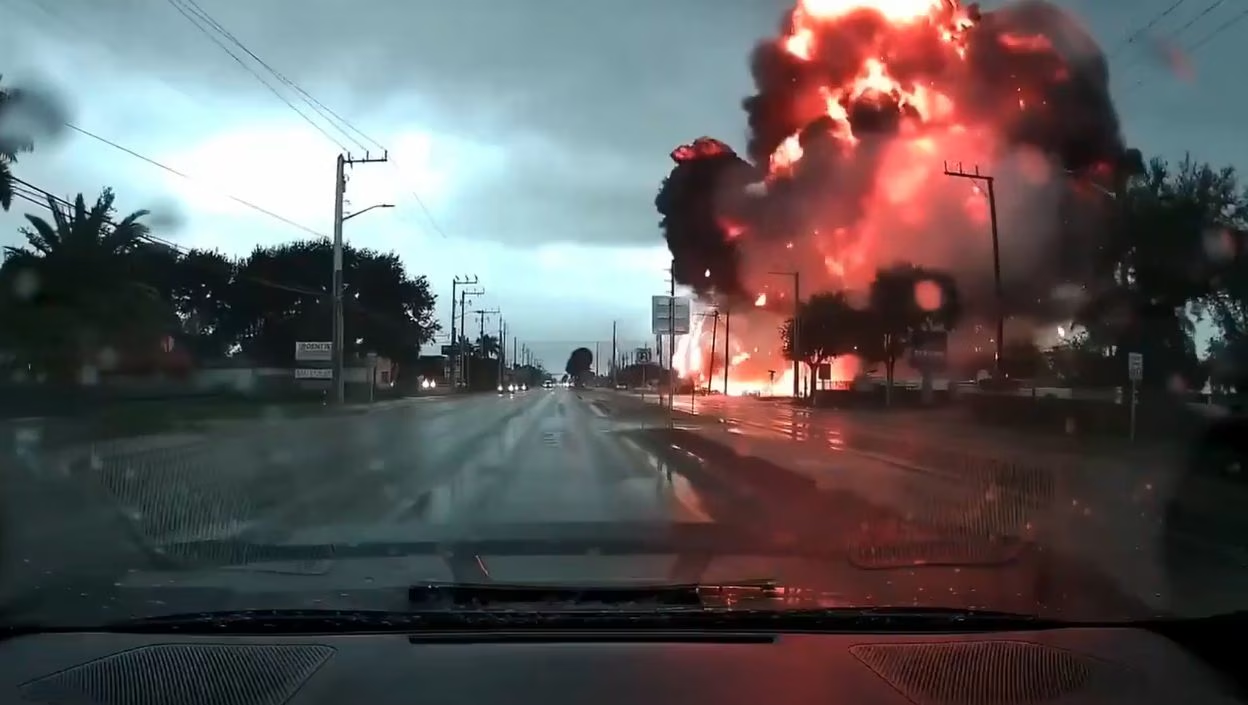
A Learjet 60 bound for the Bahamas crashed in Greenacres, near West Palm Beach, Florida: in the accident, which occurred on November 1st, the 9 people on board died, with the aircraft crashing into the road at a very high speed.
The official causes will be established by the NTSB, the US body that investigates plane crashes, but the physics of flight helps to understand how a jet cruising at 35,000 feet can reach the ground in just over a minute.
The problem manifested itself on a cruise. According to the NTSB, at 35,000 feet (10,700 meters) the crew reported light ice and moderate turbulence to air traffic control, with altitude changes of approximately 700 feet, and requested to climb to 37,000 feet. After a short climb, the aircraft entered a steep descent and the pilots launched the mayday reporting a condition of overspeed, i.e. exceeding the maximum speed.
According to Flightradar24, in just over a minute it dropped to 8,750 feet, the last radar reading before impact. There were strong thunderstorms in the area, with an external temperature at altitude of around -47 °C.
The dynamics of the crash: LOC-I, loss of control in flight
The first reconstructions describe a typical dynamic of a specific category: LOC-I, Loss of Control In-flight. It is not a cause but a category of accident: the plane leaves its flight envelope, the set of speeds, attitudes and loads for which it is designed, and the crew is unable to bring it back to normal conditions.
According to IATA, between 2009 and 2018 it was the deadliest category of accident in commercial aviation: it caused 2,462 victims out of 4,075 total. It almost always arises from multiple factors together. In aviation safety, the Swiss cheese model, proposed by psychologist James Reason, is often used: each safety barrier (aircraft design, maintenance, training, procedures, traffic control) is a slice with some holes, and the accident occurs when the holes of several slices align.
Coffin corner: because at high altitude the margins are narrow
At 35,000 feet the air has less than a third of the density it has at sea level, and the speed window in which a jet can fly narrows. Below there is the stall: with the thin air, the wing already has to work with a relatively high angle of attack (the inclination with respect to the air flow) and a gust can be enough to exceed the critical one, causing the flow to detach and the lift to collapse.
Above is the maximum speed, expressed in Mach number: for the Learjet 60 it is Mach 0.81. Already approaching that limit, the air above the wing locally exceeds the speed of sound and shock waves form. By accelerating further, these move backwards together with the point where the lift acts, while the tail receives a different flow: the plane tends to dive and the altitude controls lose effectiveness. It’s the Mach tuck.
Going up, the two limits get closer until they touch in the coffin corner. Commercial and business jets never fly so close to the limit, but at altitude the margin can be reduced to a few dozen knots (one knot is equivalent to 1.85 km/h). At 35,000 feet a Learjet 60, certified to fly up to 51,000, was not close to this limit: however, the margin remains narrower than at low altitude and a violent gust can erode it.
Hypotheses on the causes
The NTSB has not formulated any hypotheses: for now it has indicated the weather as one of the factors to be examined and is verifying whether the plane broke up in flight. The following are the scenarios that the physics of flight and the available data make plausible. The cause could be a combination of them, or something that doesn’t emerge at all today.
- The storm. In Florida, storm cells can exceed 40,000 feet, with updrafts and downdrafts capable of changing the plane’s altitude and speed in seconds. The crew reported turbulence and sought a calmer altitude.
- Ice: on the wings or on the probes? The crew had described light, glassy ice (clear ice), with an external temperature of -47 °C. This type of ice is formed from rather large droplets of supercooled water, usually between approximately 0 and -10 °C: below -40 °C the droplets freeze immediately and liquid water practically does not exist. It is therefore probable that the one reported had accumulated before, during the descent or in the clouds.
- At high altitude the risk is different: the ice crystals present in deep storm systems, which can block the Pitot tubes, the probes that measure speed. It is a phenomenon documented right in Florida, where NASA and the FAA have conducted research flights into these systems. It happened, in a much more extensive storm over the equatorial Atlantic, to Air France flight 447 in 2009. For the Learjet there are currently no reports of unreliable speeds: this is one of the investigators’ checks.
- THE’overspeed. Exceeding the maximum speed could be more of a consequence than a cause: an airplane that has lost its attitude and is pointing its nose down accelerates quickly and, beyond the Mach limit, recovery becomes more difficult. The NTSB also has indications, yet to be confirmed, of a partial failure in flight: beyond the speed limits, the aerodynamic loads on the structure may exceed the design ones.
- A technical failure. A problem with the autopilot cannot be ruled out trimwhich regulates the attitude, or the flight controls. The remains of the plane and its maintenance history will tell.
- The human factor. In each investigation the NTSB reconstructs what the crew and air traffic controllers knew, when they knew it and what they did: it is a routine verification, not an accusation. In the cloud, without external references, a sudden event can surprise anyone and the body can perceive the plane’s attitude incorrectly: it is spatial disorientation, against which pilots train with specific anomalous attitude recovery courses (UPRT). What happened in the cabin will be clarified by the on-board recorders, if recovered, together with the radar data and radio communications.
Because you have to wait for the causes
In the first hours after an accident, verdicts are already circulating online. Investigative agencies do the opposite, and not out of reticence. Annex 13 of the Chicago Convention, the international standard for aeronautical investigations, and the European regulation 996/2010 which implements it establish that the sole purpose of an investigation is to prevent new accidents, not to assign blame. For this reason, in the first phase, the NTSB communicates only verified facts.
There is also a practical reason: in complex incidents, assumptions from the first few days are often overturned. For Air France 447 the sequence of events only became clear when the recorders were recovered from the bottom of the Atlantic, almost two years later.
The hypotheses in this article serve to understand the physics of flight, not to issue a verdict: that is up to the investigations. Waiting for the investigation is also a way to respect the nine people who lost their lives, including the two pilots, and their families.