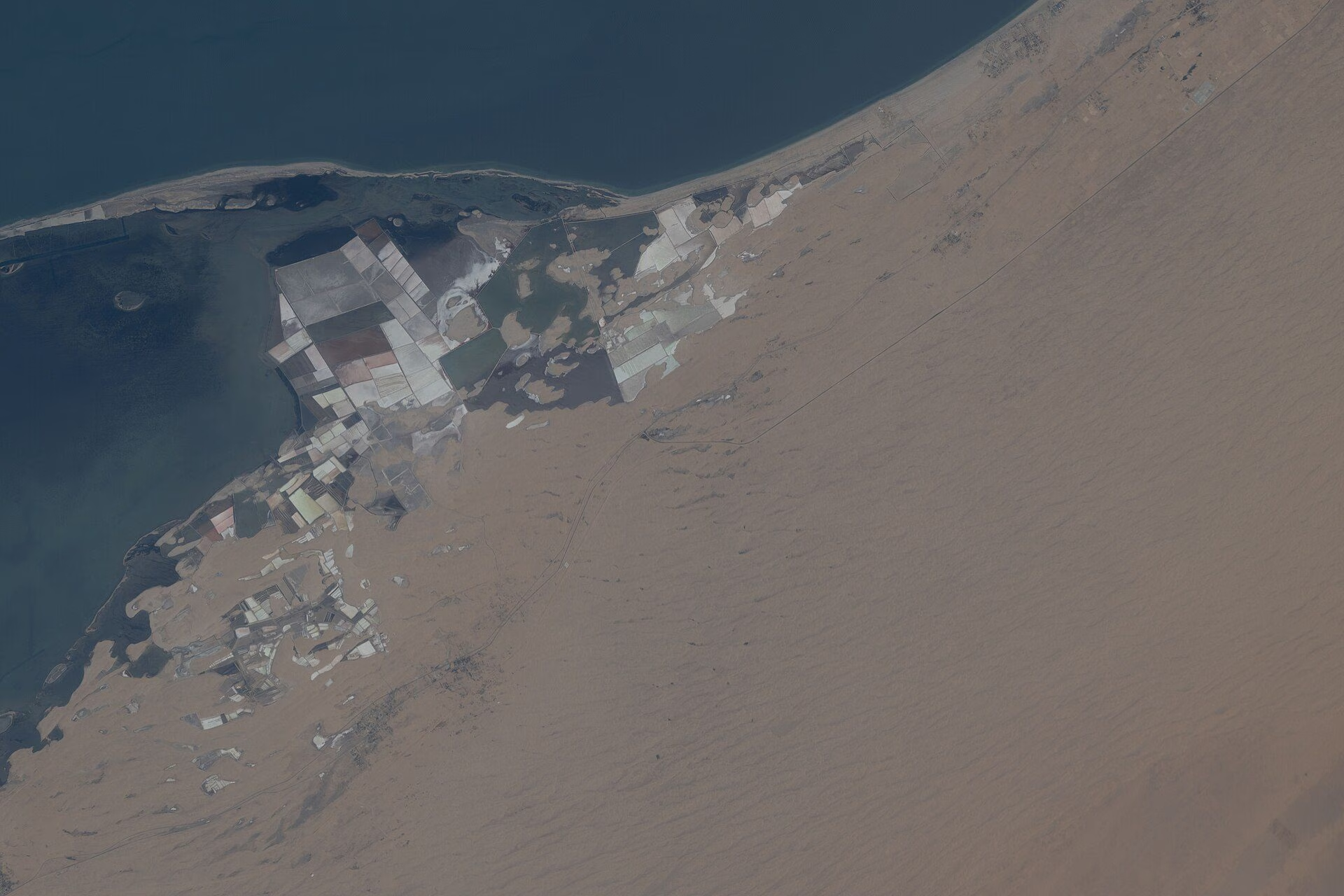
October 7, 2023 is a watershed date in the recent history of Israel and Palestine. Today, three years later, while the victims of the attacks are commemorated in Israel, satellite images tell better than many photographs how much the Gaza Strip has changed in the last 36 months. Entire neighborhoods were razed or severely damaged, while the Palestinian death toll according to UN estimates exceeded 74,000 people, including more than 20,000 children. Three years after the start of the war, the comparison between the images and the data shows a devastation which, according to satellite surveys, did not stop even after the ceasefire of October 2025.
Three years of war seen from above
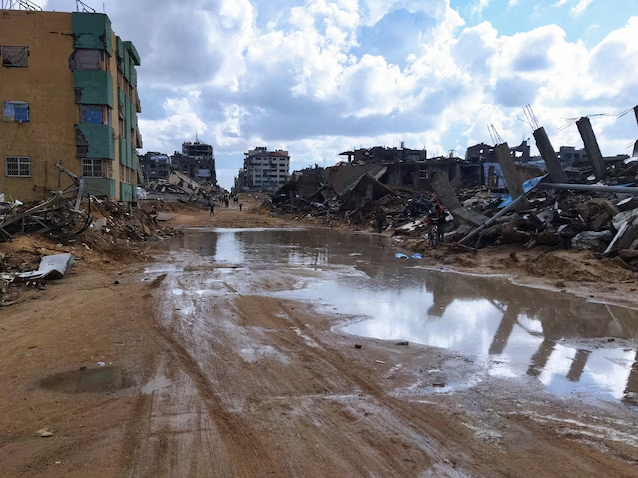
The most recent satellite images of the Gaza Strip, updated to June 2026, show a radical transformation of the territory: urban areas that were previously densely built today appear as expanses of destroyed buildings, rubble and temporary structures for displaced people. Neighborhoods such as Jabalia and Shuja’iyya have been deeply devastated, while in some areas of Rafah and Tel al-Sultan the destruction appears almost total. However, it is not just a perception obtained by comparing two photographs: satellite images are also used by the United Nations to systematically measure the damage.
According to the latest available analysis from the United Nations Satellite Center (UNOSAT), based on images collected on 16 June 2026, 201,290 structures equal to approximately 82% of the total in the Strip were damaged. Of these, 134,422 were classified as completely destroyed, 13,848 severely damaged, 28,096 moderately damaged and 24,924 potentially damaged. In other words, approximately eight out of ten structures were seriously compromised. And the data also shows that the destruction did not stop with the ceasefire: compared to the UNOSAT survey of October 2025, the overall number of structures affected increased by 1.5%, while that of completely destroyed structures grew by 9%.
What happened on October 7, 2023
To understand why this date has such great weight for Israel, we need to go back to the morning of October 7, 2023. At approximately 6:30, during the Jewish holiday of Simchat Torah, Hamas launched a massive rocket attack against Israeli territory. At the same time, armed groups crossed the barrier that separates Israel from the Gaza Strip, entering several locations in the south of the country. The attacks hit numerous Israeli communities, including Be’eri, Kfar Aza, Nahal Oz and Sderot, as well as the Nova music festival, near Kibbutz Re’im. According to Israeli data reported by Reuters, by the end of the day around 1,200 people had been killed and 251 people had been taken hostage and taken to Gaza. It was the most serious terrorist attack in the history of Israel in terms of number of victims in a single day and provoked the Israeli military response that would start the ongoing war in Gaza. Since that moment, October 7 has not become just a date on the Israeli calendar: it has become a breaking point in the perception of security in the entire country.
2023 and 2026 compared
The scale of the destruction becomes even more evident if you go back to the first weeks of the war. At the end of October 2023, satellite images already showed entire neighborhoods of Gaza transformed by the bombing. But at the time the damage was still far from the dimensions reached in subsequent years: according to estimates cited by the United Nations, in the first three weeks approximately 42% of homes had been damaged or rendered uninhabitable. One year after the start of the war, The Guardian already reported over 70% of the housing stock damaged, based on satellite analyzes and UN data.
The devastation affects not only homes but every essential infrastructure, including hospitals, schools, water systems, sewer systems and agricultural infrastructure. The joint assessment by the UN, the World Bank and the European Union, published in April 2026, estimated the overall cost of reconstruction in the decade following the conflict at 71.4 billion dollars, while the removal and management of the rubble alone is estimated at over 1.7 billion dollars.
But the problem is not just rebuilding. In October 2026, according to the UN, approximately 279,000 people were still living in 400 sites at risk of flooding and in highly precarious conditions with still limited access to water, healthcare, sanitation and adequate housing. Three years after the start of the conflict, therefore, the question no longer concerns only the end of the war but how long it will take to rebuild Gaza and, above all, how many of the people who inhabited it will really be able to return to live in the places they knew before 7 October 2023.
The estimate of civilian casualties
On a human level, the most recent figure reported by the Palestinian authorities exceeds 74,000 people killed in the Strip since 7 October 2023. But there is a fundamental issue when it comes to victims: there is no precise and verifiable number of civilian victims. The overall data is recorded by the Gaza Ministry of Health, which operates under the de facto authorities of the Strip, and is taken up by the United Nations and the main international organizations.
Furthermore, the number does not necessarily reflect the full extent of mortality caused by the war. In addition to the people killed directly in the attacks, there are indirect consequences linked to the destruction of the health system, malnutrition, disease and living conditions in displacement.
And what’s happening with the negotiations today?
As of today, October 7, 2026, there is a formal ceasefire agreement, but no real peace. The US-backed plan had led to a ceasefire in October 2025 and the release of the last Israeli hostages still held in Gaza, along with the release of Palestinian prisoners and detainees. But the second part of the agreement remained essentially blocked. The three main issues concern:
- the disarmament of Hamas
- the withdrawal of Israeli forces from Gaza
- the reconstruction and future governance of the Strip
Hamas has indicated that it is willing to hand over its weapons for safekeeping under the control of a US-backed Palestinian administration, but Israel considers the proposal insufficient and says it will not withdraw its forces until Hamas is completely disarmed. Meanwhile, Israel maintains effective control of about two-thirds of the Strip, according to Reuters, and attacks and bombings continue to occur. Since the ceasefire came into force in October 2025, more than 1,400 Palestinians have been killed, according to data reported by Reuters based on Gaza health authorities. So the ceasefire stopped the large-scale war, but it did not resolve the issues that should bring the conflict to an end.
How Israel experiences its third anniversary
In Israel the third anniversary is commemorated with ceremonies, memorials and initiatives in the places affected by the attack. In Kfar Aza, Sderot, Be’eri and at the Nova festival site, the killed and abducted people are remembered. But this year the anniversary also has a very strong political dimension: on 27 October Israel will go to the polls for the first time since the start of the war and sentiment in the country is far from uniform. A survey by the Institute for National Security Studies (INSS) shows that only 27% of Israelis believe that Israel has won the war in Gaza and 34% express satisfaction with the government’s management, highlighting a strong gap in trust at the military and political levels.
The trauma of October 7, however, continues to influence the way in which many Israelis look at Gaza and the Palestinians, considered as a threat to Israeli security, and the memory of the attack remains much more present in Israeli public discourse than the condition of Palestinian civilians. At the same time, families of the victims, former hostages and civil groups are calling for an investigation into the responsibilities that allowed the October 7 attack to occur and criticizing the Netanyahu government’s political management of the war and the return of the hostages.
The result is a deeply traumatized and polarized society: October 7 remains an open wound for many Israelis, while the war that followed produced such devastation and annihilation of the population in Gaza that it makes it increasingly difficult to imagine how the two societies can coexist peacefully again.