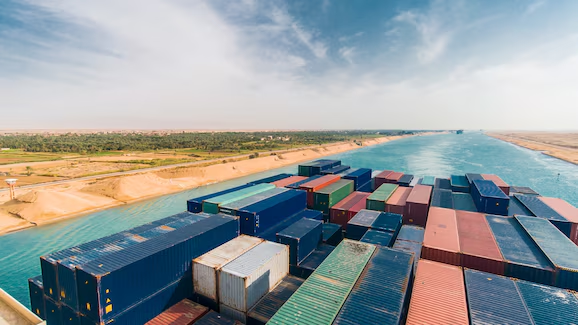
Today, November 17, we celebrate the anniversary of the inauguration of the Suez Canal, an engineering feat that profoundly changed the geography of world trade. Approximately 193 km long, the canal inaugurated in 1869 allows ships to transit between the Mediterranean Sea and the Red Sea without having to circumnavigate Africa, significantly reducing distances and navigation times between Europe and Asia.
157 years after its opening, the importance of the Suez Canal has become particularly evident in recent years, first with attacks on commercial ships in the Red Sea and then with the Strait of Hormuz crisis, which forced several Gulf countries to seek alternative routes to export oil and other raw materials.
But why is this canal so important not only for Egypt, which controls it, and for the countries of the Middle East, but also for Europe? And what would happen if the passage was closed?
The Suez Canal connects the Mediterranean to the Red Sea
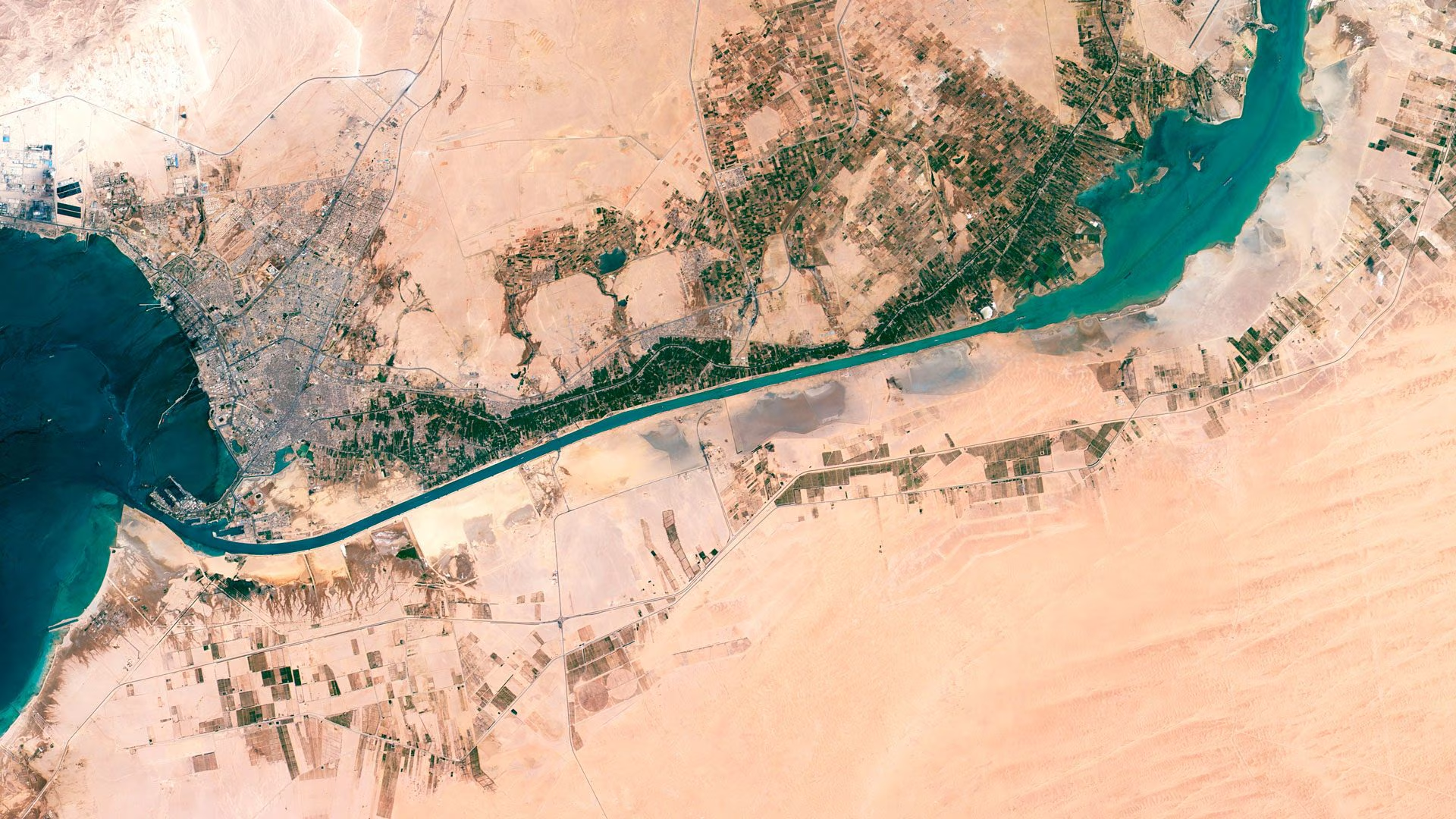
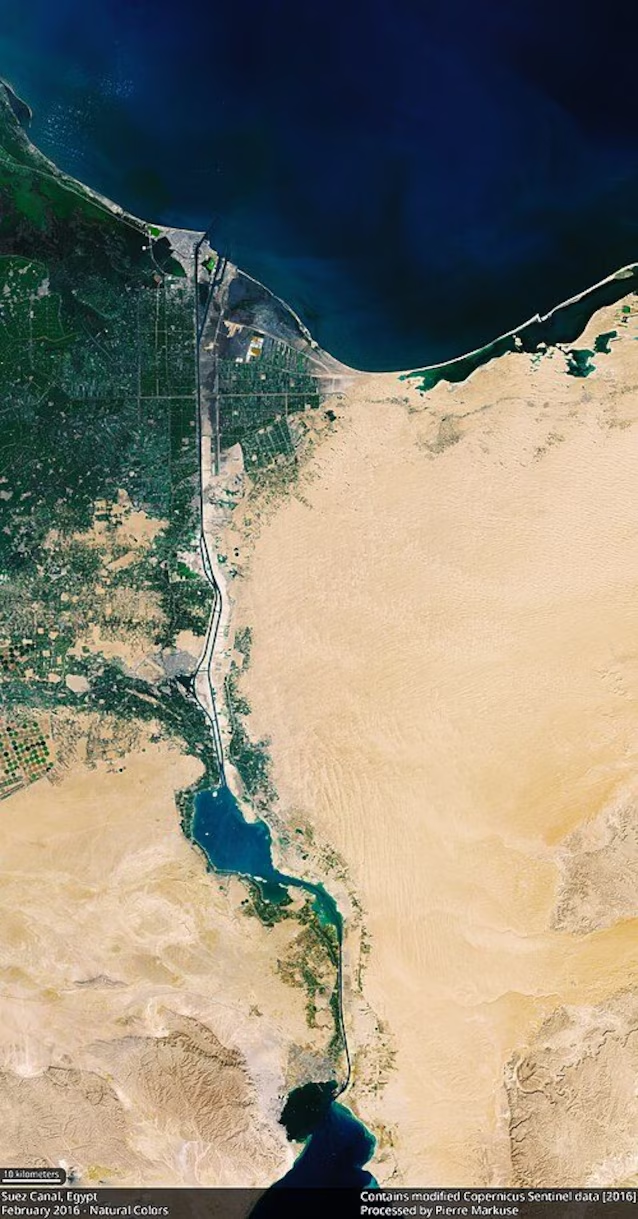
The Suez Canal is located in the north-eastern part of Egypt, in the isthmus that separates the African continent from the Sinai Peninsula. It connects the Mediterranean Sea, through the northern entrance of Port Said, to the Red Sea, through the port of Suez.
Its position is strategic because it allows ships coming from the Indian Ocean and Asia to reach the Mediterranean and therefore Europe without circumnavigating the entire African continent. In this regard, there are three particularly important and strategic geographical passages for world trade: the Suez Canal which connects the Red Sea to the Mediterranean, the Strait of Bab el-Mandeb which connects the Red Sea to the Gulf of Aden and the Indian Ocean and the Strait of Hormuz which connects the Persian Gulf to the Gulf of Oman. These passages, although distant, are all part of a network of closely interconnected shipping routes.
Why the Suez Canal is important for Egypt and the countries in the region
The first country to benefit from the presence of the Suez Canal for its economic stability is naturally Egypt. In fact, tolls paid by ships represent one of the main sources of foreign exchange for the country: in the 2022/2023 fiscal year, revenues from the canal reached a record 9.4 billion dollars.
With the Red Sea crisis and the diversion of numerous ships to the Cape of Good Hope, revenues decreased to 7.2 billion and then grew again in the 2025/2026 fiscal year, although remaining lower than pre-crisis levels.
But its economic and commercial importance extends far beyond Egypt’s borders. According to a United Nations Conference on Trade and Development (UNCTAD) analysis published in 2024 and based on 2022 trade flows, 26.4% of Saudi Arabia’s foreign trade volume depended on passage through Suez. The percentage rose to 31.6% for Yemen, 30.5% for Djibouti and 33.9% for Sudan.
These data show how the canal is also fundamental for various economies in the Middle East and East Africa: it is therefore not just a route used by major commercial powers, but an infrastructure that directly influences the supplies and exports of numerous countries.
The connection with the Strait of Hormuz: why Suez is even more strategic for Saudi Arabia
The Strait of Hormuz, located between Iran and Oman, is one of the main energy chokepoints on the planet: in 2025, on average, approximately 20 million barrels of oil per dayequal to approximately 25% of world oil trade by sea and to almost 20% of global consumption of oil and petroleum products.
The crisis that erupted at the end of February 2026 caused major traffic disruptions through Hormuz, putting pressure on Gulf countries’ energy exports and pushing Saudi Arabia to make greater use of alternative routes to the Red Sea. The country has a long oil infrastructure, the East-West Pipeline, which connects the fields and plants on the east coast with the port of Yanbu, right on the Red Sea.
The pipeline, approximately 1,200 km long, was designed specifically to allow Saudi oil to reach the sea without having to cross Hormuz. From Yanbu, oil can be loaded onto tankers and transported north through the Red Sea and the Suez Canal to reach the Mediterranean and European markets.
This route becomes especially important, then, when exports through the Persian Gulf are hampered by the Hormuz crisis. Saudi Arabia can thus diversify its export routes, reducing its dependence on the Strait. This alternative, however, is not without risks: tensions in the Red Sea and the Bab el-Mandeb Strait may compromise the safety of maritime connections. Suez represents an important logistical alternative for Saudi oil, but it alone cannot replace Hormuz. The security of the entire maritime corridor remains paramount.
Because the Suez Canal is also fundamental for Europe
The connection between Suez and Europe is above all commercial: the canal represents the most direct route for many of the ships transporting goods from Asia to European ports. According to UNCTAD, in 2023 approximately 10% of global maritime trade by volume and 22% of global container traffic transited through Suez.
These are very different goods: electronics, industrial components, cars, raw materials, textiles and energy resources. For Europe, therefore, the canal is not just a question of oil supply: it is also about the supply of industries and distribution chains. If a traffic interruption were to occur there would be direct consequences on the delivery times of goods, the availability of components for the industry and the costs of international transport.
What would happen if the Suez Canal closed?
The closure of the Suez Canal would not completely block trade between Asia and Europe, but it would force ships to follow an alternative route: the circumnavigation of Africa via the Cape of Good Hope.
For an oil tanker traveling from the Saudi port of Ras Tanura to Rotterdam, the route through Suez is approximately 10,358 km, compared to the 17,975 km needed via the Cape of Good Hope: a difference of over 7,600 km, equal to an increase of approximately 74% compared to the route via Suez.
The main consequences would be: longer delivery times (ships would take several days longer to reach European ports), higher transport costs (including fuel consumption and the costs of on-board personnel), possible increases in goods prices, greater emissions and greater pressure on logistics chains.
The Suez Canal, therefore, also affects the price of goods, energy security, supply chains and the economic stability of entire regions. Its location makes it a fundamental passage to connect Europe, Asia and the Middle East, while the recent crises in Hormuz and the Red Sea have shown how fragile a trade network is that depends on a few, strategic transit points.