She came out quality of life ranking 2026 of ItaliaOggi (28th edition), and the best province to live in is that of Bolzano. The capital of Alto Adige – Südtirol was in second position last year, after Milan. But how did Bolzano “overthrow” Milan from the throne and surpass it?
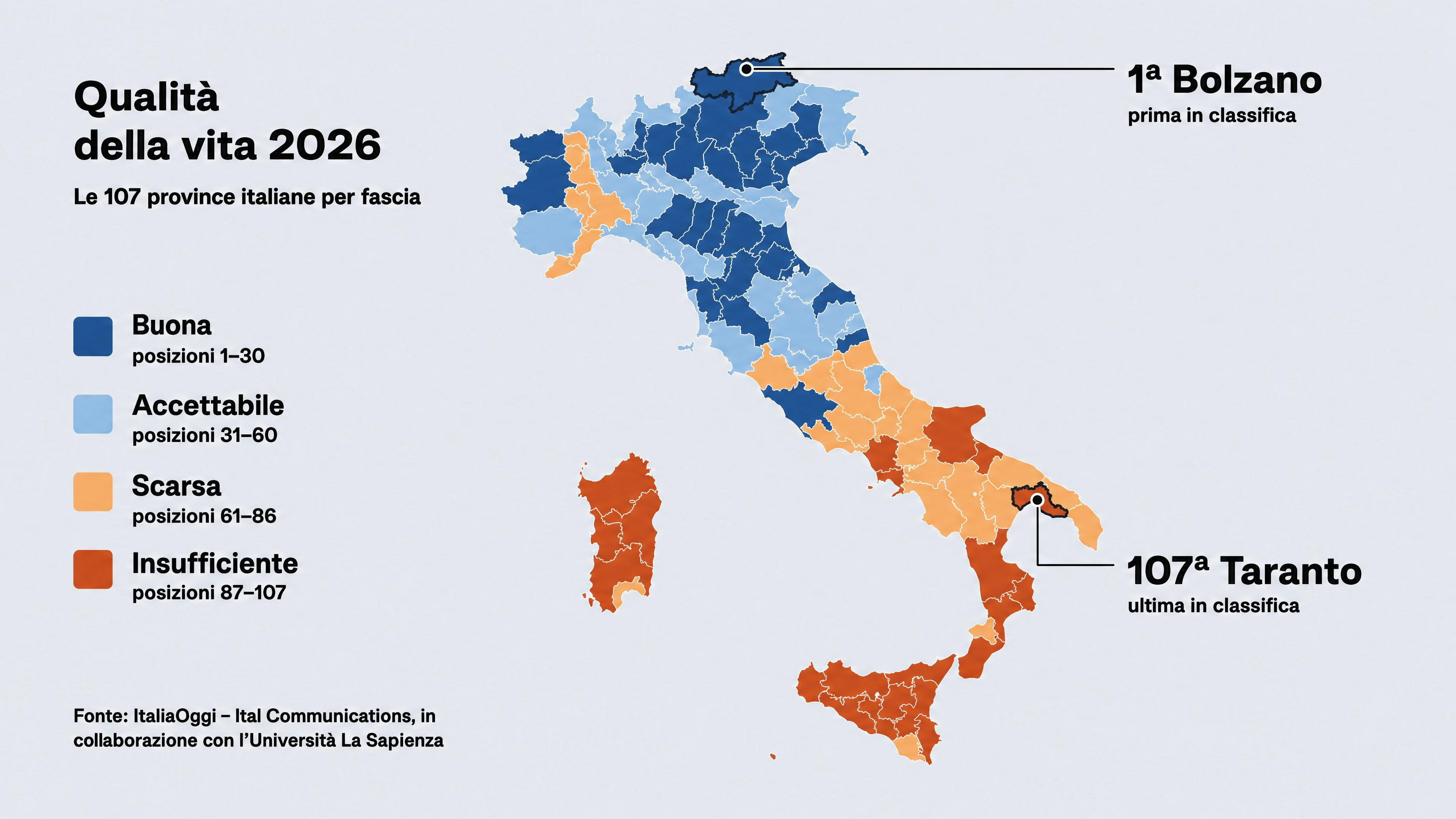
The ranking follows a series of parameters that give a certain score, and this year Bolzano managed to be in the lead by coming first in five out of nine dimensions, and making a leap in Social Security, from 87th to 30th place. At the other end of the scale there is Tarantoslipped to 107th and last place.
| Position | Province | Score | Compared to 2025 |
|---|---|---|---|
| 1 | Bolzano | 1,000 | +1 |
| 2 | Milan | 949 | −1 |
| 3 | Bologna | 908 | = |
| 4 | Padua | 832 | +3 |
| 5 | Trent | 821 | +1 |
| 6 | Rimini | 820 | +6 |
| 7 | Florence | 796 | −3 |
| 8 | Parma | 782 | +1 |
| 9 | Monza and Brianza | 782 | −4 |
| 10 | Verona | 752 | −2 |
How the quality of life ranking works
To understand how a province goes down and up, you need to understand which macro-categories are taken into consideration:
- Business and work
- Environment
- Education and training
- Population
- Crime and safety (crime)
- Income and wealth
- Health
- Social security (discomfort and vulnerability: NEET, youth unemployment and accidents)
- Tourism and culture
Within these macro-categories there are 92 statistical indicators coming mainly from ISTAT, and for each of these parameters there is a score ranging from 0 to 1,000. The province with the best result gets the maximum, the one with the worst result gets 0, while all the others are positioned in the middle (in proportion).
The weighted average of these values then generates the final ranking, and divides Italy into four quality of life bands: good, acceptable, poor and insufficient.
As anticipated at the beginning, new relevant indicators have arrived since 2025, which have changed the “specific weights” of the individual provinces. For example, in the macro-category “social security” a parameter has been introduced to measure the generational health of a territory, also calculating the incidence of NEET — or the percentage of young people among 15 to 29 years old who do not study, do not work and are not included in training courses. Inserting or recalibrating even just a few indicators has a significant impact on the final result: a territory could have very high average incomes, but lose ground if it struggles to retain or activate new generations.
Why Bolzano beat the city of Milan and why Taranto is last
After two years in which Milan held first place, Bolzano returned to the top by excelling on several fronts. Not only has it been first in Italy in the Population dimension for 12 years now, but it is also in first place for Business and work, Environment, Income and wealth and Tourism.
According to the ItaliaOggi press release, behind her there are:
- Business and work: Trento, Bologna, Padua, Cuneo
- Setting: Bologna, Bergamo, Reggio Emilia
- Population: Trento, Prato, Milan, Treviso
- Income and wealth: Milan, Bologna, Monza and Brianza, Ravenna
- Tourism and culture: Trieste, Rimini, Verona, Rome
Milan, even if it continues to remain at the top for Income and Wealth and for Education (second in both), pays the typical price of large metropolises: too high cost of living, pressure on the real estate market and a decidedly penalizing score on the crime and safety front (with it there are also Turin, Venice, Bologna, Florence and Rome), slipping into the last positions due to the high number of complaints.
Taranto, however, ended up in last place due to a series of structural critical issues that have been going on for many years, with very low scores in 6 out of 9 macro-categories: Business and work (106th), Environment (103rd), Social security (102nd), Income and wealth (96th), Health (96th) and Education (89th).
Belluno stands out for having landed in 31st position, gaining 29 positions in just one year.
The weighted average effect: the paradoxes between North and South
Clearly, we cannot stop only at these positions, because we lose sight of a fundamental detail: the fact that, in statistics, the weighted average tends to flatten the peaks of excellence. To clarify: a province could have excellent health services but a weak economy, and for this very reason end up low in the ranking.
This is the example of Taranto, last in the ranking, which however is in 30th place for Crime and safety. But it is also the example of Catanzaro, in 89th position, which is in 3rd place in Italy for the Health System. Enna, which finished in hundredth place, is almost last, but is the second safest province in Italy in the Crime and safety category. And what about Benevento? Although it is in the second half of the general ranking, it comes first in Italy for Social Security.
On the contrary, Rimini, which is in 6th position, is almost last (102nd place) in terms of safety, and has probably also been penalized by the impact of tourist flows. If instead we wanted to take into consideration the best province, that of Bolzano, we would see that it is 80th for Crime, 71st for Education, 67th for Health and has the highest rate of accidents at work in Italy.
Overall, however, the Italian territorial gap is clear: 59 of the 60 provinces that are in the good or acceptable quality of life bands, in fact, are in Central-Northern Italy (the only one in the South is Pescara, in 58th position). All 21 provinces in the insufficient range, however, are in the South (including Sardinia and Sicily).
ItaliaOggi vs Sole 24 Ore: why are the rankings different?
If you are familiar with these rankings, you will know that in addition to that of ItaliaOggi there is also that of Sole 24 Ore, which however is published in December. The two rankings, however, are different, and this risks generating confusion.
Both are truthful, but they differ in the method: in fact, the number of indicators changes – Il Sole uses 90 (15 for 6 macro-categories) and the final ranking is the arithmetic mean of the six sector rankings – and the statistical sources taken into consideration. But, above all, the weighting system changes (how much each individual parameter weighs on the final calculation), defined with statistical criteria together with Sapienza University.
The result is that the same province can end up in very distant positions: in 2025 Milan was first for ItaliaOggi and eighth for Il Sole 24 Ore, which instead rewarded Trento, sixth for ItaliaOggi.
The two rankings, therefore, act more than anything else as an analysis of the strengths and weaknesses of a territory.