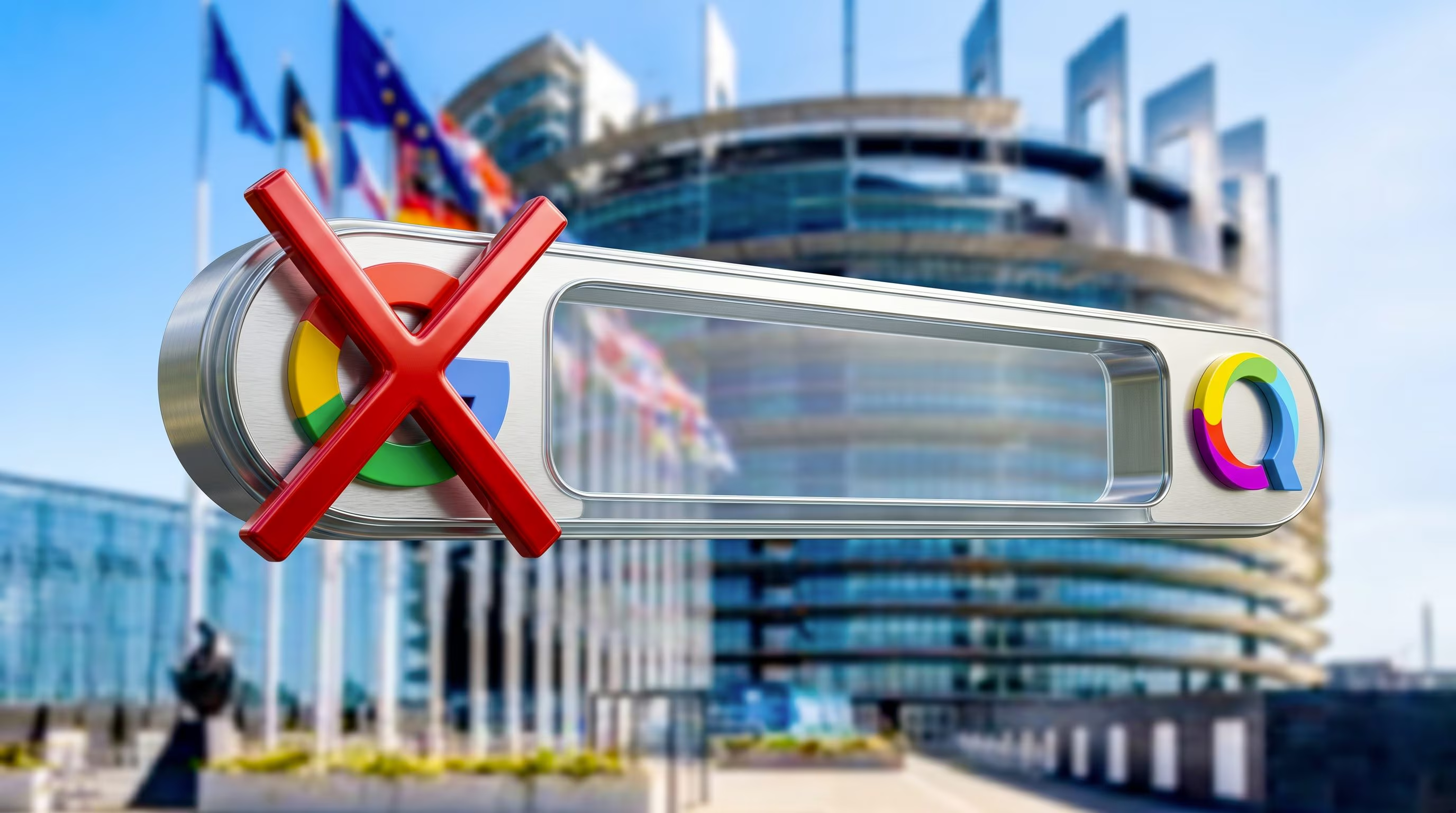
The European Parliament’s computers will no longer use Google as their default search engine, which will be replaced by French Qwantfounded in 2013. This was directly confirmed to Reuters by a spokesperson for the EU Parliament, who declared that from 4 June 2026 Qwant will become the default search engine on the EU institution’s Microsoft Edge and Mozilla Firefox browsers, with the aim of promoting European digital sovereignty and strengthening the protection of users’ personal data.
The change is automaticbut users will still be able to return to using Google (as well as other search engines) or change their default settings. But what is Qwant, why is this replacement happening now, and what does geopolitics have to do with a search bar?
What is Qwant and how does it work
Qwant was born in France in 2013 with a specific idea: to do research on the internet without leaving traces. That’s why the search engine doesn’t memorize the historian of searches, does not use cookies profiling, digit le query (i.e. converts them into an unreadable code during transmission, so no one can intercept them) e it doesn’t build over time a commercial profile on the user.
To be clear, two people carrying out the same online search from different cities see the same results: no algorithmic bubbles, no opaque personalization. To finance itself without selling data, Qwant shows contextual advertising, i.e. linked to the words searched at that moment and not based on the user’s history.
In particular, each search engine works thanks to an index, that is, a gigantic map of everything that exists on the web. Building it takes years and enormous resources, and for a long time Qwant only had a partial one, integrating the results with those of Microsoft Bing. In recent years, however, he has started with Ecosia a joint venture (a business alliance in which two companies pool resources for a common project) to build a completely autonomous European index, cutting this umbilical cord with the American infrastructure.
The task of ensuring that privacy protections are effectively respected is instead assigned to CNILthe French public body that periodically checks its services.
EU technological sovereignty: why now
The timing of this change is not at all random: Parliament’s announcement came on 3 June, i.e. one day before the European Commission presented theEuropean Technological Sovereignty Package, i.e. the package of EU measures for technological sovereignty. The document includes regulations such as the Chips Act 2.0, the Cloud and AI Development Act and an Open Source Strategy and aims to strengthen European digital autonomy on semiconductors, artificial intelligence, but also cloud and software.
The starting point, in fact, is very critical: the EU depends on non-European suppliers for over 80% of strategic digital products and services. A fragility that has become urgent in the Trump era, aggravated by an American law that few know about: the Cloud Act of 2018 forces any US-based tech company to hand over the data it manages to the American authoritieseven if physically stored on European servers.
For the EU, this means that using programs or services like Gmail, Microsoft 365 or Amazon Web Services for sensitive documents could expose you to potential vulnerabilities. The transition to Qwant fits exactly into this framework: it is a political signal even before a technical one. Europe’s bet is that this time the institutional push is enough to keep up an alternative which, in terms of quality, has yet to demonstrate that it can hold its own against Google.