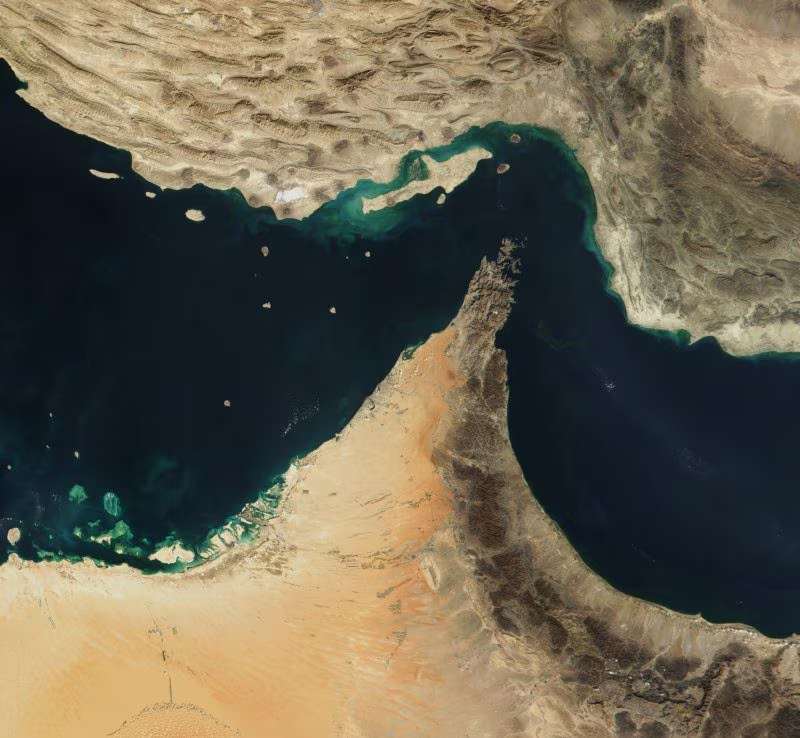
If the Strait of Hormuz becomes blocked, the problem is not just about rising fuel prices: the real risk is much broader and less visible. This Strait in fact represents one of the main “bottlenecks” of global trade: just 33 km wide at its narrowest point, with navigable lanes just 3 km wide, around a fifth of the world’s oil and around 20% of liquefied natural gas passes through Hormuz. But stopping at energy means not examining the complete picture: Hormuz is actually a hub where fundamental raw materials transit for numerous sectors, from agriculture to industry up to finance and advanced technology. When transit across the Strait slows down or stops, what is generated is not a simple energy crisis, but a chain reaction that runs through the entire global economy.
Energy crisis and strategic resources: oil, gas, helium
The first impact of the blockade of the Strait of Hormuz is undoubtedly energetic. About 20% of the world’s oil passes through Hormuz, making the Strait one of the most important chokepoints on the planet. Liquefied natural gas is also heavily dependent on this route: around a fifth of global LNG trade passes through the Strait, according to the IEA (International Energy Agency). This means that a significant part of the energy consumed in Asia and Europe depends indirectly on the stability of this passage. In the last weeks of April 2026, oil exceeded $110 per barrel, while the World Bank forecasts an overall increase in global energy prices of 24%.
Next to oil and gas, then, there is a less well-known but equally strategic element: helium. Qatar, one of the world’s leading helium producers, exports much of its production through Hormuz. According to data cited by the European Central Bank, approximately one third of global helium production is concentrated in Qatar and the Persian Gulf area. Helium is essential for semiconductors, necessary for the chips of the devices we use every day such as smartphones or computers but also in the medical field for tests such as magnetic resonance imaging and also in the field of scientific research. Among its characteristics, it is important to underline that it is not easily replaceable and does not last for a long time: for this reason even small logistical shocks can have immediate effects on technology and healthcare.
Agriculture, fertilizers and vegetable oils
One of the less obvious but equally important effects concerns agriculture: large volumes of fertilizers such as urea and ammonia, fundamental for global agricultural production, pass through the Persian Gulf. According to the World Economic Forum, a significant share of these flows passes through Hormuz. When supplies dwindle, fertilizer prices rise and farmers reduce their use. The effect is not immediate: it can manifest itself even months later, in the form of less productive harvests and therefore higher food prices. In the first months of 2026, those of urea have increased up to 50%, while the World Bank predicts an overall increase in fertilizers of more than 30%.
Added to this is another little-explored effect which concerns vegetable oils. In fact, in phases of energy crisis, the demand for biofuels increases, which use oils such as soya, rapeseed and palm. This creates a direct competition between food use and energy use of the same raw materials. Energy shocks such as the blockade of the Strait of Hormuz tend to increase the prices of agricultural commodities precisely because of this substitution effect between food and fuels and the result is an indirect pressure on many processed food products, which depend on these oils as main ingredients or as industrial inputs.
Chemistry, technology and global logistics
Another effect resulting from the Hormuz blockade concerns chemical raw materials and industrial gases. Sulfur, methanol and petrochemical derivatives passing through the Gulf are essential for fertilizers, plastics and industrial materials and are a structural component of the global supply chain. In parallel, gases such as neon and argon are essential for semiconductors and medical technologies: theInternational Energy Agency highlights that these supply chains are highly concentrated and vulnerable to even partial disruptions.
Finally there is logistics: when risk increases, insurance costs rise, routes slow down and the overall efficiency of maritime trade decreases. So costs throughout the supply chain may increase even without full cross-Strait blockades. One of the least talked about effects, in this regard, concerns marine insurance. When geopolitical risk increases, insurance companies recalculate rates in real time. In 2026, according to industry analyzes reported by Reuters, “war risk premiums” (i.e. insurance premiums in the event of war) for ships transiting the Gulf have increased in some cases by over 300%. This does not block trade but makes it more expensive upstream, even if the oil physically continues to transit.
Hormuz is therefore not just an energetic passage. It is a node in which different and deeply interconnected sectors intertwine: energy, agriculture, chemistry, technology and food markets. The critical point is therefore not the crisis of a single sector, but their interdependence and it is precisely this interconnection that makes the Strait of Hormuz one of the most fragile and sensitive points of the current global economy, with repercussions in sectors that are sometimes little explored.