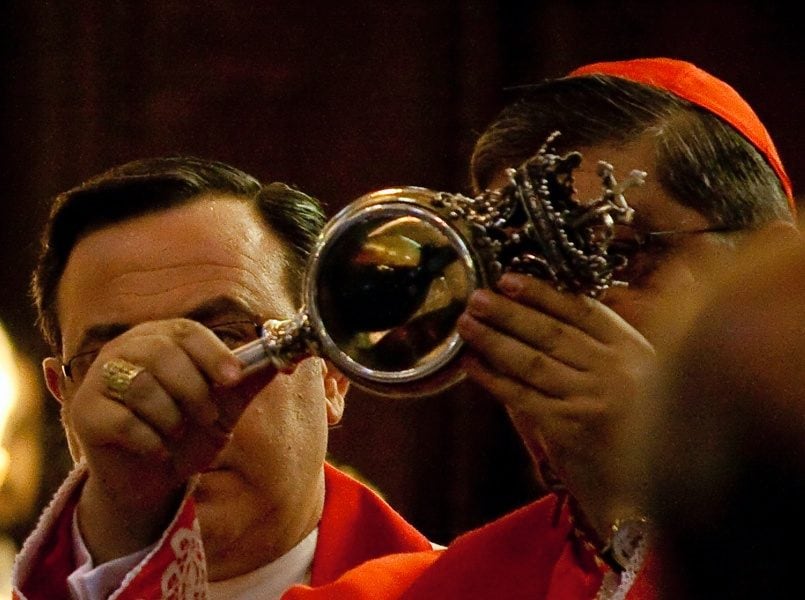
In the Cathedral of Naples, an ampoule is kept that should contain the blood of San Gennaro, the patron saint of the city. During some anniversaries, such as the feast of the saint who is celebrated on September 19, the blood could “melt” or more correctly liquefy, then go from “coagulated” to liquid. According to tradition if this happens we speak of prodigy or “miracle” and a good hope event for the city and the inhabitants, while the lack of liquefaction is an unfavorable sign. Is there a plausible scientific explanation to why does it melt? From a chemical point of view, some hypotheses have been advanced to explain the phenomenon: one concerns a substance with a low melting point while another the presence of a thissotropic mixture.
To find out what happens with certainty, you should take a little of this liquid, analyze it with the current modern instrumentation and obtain information on its chemical composition. However, since the Catholic Church has never given permission to scientists to open the ampoule, for now nobody can really know what’s inside. In fact, the “analysis” were carried out, one of 1902 and one in 1989, but only studying the light from the liquid, without opening the ampoule. In addition, these studies have never been published in a magazine and consequently have not been validated by the scientific community.
However, there are two hypotheses on the content:
- The first is that it contains a substance that has a low melting point. So the temperature, for example through the heat of the hands, makes the merger takes place, the passage of state from solid to liquid.
- The second hypothesis is that it contains a tissotropic mixture. That is, a substance that is solid if it remains firm, but that if it is agitated becomes liquid and returns solid if it is left still firm.
The interesting thing to support this last theory is a study published in 1991 on Nature, one of the most prestigious and influential scientific journals in the world. In this study, three Cicap researchers (Italian Committee for the control of statements on pseudosciences) recreated a mixture using some substances and techniques that were available in the fourteenth century, when the first liquefaction occurred on August 17, 1389.
Scientists mixed ferric chloride (Fecl3), a salt also present on the slopes of Vesuvius, and football carbonate (caco₃), the limestone. This mixture was then left to soak in the water inside a piece of parchment and in the added end of the common kitchen salt (NaCl). A red substance was thus obtained with tissotropic properties, therefore initially solid, but which became liquid by shaking it.
This study shows that technically in the Middle Ages such a substance could be produced, but it is good to reiterate that it is only a hypothesis and that until the ampoule is opened we will never be able to know with certainty what it contains.
At this point the question can arise spontaneously: how do you explain the times when the blood does not melt? According to the first hypothesis, a plausible response would be that the temperature does not reach high enough values to be able to merge the mixture. While in the event that there was a thissotropic mixture, the ampoule may not have been agitated with sufficient energy and that therefore the substance could not show its ability to change the state of solid to liquid.
In any case, you live or Sang and San Gennar!
fratm