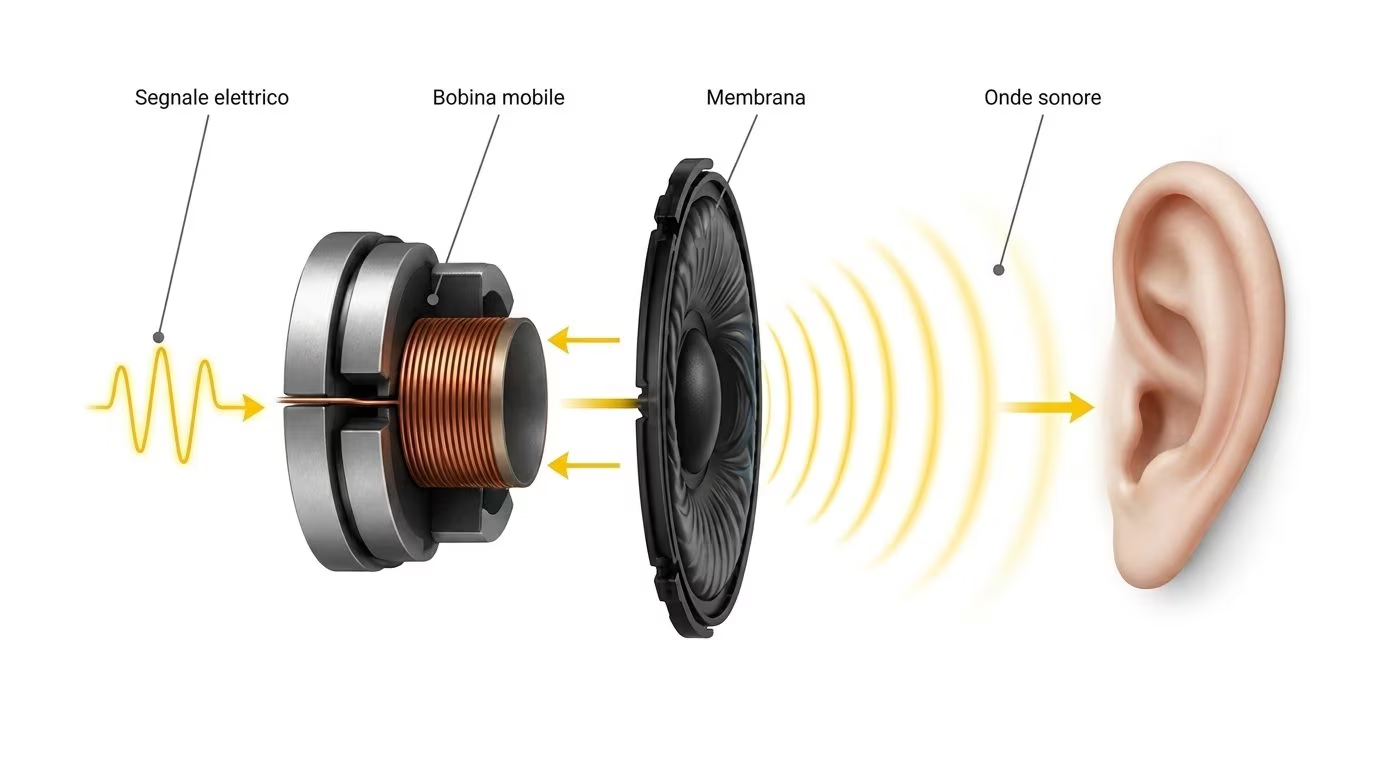
Music, podcasts, phone calls and videos have one thing in common: to be listened to on headphones they must be transformed into sound waves. The surprising detail is that no sound travels inside the headphones. In fact, what travels along the cable or wireless connection are electrical signals that must be converted into air vibrations before they can reach the human ear.
The speaker, often also called driver, carries out this task. This is the component responsible for producing sound and represents the true heart of any headphones. Small as it may be, it operates on the same physical principles that make speakers in much larger speakers work.
The speaker is the component that transforms electricity into sound
At the basis of the speaker’s operation there is a relatively simple physical principle. From a technical point of view it is an electroacoustic transducer, that is, a device designed to convert one form of energy into another. In the case of headphones, the goal is to transform the electrical signals coming from the audio source into mechanical vibrations capable of moving the air.
This process happens thousands of times per second and with an astonishing level of precision. Every musical note, every word spoken during a call and every sound effect present in a film are reconstructed by the speaker through a series of microscopic movements.
The most used technology in modern headphones is that of the dynamic driver, a solution that combines small dimensions, low consumption and good sound quality. It is precisely this type of speaker that is found in most earphones and headphones on the market.
The three fundamental elements of the driver
To understand how sound is born it is necessary to observe what is hidden inside a dynamic driver. The system consists of three main components: a permanent magnet, a voice coil and a membrane.
The magnet has the task of generating a constant magnetic field. The coil, otherwise called voice coil, is instead made up of a thin metal wire wound in a spiral and positioned inside the magnetic field produced by the magnet.
An extremely light membrane is connected to the coil, often made of plastic or composite materials. This is the part that, when moving, physically generates sound waves.
Taken individually, these elements do not produce any particular effect. However, when an electrical signal passes through them, they begin to interact with each other, exploiting one of the fundamental phenomena of electromagnetism.
What happens when a song starts
When a song starts playing, the source device sends an electrical signal to the speaker that contains all the information necessary to reconstruct the original sound. Current passes through the voice coil, temporarily turning it into an electromagnet. At this point, the permanent magnet inside the driver comes into play.
Since magnetic fields can attract or repel each other depending on their configuration, the coil is continually pushed back and forth following variations in the electrical signal. The movement is extremely rapid and can repeat itself thousands of times within a single second.
The coil, however, does not move by itself. Being connected directly to the membrane, it also drags the latter along with it.
How sound is born: the movement of air
The membrane can be imagined as a tiny vibrating surface, in some respects similar to the skin of a drum. When it moves forward it slightly compresses the air in front of it, while when it moves backwards it generates a small decrease in pressure. These continuous pressure variations propagate into the environment in the form of sound waves.
In practice, the sound is not “created” by the electric current, but by the movement of the air caused by the membrane. The speaker therefore plays the role of intermediary between the world of electronics and that of sound waves.
The entire process occurs almost instantaneously. Extremely short times pass from the moment the signal reaches the driver to the moment the sound reaches the eardrum.
Because they feel low, medium and high
One of the most fascinating aspects of the functioning of headphones concerns the ability to reproduce very different frequencies while always using the same component. The difference between bass, medium and treble depends in fact on the speed with which the membrane vibrates.
Low frequencies, such as those produced by a bass drum or electric bass, correspond to relatively slow and wide oscillations. Higher frequencies, however, require much faster movements.
To give an idea of the precision needed, the human ear can perceive sounds up to around 20,000 Hz, i.e. 20,000 oscillations per second. For reproduction to be faithful, the membrane must therefore be able to follow extremely rapid variations without deforming or introducing unwanted distortions.
Also for this reason, the materials, shape and dimensions of the driver play an important role in the final listening quality.
Why dynamic drivers dominate the market
In the audio sector there are alternative technologies to dynamic drivers. Some high-end headphones use, for example, planar magnetic drivers or alternatively electrostatic systems, capable of offering particularly high performance in certain contexts.
Despite this, dynamic drivers continue to represent the most popular solution. The reason is quite simple: they manage to offer an excellent compromise between sound quality, energy consumption, production cost and size. They can be miniaturized into very compact earphones and work well even with the limited power provided by smartphones and portable devices. This combination of features has made them the reference standard for much of the consumer market.
A small electromagnetic system hidden in the ears
Behind every song listened to through headphones lies a much more complex process than it might seem at first glance. In fact, inside each pavilion works a tiny electromagnetic system composed of magnets, coil and membrane, designed to continuously transform electrical signals into movement.
The speaker faithfully reconstructs the vibrations in the air corresponding to the received signal. It is precisely this sophisticated electromagnetic system that converts electrical signals into sound waves within a fraction of a second.