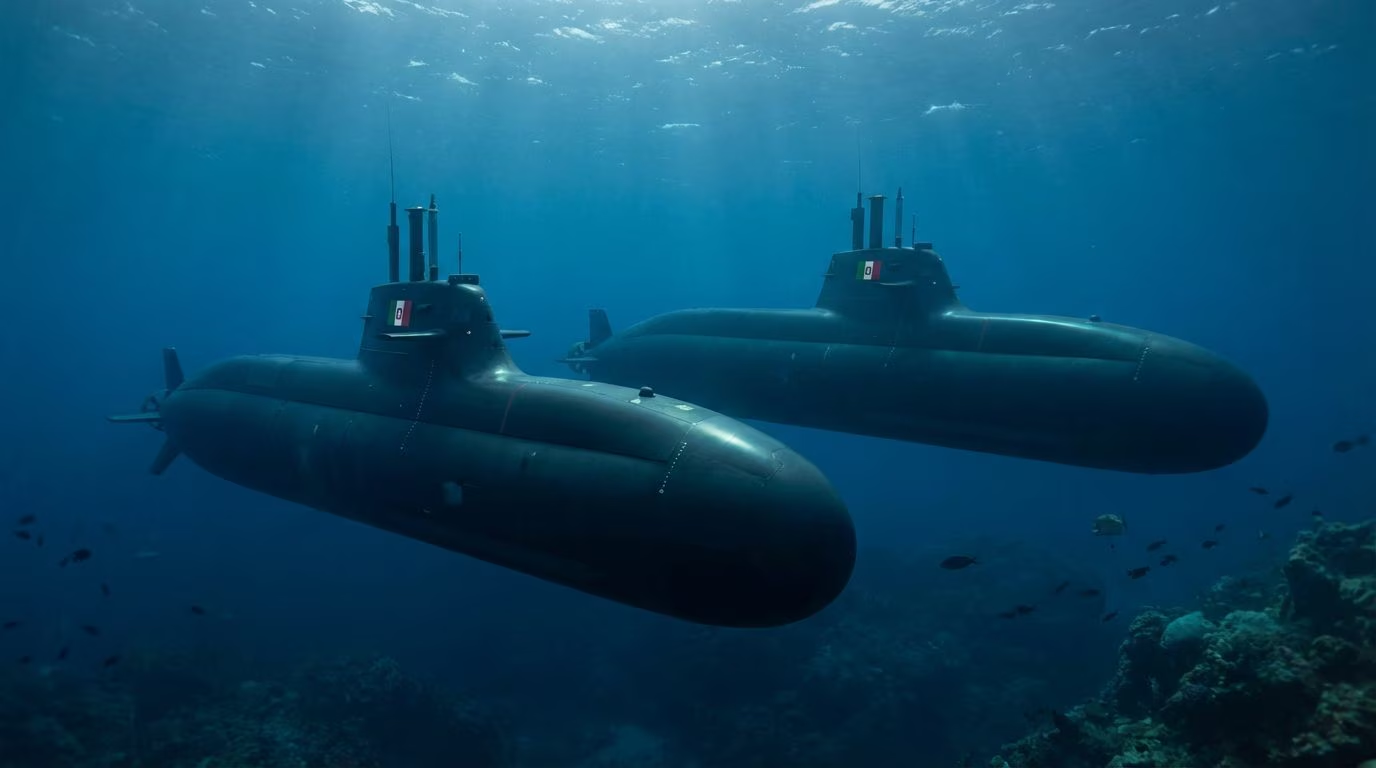
The Italian Navy currently has 8 submarines in service: the national fleet is made up of 4 units of the “Sauro class” and 4 of the “Todaro class”. However, “underwater boats”, first “submarines” and then “submarines” have always captured the imagination of the general public and, at the same time, thanks also to the results obtained during various wars and international crises, the attention of military strategists as they are ideal weapons for projecting power at short or long distances but in a discreet, if not to say sneaky, manner, thanks to their silent navigation capabilities under water. Italy is one of the countries that has operated and continues to operate such “boats” and is determined to remain relevant within this small club of nations, not least thanks to its industrial expertise.
The Italian submarines of the Royal Navy: the Delfino
On 1 April 1895 the Royal Navy launched the first “submarine” in its history, the “Delfino”, which would remain in service until the end of the First World War. In the following fifty years, the Kingdom of Italy became one of the most important powers in the underwater field and its submarines distinguished themselves during both the First and Second World Wars, also contributing to amplifying the operational capabilities of the first naval raider unit in history, the famous 10th MAS Flotilla.
Parallel to the numerical growth of the Italian underwater weapon, the technological and productive capabilities of the national industry also grew which, thanks to the presence of cutting-edge shipyards, managed to design some of the most sophisticated classes of submarines among those of the great powers involved in the aforementioned wars. Classes, the latter, which overall included hundreds of boats.
The “Silent Service” after the Second World War: the Toti and Sauro classes
At the end of the Second World War, as a defeated power, Italy was originally prohibited from rebuilding an underwater warfare component, but the renewed hostility found at a global level due to the new balance of power that characterized the Cold War forced the Western Allies to reconsider this decision, and already during the 1950s Italy had the opportunity to rebuild its “Silent Service” (an international term which identifies the operational branch of the Armed Forces that controls the submarines).
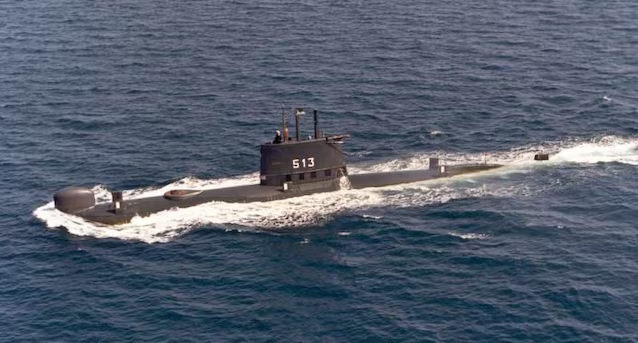
The first 9 submarines that Italy had in service after the Second World War were all of American origin (2 of the “Gato class”, 3 of the “Balao class”, 2 of the “Tench class” and 2 of the “Tang class”) designed during the Second World War or in the immediate post-war period and subsequently updated several times. Even though they were not considered top units in the technological field, they allowed our Navy to re-enter the “club of underwater powers” from which it had been expelled.
Starting from the end of the 1960s, the Navy began to remove submarines of US origin and introduce into service two classes of nationally designed submarines: the “Toti class” (4 units) and the “Sauro class” (8 units) which allowed the Italian shipbuilding industry to regain possession of the technical mastery necessary for the production of modern high-performance submarines, reviving Italian traditions in the sector.
From the Todaro to the U-212 NFS class: what are Italy’s submarines today
Currently the Navy boasts a “Silent Service” made up of 8 units. The first 4 are the survivors of the “Sauro class”, belonging to its most technologically advanced series, while the other 4 belong to the “Todaro class”, the Italian variant of the “Type 212A/U-212A class” submarines that Italy developed jointly with Germany.
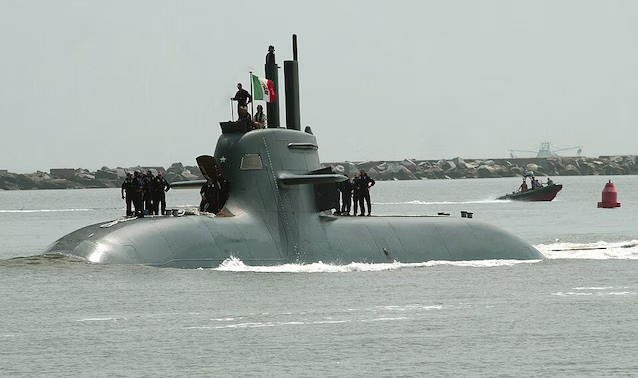
At the moment, the modernization programs include the progressive decommissioning of even the last Sauros and their replacement with 4 new “U-212 NFS class” (Near Future Submarine), a new technological standard to which the U-212As now in service should also be brought. This should keep the numerical threshold of 8 units unchanged (currently considered indispensable), and at the same time guarantee an increase in operational capabilities, allowing the Italian submarine fleet to remain a first-rate force on the international scene well into the 21st century. Currently, the Italian Navy does not own or operate nuclear-powered submarines.