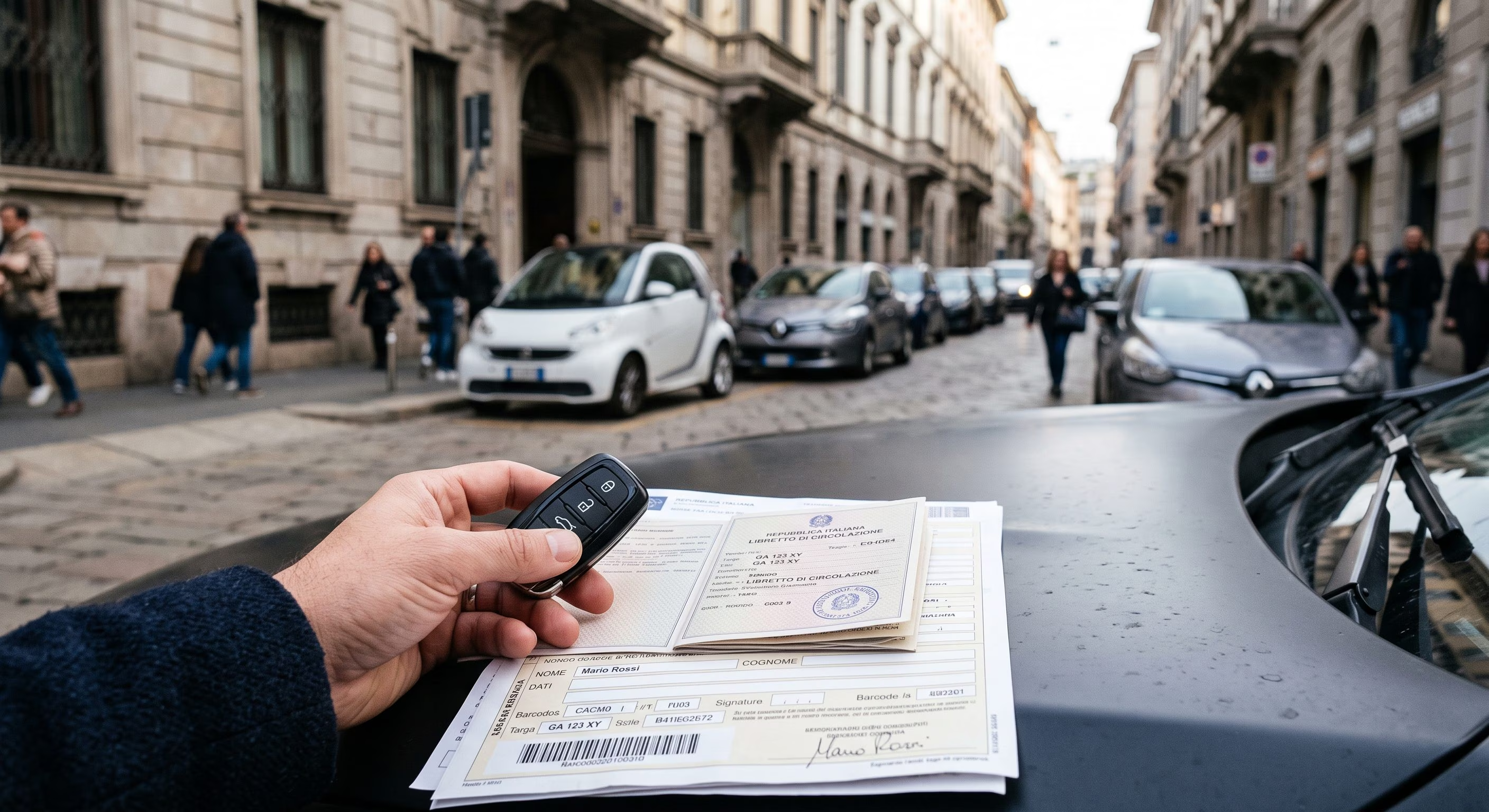
Every year millions of Italian motorists have to deal with an expense and a deadline that they know well: car tax. This is a car tax, a tax linked to the ownership of a vehicle registered in the Public Automotive Registry (PRA). Some changes relating to this tax will come into force from 1 January 2028: it should be immediately specified, however, that the reform will not concern the amount of the tax. Rather, the timing and deadlines for payments will change, with the deadline for the first payment of the fee being set “on the last day of the month following the month of enrolment”.
The amount of this tax, however, is not the same for everyone: it depends on elements such as the type of vehicle, the environmental class and the actual power of the vehicle. It is possible to automatically calculate the amount of your car tax via the dedicated ACI portal, available at this link.
The car tax is managed by the Regions and the Autonomous Provinces of Trento and Bolzano, with only two exceptions: Friuli-Venezia Giulia and Sardinia, where management is entrusted to the Revenue Agency. According to the most recent data released by the Court of Auditors, for the Regions with ordinary statute the revenue deriving from car taxes is equivalent to approximately 7.1 billion euros, approximately 5.7% of the total tax revenue for the Regions with ordinary statute (over 125.3 billion euros).
How to calculate the car tax amount: power and class
As anticipated, the amount of the car tax depends on the class of the vehicle. For cars, buses, special purpose vehicles and motorcycles, the tax is calculated on the actual power of the vehicle expressed in kilowatts (kW), a figure present in the registration certificate.
Environmental class
For cars, mixed-transport vehicles and motorcycles, the tax is differentiated based on the Euro class on polluting emissions: the higher the class of the vehicle (and therefore the less polluting), the less you pay.
An exception is made for vehicles powered (exclusively or dually) by electricity, methane, LPG or hydrogen, which are always taxed with the more favorable amount foreseen for Euro 4 vehicles.
Power
For cars and mixed transport vehicles exceeding 100 kW, the excess part is taxed at an increased rate: multiply the basic amount by the first 100 kW and add the additional kW multiplied by the increased rate.
The ACI reports a concrete example: a 110 kW Euro 3 car could pay 2.70 euros per kW up to 100 kW, plus 4.05 euros for each kW over 100, for a total of 310.5 euros in car tax.
But be careful: the rates are established by each individual Region or autonomous Province, so the same vehicle can cost different amounts depending on where it is registered.
And the super stamp? As confirmed by the ACI, when the car’s power exceeds 185 kW, in addition to the ordinary tax, a tax surcharge is applied, precisely defined super stamp. In particular, it is an addition of 20 euros for each KW of vehicle power greater than 185 KW: while the car tax is a tax that ends up in the Regions, the super tax is a state surtax, i.e. destined for the treasury.
To be clear, a modern small car generally varies between 45 kW and 75 kWwhile sports cars and large SUVs exceed the 185 kW threshold.
Revenue from car taxes is equivalent to approximately 7.1 billion euros
But how much do car taxes weigh on the tax revenues of the Regions? The most updated data comes from the Court of Auditors, in the Report on the financial management of the Regions and autonomous Provinces relating to the financial years 2021-2024.
Let’s start with the numbers. In 2023, for the Regions with ordinary statute, revenues of approximately 7.1 billion euros were ascertained for the car tax, an increase compared to the 6.6 billion in 2021.
This figure, however, must be put into perspective: in the same year the total tax revenue of the regions with ordinary statute exceeded 125.3 billion euros. The car tax, therefore, accounts for approximately 5.7% of the total.
The overall weight of these car taxes, therefore, is relatively low and this can be explained by looking at the composition of regional revenues. The largest slice is in fact absorbed by taxes intended for healthcare: VAT sharing for healthcare, the main source of revenue, alone is worth over 68.4 billion euros assessed in 2023.
Then there is a detail to take into account: car tax is among the most difficult revenues to collect. In 2023, its collection capacity for ordinary statute Regions stopped at 80.17%, compared to percentages that for taxes related to healthcare are close to or exceed 94-98%.
The Court of Auditors has not yet published more recent data relating to 2025: however, according to a study by Codacons (based on Siope data) last year the combination of car tax, PRA registration tax and tax on car liability insurance brought a total revenue of 11.3 billion euros to the Regions and Municipalities, equal to an average of 438 euros per resident family. This figure, however, refers to three different taxes and considers Regions and Municipalities together and is therefore not directly comparable with the 5.7% calculated on regional tax revenues alone.