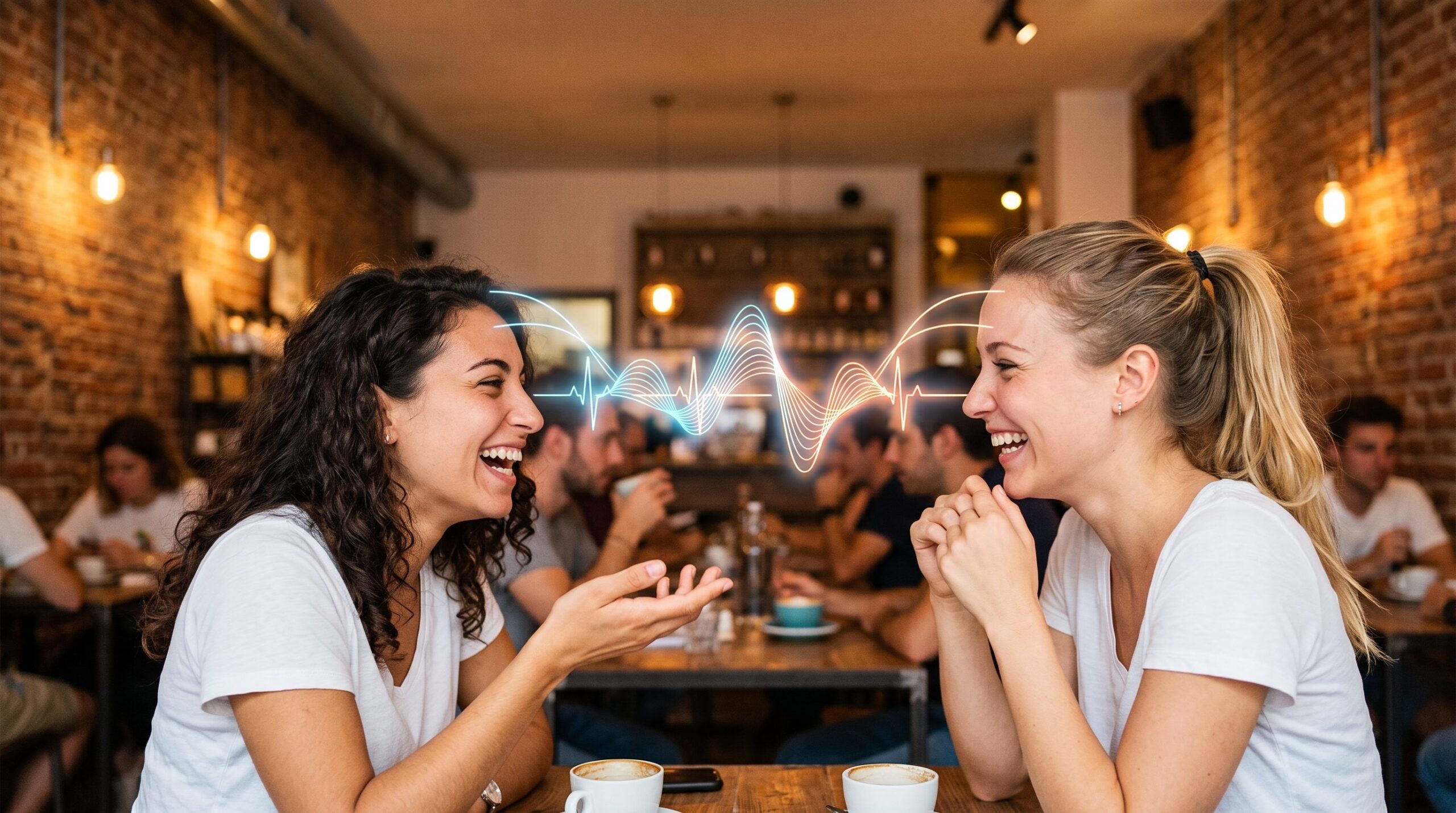
“Come on, I don’t believe it. I was just about to say that.” How many times has this happened to us? With a friend, with your partner or with someone we know very well. We can find ourselves laughing at the same time, finishing the sentence that the other hasn’t finished yet, or even having the same idea.
We call it harmony, we say we are “on the same wavelength”. But what really happens when two people seem to be in sync? Psychology has found no evidence that there is a mysterious transmission of thoughts between two people. However, he discovered that when we interact, we can influence each other much more than we imagine: in the body, in movements, in emotions, in the way we speak and even in brain activity. Furthermore, synchrony does not necessarily mean doing or feeling exactly the same thing at the same time, but rather learning to predict the other and continually adapt to what he or she will do.
Heart rate can synchronize during interactions
When two people interact, some physiological signals may also begin to show coordinated changes. One of the most interesting examples concerns heart rate.
A study published in 2026 in PNAS Nexus tracked 72 people during three multi-day trips to New York, collecting nearly a thousand hours of physiological data along with location and environmental information. The researchers observed that heart rates tended to synchronize when people were in close physical proximity, but especially when they were involved in the same situation. Synchrony was greater among people who were familiar with each other and who shared attention towards the same stimuli. This does not mean, of course, that two hearts start beating at exactly the same rhythm: it is a temporal correlation in the variations in heart rate.
The environment also seemed to play a role: in the noisiest places, in fact, synchrony decreased. One possible explanation is that noise makes it more difficult to interact and share experiences, thus reducing opportunities for mutual engagement. In short, it is not enough to simply be next to each other. What makes the difference seems to be the opportunity to interact and share something with the other person.
The chameleon effect: we imitate others unconsciously
Synchrony does not only concern physiological aspects, but can also involve movement. During a conversation it may happen, for example, that a person crosses their legs and shortly afterwards we do it too; or he may smile, make a small gesture or assume a certain posture that we end up unconsciously reproducing.
In 1999, psychologists Tanya Chartrand and John Bargh called this phenomenon the chameleon effect: the tendency of people to involuntarily imitate certain behaviors of their interlocutor. In one of their experiments, participants tended to unconsciously reproduce some movements of the collaborators with whom they were carrying out a task. In a second experiment, however, the researchers imitated the participants; well, those who were imitated perceived the interaction to be more fluid and found their interlocutor more likeable.
The study therefore suggested that our behavior continuously adapts to that of the person we interact with, often without realizing it. At a brain level, the basis of this behavior is the activation of mirror neurons, a network of motor neurons that are activated when we see someone perform a purposeful action or when we perform it ourselves.
This mechanism can also concern language: do you know when we spend time with a person who speaks in a certain way and, almost without realizing it, we pick up some expressions, the rhythm or even the tone of voice? Well, this too can be a form of adaptation to the other.
Emotions can also become “infected”
Synchronization isn’t just about the body. During an interaction, we can also influence each other on an emotional level (emotional contagion).
An exemplary experiment is the one conducted by psychologist Sigal Barsade in 2002. The researcher divided 94 business students into small groups for a decision-making simulation. In each group there was a collaborator trained to manifest a specific emotional state through tone of voice, facial expressions and body language. The content of his arguments remained as much the same as possible for both groups: what changed above all was the way in which he expressed them. The result was that the emotional state of the collaborator tended to be reflected in the other members of the group. Participants showed mood changes in the same direction (positive or negative), resulting in changes in group performance.
In other words, the mood of others can “infect” us, leading us to align, at least in part, our emotional state with theirs.
Knowing the other helps us anticipate what he or she will do
There is another even more interesting element: when we interact, we don’t just react to what the other does, but we progressively learn to predict it.
In 2010, Greg Stephens, Lauren Silbert and Uri Hasson, in their studio “Speaker–listener neural coupling underlies successful communication”, they investigated with functional magnetic resonance imaging (fMRI) what happens in a person’s brain while listening to someone tell a story. The researchers observed that the listener’s brain activity coupled with that of the speaker and that, in some regions, it even preceded it. Furthermore, the greater this anticipatory coupling, the better the understanding of the story. However, when communication did not work, for example because the listeners did not know the language used by the speaker, the coupling was drastically reduced.
This does not mean that two people are thinking exactly the same thing, nor that a thought can pass directly from one brain to another. The connection passes through communication: words, sounds, gestures, expressions and context. In short, the listener uses all this information to build predictions about what the other is about to say or do.
And in everyday life this ability can become surprisingly precise. Let’s think about when someone asks us a question and, even before they finish speaking, we have already understood what they want to know. Or when we hear the first words of a joke and we already know how it will end. There is no need for a mysterious connection between two minds: our brain uses what it knows about the context, the situation and the person in front of us to anticipate what is likely to come.
Is this how we can come to think “the same thing”?
Maybe, at least in part. Let’s imagine two friends who have known each other for ten years. They’ve seen the same movies, know the same people, share dozens of memories, and have developed jokes and references that only they understand. When they find themselves faced with the same situation, therefore, they not only share the same stimulus: they also know the way in which the other tends to interpret it.
If I know that my friend finds a certain situation funny, I can expect his joke. If I know he hates something, I can predict his reaction before he even speaks.
The same can happen with thoughts. It is not necessary to imagine that a thought has passed from one mind to another: we may simply have arrived at the same point because, through hundreds of interactions, we have learned to predict the other and the way in which he interprets what is around us.
Perhaps, therefore, being “on the same wavelength” or “thinking the same thing” means precisely this: continually influencing us in the way we move, speak, react emotionally and interpret what happens. The more we share experiences, the more we know a person, the more predictable we can become for each other.