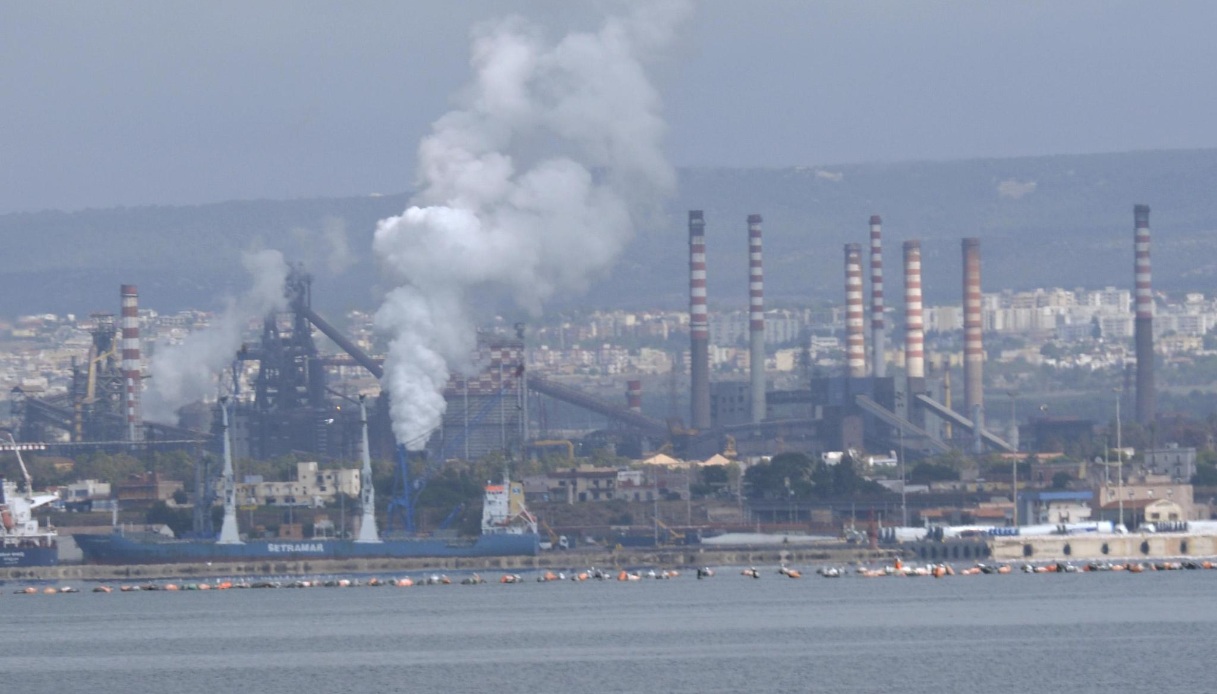
The field is narrowed in the battle for steelworks of Italy. With the step back of the Azero Consortium, composed of Baku Steel Company and Azerbaijan Investment Company, now the Indian steel giant Jindal and the American investment fund Bedrock remain in the race. This remediation may have pushed the government to postpone the deadline to present the offers, which can be slipped from 15 to 26 September. It is a mini-program, designed to grant more time to candidate companies and deepen some technical aspects.
The two challenge between Jindal and Bedrock
The motivations of the step back of the Azeri have not yet been officially communicated, but it seems that there may be the refusal of the municipality to the approval of a regasifying ship in the port of Taranto. Useful to feed the decarbonisation process of the steel system, but strongly contested by environmentalists and city committees.
The mayor of the city, Piero Bitetti, has categorically denied this hypothesis, without however providing further details. The absence of a lines, however, is a significant and crucial factor in the decarbonisation process, a crucial aspect underlined by the Business Minister, Adolfo Urso.
Jindal and Bedrock remain in the race, two completely opposite companies: the first focus on operational experience in the sector, the second on financial conversion. To the government, therefore, it is up to the decision that entrusting the fate of the largest and most controversial plant in Europe to those who make the steel or those who “repair” companies. A decision that will have to evaluate not only the numbers, but also the production, employment and environmental future of Taranto.
And the government refers the deadline
All these reasons led the government to carry out an extension to the expiry of the sending of the candidates for the former Ilva. As the note explains, the decision was made:
With the aim of allowing proponents to complete the necessary documentation, in full compliance with the principles of transparency and equal treatment between the operators involved.
The extension had been confirmed by Urso, explaining that “objectively the conditions we placed for full decarbonisation in the shortest possible time are stringent” and moreover we must “take note of the fact that there will be no reversal ship that can give that gas necessary to make the pre -launch center in Taranto anyway”.
The “Spezzatino” hypothesis appears: what it is
If the final duel is between the Indian giant Jindal Steel and the American fund Bedrock Industries, a third option overlooks the horizon: the “stew” solution.
In fact, it is not excluded that the proposals for the entire group can evolve into offers for individual assets. In this scenario, several subjects – including the two current contenders – would only acquire specific parts of the factory, making them autonomous and sustainable.
A similar approach would radically change the future of the largest steel center in Europe. The potential advantages are a possible acceleration in the conversion of the most polluting systems, with each new owner called to invest rapidly in the asset purchased to make it productive. On the other hand, however, enormous risks are looming: fragmentation would compromise the consistency and industrial integration of the site forever. The end of a unified production cycle could undermine the overall efficiency, logistics and perhaps even the employment budget.
The government, called to decide, will therefore have to evaluate not only two contenders, but also two philosophies: to save the former Ilva as the only great pole or start a controlled distribution, an unprecedented experiment, destined to leave a completely unprecedented imprint.