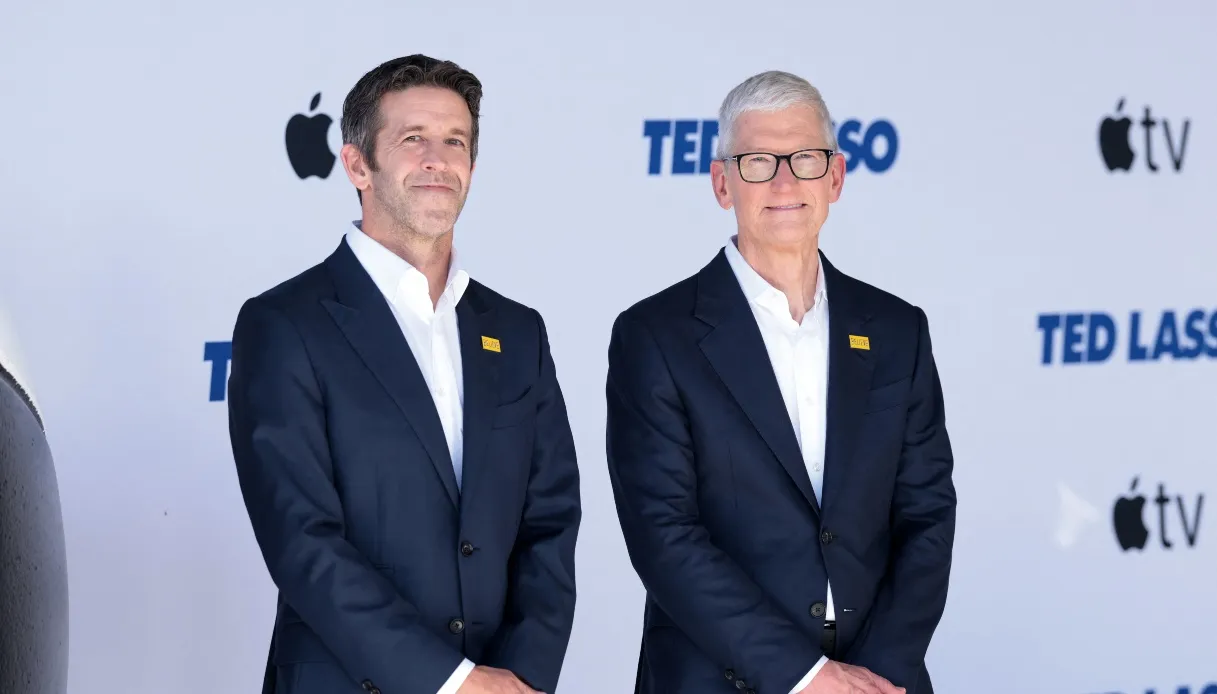
After 15 years, Tim Cook leaves the helm of Apple. The baton passes to John Ternus, previously head of Apple’s hardware division. A handover that not only concerns roles, but also a new remuneration structure that commits the group to over 100 million dollars a year. Ternus will have a target compensation package of $58 million for 2027, while Tim Cook, who has moved to the role of executive chairman, will have a compensation of approximately $47 million.
Mind-boggling figures, but with a logic: that of linking the majority of the remuneration to the performance of the stock and the value created for shareholders.
The numbers of the new remuneration structure
According to the document filed by Apple with the Securities and Exchange Commission (SEC) on September 1, the Ternus package for 2027 consists of:
- annual base salary of $3 million.
- target share bonus of 55 million dollars, of which 75% (approximately 41.25 million) in restricted stock units (RSUs), while the remaining 25% (approximately 13.75 million) will instead be made up of time-based RSUs, i.e. linked to permanence in the company, with semi-annual vesting of 12.5% every six months for four years.
For the final months of 2026, Ternus also receives an RSU award of $2.5 million, proportional to his time as CEO.
Tim Cook, in the new role of executive chairman, will have:
- an annual base salary of $2 million;
- a target equity premium of 45 million dollars, of which 50% (22.5 million) in RSUs, always linked to the relative return of Apple stock, and 50% (22.5 million) in time-based RSUs, with the same rules that apply to Ternus.
In 2025, when he was still CEO, Cook had received a total of $74.3 million, including salary, stock awards, cash bonuses and other compensation.
Ternus’ greeting
Ternus yesterday chose to present himself publicly in the new role of CEO of Apple in a simple way: his post on X simply reads “hello”. Just one word, but deeply linked to the history of Apple. “Hello” appeared on the screen of the first Macintosh in January 1984, which also pronounced it in a robotic voice. Even today the word appears the first time you start up an iPhone or iPad.
Because packages are built like that
There’s a reason why compensation is structured this way. This is because they are not guaranteed checks, but target values: the share portion depends on the performance of the stock and, for the performance-based portion, on Apple’s result compared to the companies in the S&P 500. In other words, the higher Apple’s performance compared to the benchmark, the higher the remuneration linked to the results can be.
What changes for Apple with Ternus
John Ternus inherits a much larger company than the one entrusted to Cook in 2011: during Cook’s 15 years, Apple’s capitalization went from around 350 billion to over 4,500 billion dollars, with annual revenues growing from 108 to 416 billion and profits above 112 billion.
However, there is no shortage of challenges. The most urgent concerns artificial intelligence, a sector in which Apple is called to catch up after delays in the development of new Siri features and in the integration of AI into products. Added to this is the need to continue the diversification of the production chain, reducing dependence on China without compressing margins. Apple has already expanded production in India and Vietnam and aims to make the majority of iPhones destined for the US market in India by the end of 2026.