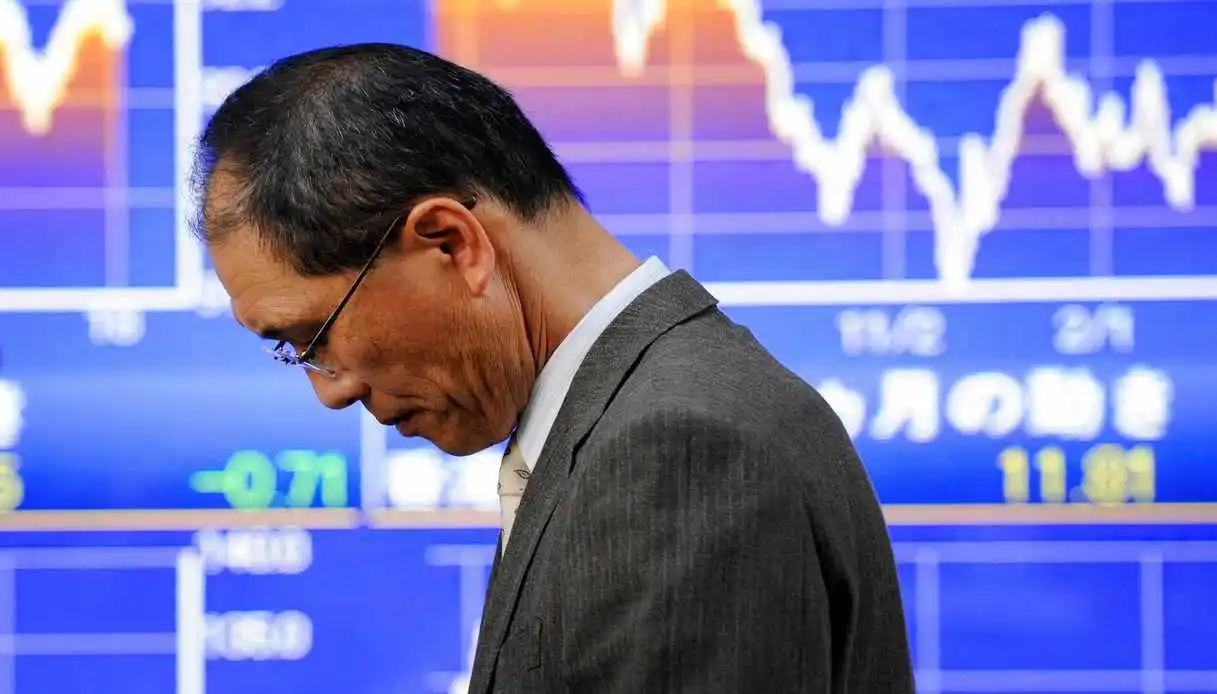
The Nikkei loses around 3% and the Kospi over 3% after the new clashes between the United States and Iran. The ten-year Treasury exceeds 4.81%, while the chances of a Fed hike increase and the Bank of Japan opens up to a new tightening.
Asian stock markets are sinking under the weight of oil, bond yields and the return of the specter of inflation. In today’s session, Wednesday 2 September, Brent pushed towards 96 dollars a barrel, while the ten-year US Treasury exceeded 4.81%, reaching its highest level in almost three years.
The new increase in energy costs, caused by the military escalation between the United States and Iran, is rapidly changing expectations on central banks. The markets, which until a few weeks ago were looking at a stabilization of rates, are now once again evaluating new monetary tightening.
Asian stock markets in the red: Tokyo and Seoul collapse
The MSCI Asia-Pacific index lost about 1.5%. In Tokyo, the Nikkei lost almost 3%, penalized above all by technology and semiconductor stocks. Among the hardest hit are SoftBank, Advantest and Tokyo Electron, all sensitive to rising yields.
The session in Seoul was even more difficult, with the Kospi falling by more than 3%. Hong Kong and Shanghai recorded smaller declines, but the signal coming from the Asian markets remains clear: investors are reducing exposure to riskier assets.
The rise in yields, in fact, makes bonds more competitive than shares and especially penalizes technology companies, whose prices incorporate expected profits that are very distant in time.
The 10-year Treasury hit 4.8122%, while the five-year Japanese government bond yield rose to a record 2.295%.
Because oil rose towards 96 dollars
The new attacks between the United States and Iran reignited the rally in crude oil. Washington struck Iranian targets, while Tehran responded with missiles and drones against US installations in Jordan and Bahrain.
Brent, the international oil benchmark, thus reached close to 96 dollars a barrel, while the US WTI remained above 90 dollars.
Attention remains focused on the Strait of Hormuz, through which approximately one fifth of the world’s consumption of oil and petroleum products has historically passed. Attacks on oil tankers and the risk of new disruptions are increasing the geopolitical premium embedded in prices.
The 2.6 million barrel decline in U.S. inventories added further pressure to an already tense market. Traders are no longer assessing just the risk of individual attacks, but the consequences of a prolonged conflict over the availability of crude oil.
Fed and Bank of Japan, the risk of a rate increase returns
More expensive oil may result in a new increase in inflation, reducing central banks’ room for maneuver. In the United States, Fed Funds futures now indicate a probability of close to 67% of a 25 basis point increase at the September meeting.
The governor of the Bank of Japan, Kazuo Ueda, also opened up the possibility of a new tightening. The institute’s board will evaluate the impact of oil and yen weakness on prices at its meeting on September 17 and 18.
In fact, the Japanese currency remains above 160 per dollar, despite the prospect of higher rates. A weak yen makes energy imports more expensive and accentuates inflationary pressures in a country heavily dependent on foreign countries.
What changes for BTPs, mortgages and Italian families
The consequences can quickly reach Italy too. The first channel is that of fuels: a Brent steadily close to 100 dollars could translate into new increases in petrol and diesel prices, even if the transfer to the pumps is not immediate and also depends on the euro-dollar exchange rate.
The second concerns government bonds. The global increase in yields can also push up those of BTPs, causing the market value of the securities already in circulation to fall. The new issues could offer higher coupons, but at the same time it would increase the cost of public debt.
Finally, more persistent inflation could lead the ECB to keep rates high for longer or to consider a new tightening. In this scenario, the decline in mortgage rates would slow down and pressure on family spending would increase again.
The Asian session therefore shows that oil, bonds and stock markets are moving in the same direction again: crude oil and yields rise, while shares fall. Until signs of détente emerge between the United States and Iran, volatility is likely to remain high.