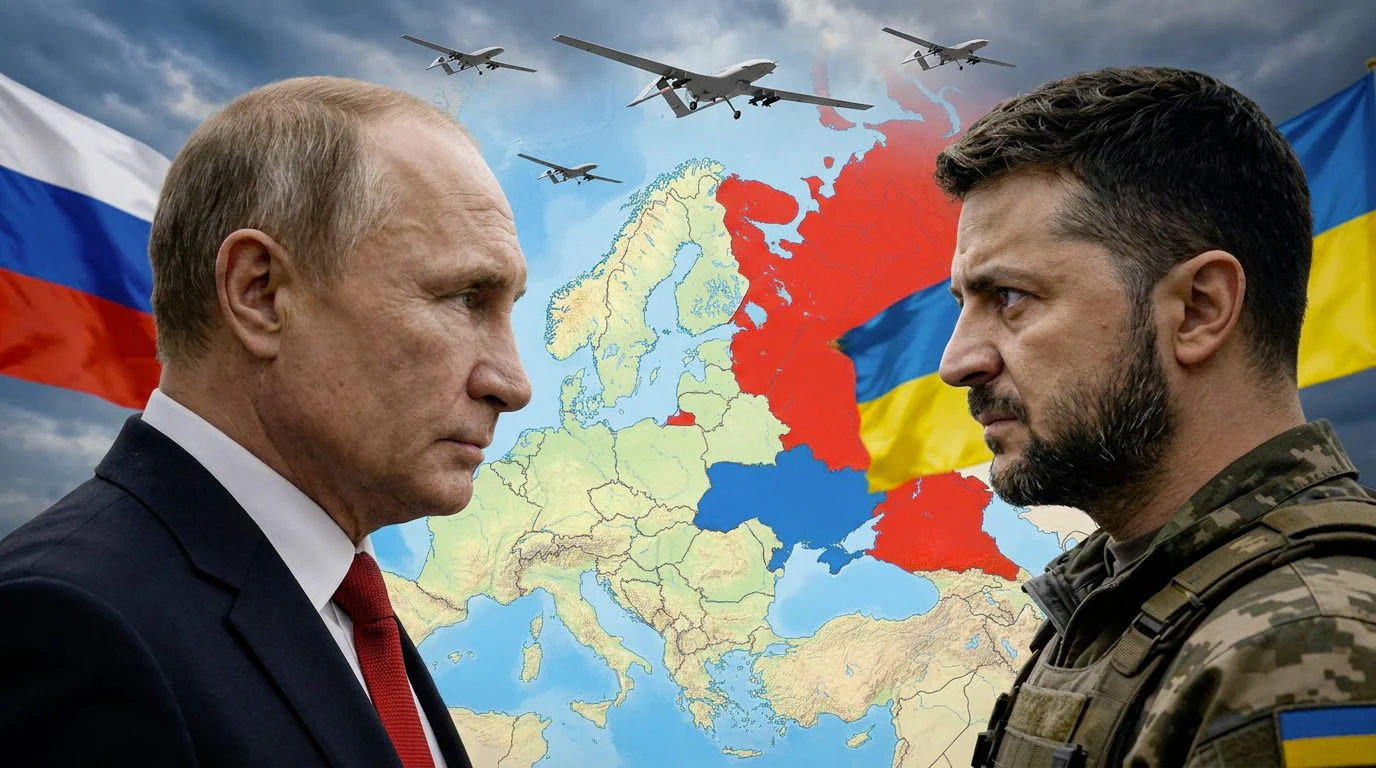
Russia’s large-scale invasion of Ukraine has upset global balances. What should have been a “lightning military operation” has in fact become a high-tech conflict of attrition, which has continued since February 2022: to fully understand the reasons, it is necessary to analyze its historical roots, the impact of drones on the front and the political constraints, such as the armoring in the Russian Constitution of the territories occupied by Moscow, which still make the requests for peace of the two parties irreconcilable.
Recently, the war seems to have entered a particularly violent phase and neither side seems willing to give in: the Ukrainian strategy now aims to hit Russian energy infrastructures (such as refineries) to paralyze supplies, while Moscow is betting on the progressive depletion of supplies and the political tiredness of the West and Kyiv.
The historical roots of the Russian-Ukrainian conflict
In 1991, the collapse of the Soviet Union led to the emergence of several independent states. Russia, the heart of the dissolved Soviet empire, found itself with around 25 million ethnic Russians living outside its borders, suddenly becoming minorities within the newly created post-Soviet countries, from the Baltic Republics to Central Asia, up to Ukraine.
This demographic factor has become a geopolitical double-edged sword:
- Moscow’s narrative: argues for the existence of a “moral duty” to protect these “sister” populations from alleged linguistic, social or cultural discrimination in host countries.
- The Western analysis: considers the presence of these minorities as a strategic lever of influence by Russia, which can be used as a potential tool for territorial claims or hybrid wars in neighboring countries.
Added to this complex post-Soviet legacy is the historical vision promoted by the Kremlin, according to which Russia, Ukraine and Belarus share the same cultural and state matrix, dating back to the Kyiv Rus’ of the 9th century.
From a strategic point of view, Ukraine has always represented an essential security “buffer” for Moscow; for this reason, its progressive rapprochement with NATO and the European Union is perceived by Russia as a direct threat to its sphere of influence.
On the contrary, Ukrainian historiography and many international analysts underline the existence of an autonomous national and state identity path, very distinct from that of Moscow.
2014: Euromaidan and the split
The turning point occurred between 2013 and 2014, when the decision of the pro-Russian Ukrainian president Viktor Yanukovych to freeze the Association Agreement with the EU triggered massive street protests in Kyiv (Euromaidan or Revolution of Dignity).
The readings of the events diverge sharply:
- For Russia: It was a coup orchestrated by the West to forcibly detach Ukraine from Moscow’s orbit.
- For Kyiv and the West: It was a spontaneous popular revolution to reaffirm national sovereignty and the European path.
Moscow’s response was immediate: the annexation of Crimea, which took place in March 2014, and subsequently the military and economic support to the pro-Russian separatist movements in the Donbas, began a war of attrition that lasted eight years.
2022, the year of large-scale invasion
On the night of February 23-24, 2022, Russia launched a large-scale invasion of Ukraine, officially calling it a “Special Military Operation.”
The choice of the term was not accidental. It served to avoid general internal mobilization and to present the intervention not as an open war, but as an operation with three purposes: to demilitarize the country, to “denazify” the political leadership and to protect the Russian-speaking populations of Donbas.
Even today, in Russia, using the term “war” is severely punished with several years in prison.
The initial plan for a blitzkrieg to occupy Kyiv in a few days and depose the government failed, however, due to rigid Ukrainian resistance, also supported by the West, and serious Russian logistical errors.
At the end of March the two nations attempted diplomacy for the first time, with a meeting held in Istanbul (Türkiye), which then ended in nothing. In autumn 2022, the Ukrainian army retook large portions of territory in the Kharkiv and Kherson regions.
From war of movement to stalemate
In 2023 the outlook has changed again. The Ukrainian summer counteroffensive crashed against the “Surovikin Line”: an imposing Russian defensive system made up of trenches, fortifications and endless minefields.
Without air superiority, the war of movement turns into a war of trenches and attrition. The advance of both sides becomes minimal and measured in metres, in the face of enormous human and material costs.
The technological revolution between drones and Starlink
In this context of stalemate, Ukraine has transformed the battlefield by exploiting technological innovation and using, among other things:
- FPV (First Person View) Drones: Commercial aircraft costing a few hundred dollars armed with explosives, capable of destroying million-dollar tanks.
- Transparent Battlefield: With thousands of reconnaissance drones always in the air, moving troops or vehicles without being seen in real time has become nearly impossible.
- Naval Drones and Deep Strike: Kyiv has used maritime drones to damage the Russian Black Sea Fleet and long-range aerial drones to strike refineries and fuel depots within Russian territory.
- The Starlink Factor: Since the early days, the low-orbit satellite network provided by SpaceX has become the backbone of Ukrainian communications. Without it it would not have been possible to coordinate artillery in real time or guide FPV and maritime drones. However, the Starlink case has highlighted an unprecedented geopolitical problem: the strong tactical dependence of a State on a private (US) company and on the decisions of its owner (Elon Musk).
This massive “droning” demonstrated how the saturation of the sky via low-cost swarms and electronic warfare can neutralize the most advanced conventional weapons, anticipating tactics that we see today also applied in recent crisis scenarios in the Middle East.
Why the war in Ukraine seems to have no end: the situation today
Even today the word “peace” not only does not seem close, but as recently stated by Kaja Kallas, High Representative of the Union for Foreign Affairs and Security Policy, the war seems to have entered a particularly violent phase. This is because neither side is willing to give in, convinced that their own strategy on the field will ultimately prevail.
More specifically:
- Ukrainian strategy bets on technological asymmetry. It uses long-range drones to target energy infrastructure (such as refineries) and military logistics on Russian territory, with the aim of drying up Moscow’s economic revenues and paralyzing its supplies.
- The Russian strategy instead focuses on the long term and large numbers. With a population three times larger, an economy entirely converted to war production and the commercial and technological support of partners such as China, Iran and North Korea, Moscow is betting on the progressive depletion of supplies and the political fatigue of the West and Ukraine.
At the same time, the two countries have completely incompatible political objectives. Moscow demands that Kyiv forever renounces the idea of joining NATO and that it cede the four regions (Donetsk, Luhansk, Zaporizhzhia and Kherson, as well as Crimea) that it has already annexed and protected within its own Constitution.
On the other hand, Ukraine refuses any territorial concessions, considering it not only an injustice, but a dangerous incentive for future invasions and annexations.
The “fuel war”: attacks on refineries and the domino effect in Asia
Aware of the impossibility of competing on conventional numbers, Ukraine has bet on long-range drones to target energy infrastructure in the heart of Russia, including refineries in Nizhny Novgorod, Samara and Ryazan. This campaign has paralyzed up to 10-15% of Russian refining capacity, triggering price increases on the domestic market and forcing the Kremlin to block gasoline exports.
The block generated a international domino effect in neighboring countries totally dependent on Moscow, such as Mongolia, which has remained dry for over 90% of its needs, and the nations of Central Asia.
Moscow responded to this pressure on multiple levels:
- Defensive re-displacement: the anti-aircraft systems (Pantsir and S-400) were taken from the front to protect refineries and industrial centers in European Russia.
- Mirror Retaliation: massive waves of attacks with Shahed missiles and drones hit the Ukrainian electricity grid, power plants and water infrastructure to paralyze the civil and economic life of Kyiv, now deprived of the air coverage provided by interceptors.
- Censorship and economic emergency: domestically, the Kremlin downplays the damage through propaganda, bans the dissemination of images of the affected sites and supports a war economy under severe pressure, with high inflation and interest rates soaring to around 18-20%.
The real cost of conflict: human losses
Military secrecy has been claimed on both sides regarding human losses, but independent analyzes allow us to evaluate the real impact of the war. According to a report by Center for Strategic and International Studies (CSIS), the numbers and logistics costs paint a significant picture:
- Russian human losses: CSIS estimates around 1.4 million overall losses for the Russian army since the beginning of the invasion (between dead, wounded and missing), with a share of casualties in the field of up to 450,000 soldiers.
- Loss ratio at the front: the massive use of drones and drone-guides by the Ukrainian side has pushed the tactical loss ratio (in some phases of the conflict) up to almost 8 to 1 in favor of the Ukrainian defense.
- The slowness of advances: studies show how the average rate of advance of Russian ground forces in the most fought-over directions (such as Pokrovsk or Sloviansk) fluctuated between 50 and 90 meters per day, ranking among the slowest rates of advance recorded in the conflicts of the last century.