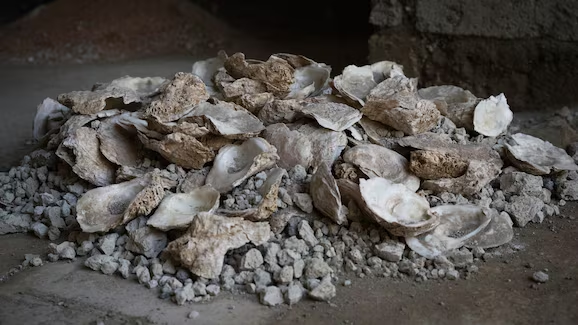
If Roman concrete has lasted so long through the millennia, we finally know why: during the excavations of a Roman construction site that remained intact since 79 AD and recently discovered in Pompeii, the use of “hot mixing”, a technique that gave the material self-repairing and resistance properties, was evident to archaeologists. Admir Masic, professor of civil and environmental engineering at the Massachusetts Institute of Technology (MIT) and responsible for the study published in the journal Nature, commented:
Studying it really felt like I was going back in time and being next to the workers as they mixed and placed the concrete
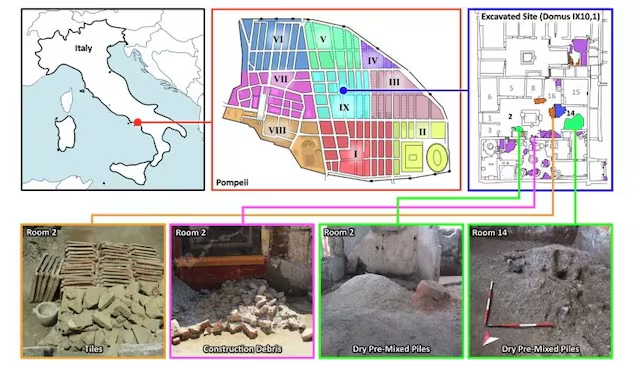
The discovery, in a building in the “Regio IX, Insula 10” of the city – with walls under construction, piles of raw materials, work tools and bricklayers’ tools – demonstrates that the bricklayers of the time mixed quicklime with dry volcanic materials before adding water, generating thermal reactions capable of preserving highly reactive minerals useful for healing the microfractures of the structures over time.
The discovery by the team of archaeologists is particularly rare for one reason: in fact, it is the first time that a true “active Roman construction site” has been found, and by “active” we mean that the building under construction inside it had not been completed due to the eruption of 79 AD, which sealed it with ash. Precisely for this reason, archaeologists were able to observe how building materials were prepared and mixed on half-finished structures.
Concrete was an indispensable building material for the Romans, who helped build structures such as the Colosseum, domed temples, baths, and even bridges and aqueducts, as this material can harden underwater (which also made it essential in the construction of harbors and breakwaters). For a long time it was thought that what was reported in the accounts reported in a 1st century BC treaty by the Roman architect and engineer Vitruvius was correct, i.e. that the Romans slaked quicklime with water to transform it into slaked lime, and then mixed it with pozzolana. But today we are certain that this was not the case.
According to what Nature reports, in fact, the chemical and microstructural analysis of the samples found demonstrated that the Romans used quicklime (quicklime) – and not “slaked” lime, as they said in ancient texts – mixed dry with pozzolanic materials before adding water. These materials alone have no binding capacity, but they react with lime in the presence of water to form very solid and resistant cementitious compounds. This method, called “hot mixing”, causes an exothermic reaction: in simple terms, the hydration of the lime releases heat, which influences the crystallization of the mortar.
This type of processing causes “lime clasts” to form inside the concrete, small lumps of quicklime included which have not completely dissolved during the reaction, and which have remained only partially hydrated. Here, these pieces are very reactive quicklime, fundamental, because it works as a “calcium reserve” for the future of the structure, giving it the mechanical properties and durability of the material. When concrete cracks, these lime clasts release calcium that “plugs” the cracks, allowing it to self-repair and last for millennia.
This discovery may help modern builders correct or expand our knowledge of Roman construction techniques and inspire the development of more durable and sustainable modern concretes, with self-healing properties and lower environmental impact. Archeology therefore meets materials science, and in doing so offers a bridge between “ancient knowledge” and innovation for modern and future construction.